
Short Answer
Definition and Overview of Lead
Lead, symbolized as Pb from the Latin term “Plumbum,” is a dense, heavy metal that has captivated scientific inquiry for centuries. Its distinctive characteristics are deeply rooted in its atomic structure, which governs its chemical properties and reactivity. To fully grasp the nature of lead, it is essential to explore its placement on the periodic table, atomic composition, and the significance of its structural features.
Atomic Composition and Periodic Table Position
Central to atomic theory is the atomic number, which identifies the number of protons in an element’s nucleus. Lead’s atomic number is 82, indicating it contains 82 positively charged protons. These protons define lead’s elemental identity and its location within the periodic table. Alongside protons, lead’s nucleus houses neutrons-neutral particles that contribute to the atom’s mass and nuclear stability. The most common and stable isotope of lead contains 126 neutrons, resulting in a mass number of 208. This isotope exemplifies the fundamental atomic structure of lead.
Electron Configuration and Chemical Behavior
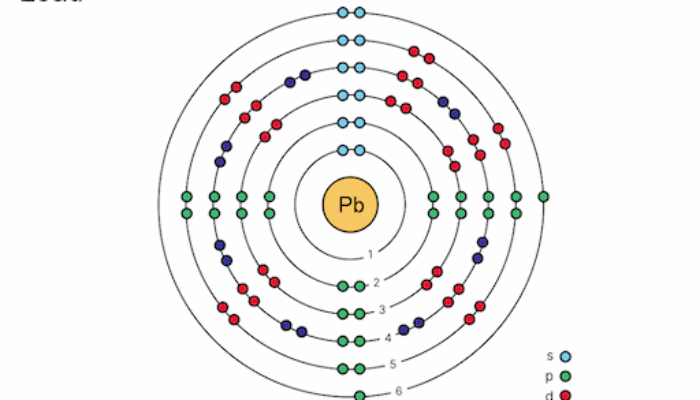
Electrons, negatively charged particles orbiting the nucleus, are crucial in determining lead’s chemical properties. Lead has 82 electrons arranged in a complex configuration: 1s² 2s² 2p⁶ 3s² 3p⁶ 4s² 3d¹⁰ 4p⁶ 5s² 4d¹⁰ 5p⁶ 6s² 4f¹⁴ 5d¹⁰ 6p². This detailed arrangement reveals that lead possesses four electrons in its outermost shell (the sixth shell), which significantly influence its bonding tendencies and chemical reactivity.
Electron Shells and Subshells Explained
Electrons occupy specific energy levels known as shells, which are further divided into subshells (s, p, d, f) with defined electron capacities. The inner shells of lead (such as 1s, 2s, 2p) are fully occupied, providing a stable core, while the outermost electrons in the sixth shell are less tightly bound and more reactive. This distribution affects lead’s oxidation states and its ability to form various compounds.
Valence States and Chemical Versatility
Lead exhibits multiple valence states, predominantly +2 and +4, reflecting its ability to lose or share electrons during chemical reactions. This variability is characteristic of p-block elements in group 14 of the periodic table. Understanding lead’s valency is essential for predicting its behavior in diverse chemical environments, including organic chemistry, coordination complexes, and alloy formation.
Crystallographic Structure of Lead
In its metallic form, lead crystallizes in a face-centered cubic (FCC) lattice. This arrangement optimizes atomic packing and coordination, influencing lead’s physical attributes such as density, malleability, and conductivity. The FCC structure also provides interstitial spaces that allow for the incorporation of impurities or other elements, facilitating the creation of various lead alloys with tailored properties.
Allotropy and Structural Variations
Lead can exist in multiple structural forms depending on environmental conditions like temperature and pressure. While the metallic FCC form is most common, alternative allotropes may arise, each with distinct physical and chemical characteristics. This structural adaptability has implications for industrial applications and safety considerations.
Lead in Coordination Chemistry and Environmental Impact
Lead’s atomic structure enables it to form covalent bonds with ligands, resulting in coordination compounds utilized in numerous chemical processes. These complexes are significant not only in industrial chemistry but also in environmental contexts, as lead compounds are known for their toxicity and potential for bioaccumulation. Understanding these molecular interactions is vital for managing lead’s environmental risks while harnessing its industrial benefits.
Applications and Scientific Importance
Insights into lead’s atomic structure have broad implications across multiple scientific disciplines. In materials science, this knowledge aids in designing advanced alloys with improved performance. Environmental science benefits from understanding lead’s molecular behavior to develop effective remediation strategies. Thus, lead’s atomic framework serves as a foundation for innovations and safety measures in both technology and ecology.
Summary: The Significance of Lead’s Atomic Structure
Lead exemplifies a complex and adaptable element whose atomic makeup-comprising protons, neutrons, and electrons-directly influences its chemical and physical properties. This intricate interplay elevates lead beyond a mere periodic table entry to a material of considerable scientific and industrial relevance. Ongoing research continues to unravel the nuances of lead’s atomic behavior, expanding our comprehension and application of this multifaceted metal.
FAQ
What is the atomic number of lead?
The atomic number of lead is 82, indicating it has 82 protons.
What are the common valence states of lead?
Lead commonly exhibits valence states of +2 and +4.
What type of crystal structure does lead have?
Lead crystallizes in a face-centered cubic (FCC) lattice.






Leave a Reply