
Short Answer
Definition of Quantum Field Theory
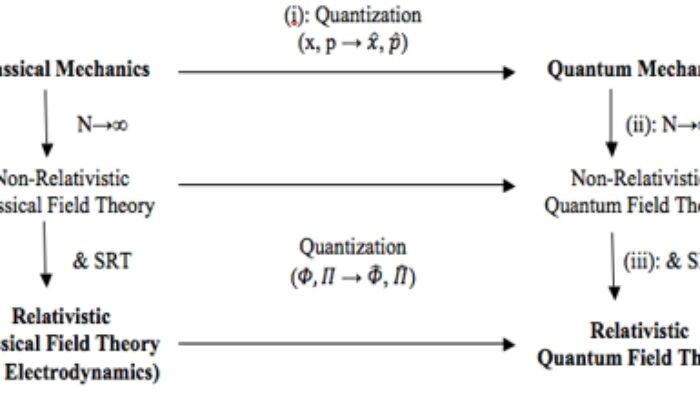
Quantum Field Theory (QFT) is a pivotal theoretical framework in contemporary physics that merges the principles of quantum mechanics with those of special relativity. It fundamentally redefines the concept of particles, viewing them not as isolated points but as quantized excitations of continuous fields that exist throughout space and time. This approach provides a unified language to describe the behavior and interactions of subatomic particles, offering profound insights into the fabric of the universe at its most elementary scale.
Historical Background and Evolution
The inception of Quantum Field Theory arose from the need to reconcile the inconsistencies between quantum mechanics and special relativity encountered in the early 20th century. Pioneering contributions, such as Paul Dirac’s formulation of the Dirac equation, established a relativistic quantum framework that could accommodate particle-antiparticle creation and annihilation phenomena. These developments laid the foundation for QFT, enabling physicists to describe processes occurring in high-energy environments, including those observed in particle accelerators.
Core Principles and Conceptual Framework
At the heart of QFT lies the idea that each fundamental particle corresponds to a specific quantum field permeating the universe. For example:
- Electron Field:
The electron is interpreted as an excitation or quantum of the electron field. - Electromagnetic Field:
Photons emerge as excitations of the electromagnetic field. - Quark Fields:
Quarks are excitations of their respective quark fields.
This field-based perspective replaces the classical notion of particles as discrete, point-like objects, allowing for a more comprehensive understanding of particle interactions and transformations.
Gauge Theories and the Standard Model
One of the most profound advancements within QFT is the formulation of gauge theories, which describe the fundamental forces governing particle interactions. The Standard Model of particle physics, constructed on the principles of QFT, encapsulates three of the four fundamental forces:
- Electromagnetism:
Mediated by photons. - Weak Nuclear Force:
Carried by W and Z bosons. - Strong Nuclear Force:
Transmitted by gluons, which bind quarks inside protons and neutrons.
These forces are understood as interactions between fields, with gauge bosons acting as the force carriers associated with specific symmetries in the theory.
Mathematical Techniques in Quantum Field Theory
Calculating measurable quantities in QFT often involves perturbative methods, with Feynman diagrams serving as a powerful computational tool. These diagrams graphically represent particle interactions, simplifying the evaluation of complex integrals related to scattering amplitudes and cross-sections. However, certain phenomena, such as quark confinement in quantum chromodynamics (QCD), are inherently non-perturbative and require alternative analytical or numerical techniques.
Renormalization: Addressing Infinities
Quantum Field Theory calculations frequently encounter divergences or infinite values when determining physical observables. Renormalization is the systematic procedure developed to manage these infinities by redefining fundamental parameters like mass and charge. This process ensures that predictions remain finite and physically meaningful, highlighting the deep interplay between theoretical constructs and empirical measurements.
Challenges and Frontiers in Quantum Field Theory
Despite its successes, QFT faces significant challenges, particularly in incorporating gravity into its framework. Attempts to quantize general relativity have proven difficult, prompting the exploration of alternative theories such as string theory and loop quantum gravity. These efforts aim to develop a comprehensive theory that unifies all fundamental interactions, including gravitational forces.
Applications Beyond Particle Physics
Quantum Field Theory’s influence extends into various branches of physics beyond high-energy particle interactions:
- Condensed Matter Physics:
QFT techniques describe phenomena like spontaneous symmetry breaking and phase transitions, providing insights into material properties. - Cosmology:
The early universe’s evolution, including inflation and structure formation, is analyzed using quantum field theoretic models. - Statistical Mechanics:
Field theory methods help explain collective behaviors in complex systems.
Why Quantum Field Theory Is Essential
Quantum Field Theory is indispensable for understanding the fundamental workings of nature. By integrating quantum mechanics with relativistic principles and conceptualizing particles as field excitations, QFT offers a coherent explanation of the forces and particles that constitute the universe. Its predictive power and versatility have transformed physics, enabling breakthroughs in both theoretical research and experimental discoveries. As ongoing investigations continue to probe the quantum realm, QFT remains a cornerstone in the quest to unravel the deepest mysteries of reality.
FAQ
What is Quantum Field Theory?
Quantum Field Theory is a framework in physics that combines quantum mechanics and special relativity to describe particles as excitations of underlying fields.
Why is Quantum Field Theory important?
QFT provides the theoretical foundation for understanding particle interactions, fundamental forces, and many phenomena in physics including the Standard Model.
What are the main forces described by Quantum Field Theory?
QFT describes electromagnetism, weak nuclear force, and strong nuclear force through gauge theories and associated gauge bosons.
What challenges does Quantum Field Theory face?
One major challenge is incorporating gravity into the QFT framework, which has led to research in theories like string theory and loop quantum gravity.
How is Quantum Field Theory applied outside particle physics?
QFT techniques are used in condensed matter physics, cosmology, and statistical mechanics to understand phenomena like phase transitions and early universe evolution.





Leave a Reply