
Short Answer
Definition of Quantum Field Theory
Quantum Field Theory (QFT) is a fundamental framework in physics that merges the principles of quantum mechanics with those of special relativity. It provides a comprehensive description of how particles and forces interact by conceptualizing particles not as isolated objects but as excitations within continuous fields that permeate all of spacetime.
- Particles as Field Excitations:
Instead of treating particles as discrete entities, QFT views them as localized disturbances or quanta of underlying fields, such as the electromagnetic field giving rise to photons. - Integration of Quantum Mechanics and Relativity:
QFT harmonizes the probabilistic nature of quantum mechanics with the relativistic constraints of high-speed phenomena, enabling accurate predictions of particle behavior at fundamental levels.
Fundamental Principles and Mechanisms
At the heart of QFT lies the idea that every fundamental force corresponds to a quantum field, and particles emerge as quantized vibrations of these fields. This perspective revolutionizes our understanding of interactions and the fabric of reality.
- Virtual Particles:
QFT introduces the concept of virtual particles-transient fluctuations that appear and disappear within fields, mediating forces between actual particles and enabling phenomena like quantum tunneling. - Heisenberg Uncertainty Principle:
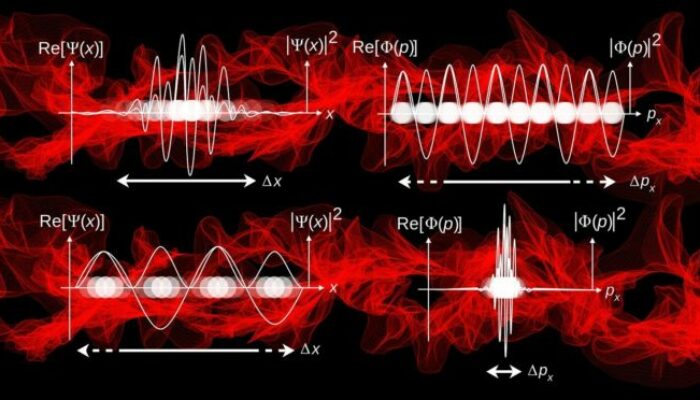
The theory inherently incorporates uncertainty, asserting that certain pairs of physical properties cannot be simultaneously measured with arbitrary precision, reflecting the probabilistic essence of nature.
Mathematical Framework and Theoretical Constructs
Quantum Field Theory employs advanced mathematical tools to describe particle interactions and field dynamics. Central to this framework are concepts such as renormalization and symmetry breaking.
- Renormalization:
A technique used to manage and eliminate infinities that arise in calculations, ensuring that predictions remain finite and physically meaningful. - Spontaneous Symmetry Breaking:
A process where symmetrical laws give rise to asymmetrical states, crucial for explaining how particles acquire mass through mechanisms like the Higgs field.
QFT and the Standard Model of Particle Physics
The Standard Model, a cornerstone of modern physics, is formulated within the QFT framework. It unifies three of the four fundamental forces-electromagnetic, weak, and strong interactions-into a coherent theoretical structure.
- Electroweak Unification:
QFT successfully merges electromagnetic and weak nuclear forces, revealing underlying symmetries and deepening our understanding of particle interactions. - Classification of Fundamental Particles:
The Standard Model categorizes elementary particles such as quarks, leptons, and gauge bosons, all described through quantum fields.
Applications and Impact in Various Fields
Beyond particle physics, QFT principles extend to multiple scientific domains, influencing both theoretical research and practical technologies.
- Condensed Matter Physics:
QFT techniques help explain phenomena like superconductivity and phase transitions in materials. - Cosmology and Quantum Gravity:
Efforts to reconcile QFT with general relativity inspire theories such as string theory and loop quantum gravity, aiming to describe gravity at quantum scales. - Technological Innovations:
Quantum computing, quantum optics, and advanced materials science leverage QFT concepts to develop cutting-edge technologies.
Common Misconceptions About Quantum Field Theory
Particles are tiny solid objects.
In QFT, particles are better understood as excitations or quanta of underlying fields, not as classical solid entities.
Virtual particles are real, observable particles.
Virtual particles are temporary, unobservable fluctuations that facilitate interactions but cannot be directly detected.
QFT provides a complete theory of everything.
While powerful, QFT does not yet fully integrate gravity, and unifying it with general relativity remains an open challenge.
Significance and Philosophical Implications
Quantum Field Theory is not only a triumph of mathematical physics but also a profound philosophical lens through which we examine the nature of reality. It challenges classical deterministic views by embracing uncertainty and transience at fundamental levels, prompting deeper reflections on existence and knowledge.
The theory’s success in unifying forces and explaining particle properties underscores its central role in advancing our comprehension of the universe’s underlying order and symmetries. Moreover, QFT’s influence permeates modern technology, making it indispensable in both scientific inquiry and practical innovation.
Real-World Examples of Quantum Field Theory in Action
QFT’s principles manifest in numerous experimental and technological contexts:
- Particle Accelerators:
Facilities like the Large Hadron Collider use QFT-based models to predict and analyze particle collisions, leading to discoveries such as the Higgs boson. - Quantum Computing:
Manipulation of quantum states in computing devices relies on QFT concepts to harness superposition and entanglement. - Superconductivity:
The explanation of zero-resistance electrical flow in certain materials at low temperatures is grounded in QFT methods.
Challenges and Future Directions
Despite its profound achievements, Quantum Field Theory faces ongoing challenges, particularly in integrating gravity into its framework. The quest for a unified theory of quantum gravity drives research into novel approaches like string theory and loop quantum gravity, which seek to reconcile the quantum and gravitational realms.
This frontier of physics remains vibrant and complex, reflecting the intricate and often elusive nature of the universe’s fundamental workings.
Frequently Asked Questions (FAQ)
What is Quantum Field Theory in simple terms?
Quantum Field Theory is a scientific framework that describes particles as ripples or disturbances in fields that exist everywhere in space and time, combining ideas from quantum mechanics and relativity.
Why is Quantum Field Theory important in physics?
It is crucial because it unifies several fundamental forces, accurately predicts how particles interact, and offers deep insights into the nature of reality.
What are virtual particles in Quantum Field Theory?
Virtual particles are fleeting fluctuations within quantum fields that mediate forces between real particles and enable effects like quantum tunneling.
How does Quantum Field Theory relate to the Standard Model?
The Standard Model is built on QFT principles and describes the electromagnetic, weak, and strong nuclear forces, as well as classifying fundamental particles.
What are some challenges facing Quantum Field Theory?
A key challenge is merging QFT with general relativity to develop a consistent theory of quantum gravity, which remains an active area of research.
FAQ
What is Quantum Field Theory in simple terms?
Quantum Field Theory is a physics framework that treats particles as disturbances in fields that exist throughout space and time, combining principles from quantum mechanics and relativity.
Why is Quantum Field Theory important in physics?
QFT is essential because it unifies fundamental forces, accurately predicts particle interactions, and provides deep insights into the nature of reality and existence.
What are virtual particles in Quantum Field Theory?
Virtual particles are temporary fluctuations in quantum fields that mediate forces between real particles, playing a key role in phenomena like quantum tunneling.
How does Quantum Field Theory relate to the Standard Model?
The Standard Model is a theory built using QFT that describes the electromagnetic, weak, and strong nuclear forces and classifies fundamental particles.
What are some challenges facing Quantum Field Theory?
A major challenge is reconciling QFT with general relativity to form a consistent theory of quantum gravity, which remains an active area of research.




Leave a Reply