
Short Answer
Definition of Quantum Error Correction
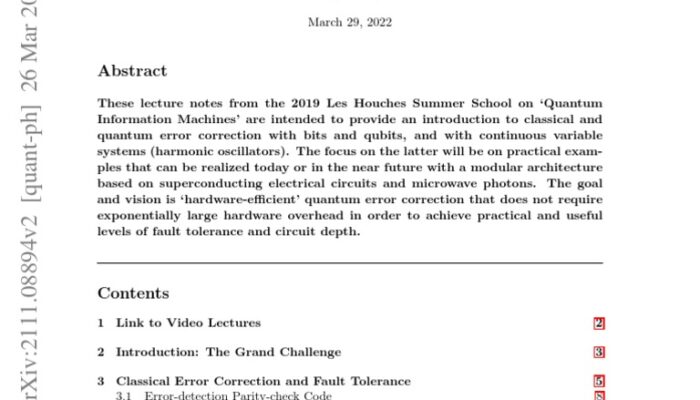
Quantum error correction (QEC) is a critical framework within quantum computing designed to protect quantum information from errors caused by environmental disturbances and operational imperfections. Unlike classical error correction, which relies on duplicating bits to detect and fix errors, QEC must navigate the unique challenges posed by quantum mechanics, such as the no-cloning theorem and the fragile nature of qubits. This field aims to preserve the integrity of quantum data, enabling reliable quantum computation despite the inherent susceptibility of qubits to noise and decoherence.
Fundamental Challenges in Quantum Information
Quantum bits, or qubits, are the fundamental units of quantum information, capable of existing in superpositions of states. However, this very property makes them highly sensitive to external interference. Two primary issues threaten qubit stability:
- Decoherence:
The process by which qubits lose their quantum characteristics due to interaction with the environment, effectively collapsing their superposition. - Operational Noise:
Errors introduced during the manipulation of qubits, such as imperfect gate operations or control inaccuracies.
Classical error correction methods, which depend on copying data, cannot be directly applied because quantum states cannot be cloned. This necessitates innovative approaches tailored to quantum mechanics.
Mechanisms Behind Quantum Error Correction
Quantum error correction codes employ a combination of entanglement, superposition, and fault-tolerant protocols to detect and rectify errors without directly measuring the quantum state, which would otherwise destroy the information. A landmark example is the Shor code, which encodes a single logical qubit into nine physical qubits. This redundancy allows the system to identify and correct errors while preserving the qubit’s superposition.
Key Quantum Error Correction Codes
- Shor Code:
The first quantum error-correcting code, using nine physical qubits to protect one logical qubit by detecting both bit-flip and phase-flip errors. - Surface Code:
A leading candidate for scalable quantum computing, the Surface Code uses a two-dimensional lattice of qubits with local interactions, enabling efficient error syndrome extraction and correction. - Steane Code:
A code that encodes one logical qubit into seven physical qubits, capable of correcting single-qubit errors. - Bacon-Shor Code:
A hybrid approach combining features of Shor and surface codes, offering flexibility in error correction strategies.
Principles and Mathematical Framework
Quantum error correction relies on encoding logical qubits into entangled states of multiple physical qubits. The process involves syndrome measurements that reveal error information without collapsing the quantum state. The general principle can be summarized as:
Logical Qubit Encoding:
[
| psi_L rangle = sum_{i} alpha_i | i rangle_{text{logical}} rightarrow sum_{i} alpha_i | i rangle_{text{physical}}
]
Here, the logical qubit state (| psi_L rangle) is represented by a superposition of physical qubit states, where the coefficients (alpha_i) encode the quantum information. Error syndromes are extracted via stabilizer measurements, which commute with the logical operators, allowing error detection without disturbing the encoded information.
Applications and Impact of Quantum Error Correction
Beyond error mitigation, QEC fundamentally transforms how information is processed in quantum systems. By creating logical qubits resilient to localized errors, QEC enables the development of fault-tolerant quantum computers capable of executing complex algorithms with high fidelity.
Some notable applications include:
- Quantum Algorithms:
Enhanced stability in quantum algorithms used for cryptography, optimization, and simulation of quantum systems. - Drug Discovery and Materials Science:
Reliable quantum simulations of molecular interactions, which are computationally intensive for classical computers. - Quantum Machine Learning:
Improved accuracy and efficiency in quantum neural networks and other learning models. - Achieving Quantum Advantage:
Enabling quantum computers to outperform classical counterparts by reducing error rates to manageable levels.
Challenges in Implementing Quantum Error Correction
Despite its promise, practical deployment of QEC faces significant hurdles:
- Qubit Fidelity:
Current qubits often have limited coherence times and gate fidelities, complicating error correction efforts. - Resource Overhead:
QEC requires multiple physical qubits to encode a single logical qubit, increasing hardware demands. - Connectivity Constraints:
Efficient error correction codes often require specific qubit connectivity, which can be difficult to realize in hardware.
Ongoing research focuses on optimizing codes and hardware architectures to overcome these limitations.
Significance of Quantum Error Correction in the Future of Computing
Quantum error correction is pivotal in transitioning quantum computing from theoretical promise to practical reality. By enabling error-resilient quantum operations, QEC lays the foundation for scalable, reliable quantum processors. This interdisciplinary endeavor, bridging physics, computer science, and engineering, is essential for unlocking the transformative potential of quantum technologies across diverse fields.
Common Misconceptions About Quantum Error Correction
Quantum error correction simply duplicates qubits like classical error correction.
Due to the no-cloning theorem, QEC encodes logical qubits into entangled states of multiple physical qubits rather than copying them.
Measuring qubits directly is necessary to detect errors.
QEC uses indirect syndrome measurements that reveal error information without collapsing the quantum state.
Quantum error correction eliminates all errors completely.
QEC reduces error rates to manageable levels but does not guarantee perfect error elimination; it enables fault-tolerant computation.
FAQ
What is the main purpose of quantum error correction?
The main purpose of quantum error correction is to protect quantum information from errors caused by environmental disturbances and operational imperfections.
How does quantum error correction differ from classical error correction?
Unlike classical error correction, which duplicates bits, quantum error correction must navigate unique quantum mechanics challenges, such as the no-cloning theorem.
What are some notable quantum error correction codes?
Some notable quantum error correction codes include the Shor Code, Surface Code, Steane Code, and Bacon-Shor Code.




Leave a Reply