
Short Answer
Definition of Quantum Computing
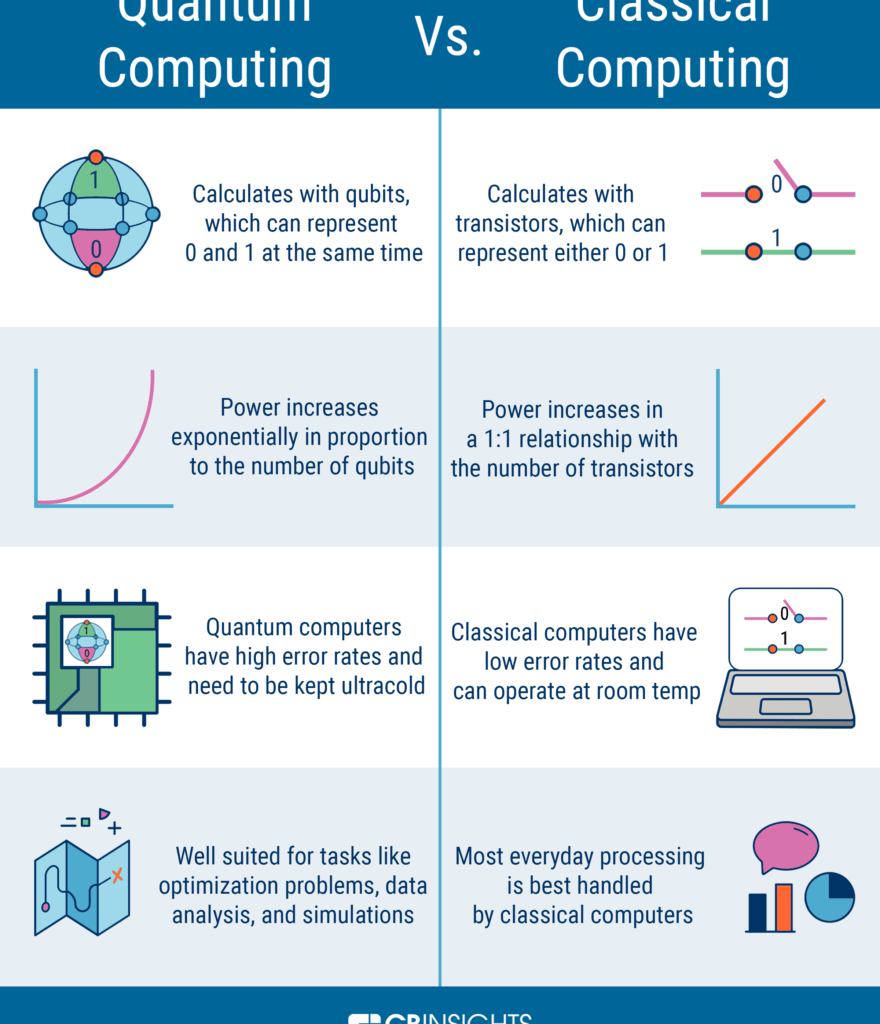
Quantum computing is an emerging computational paradigm that leverages the principles of quantum mechanics to surpass the capabilities of traditional classical computers. By utilizing quantum phenomena, this innovative technology aims to transform various fields such as cryptography, optimization, artificial intelligence, and drug development. It represents a fundamental shift in how information is processed and analyzed.
Fundamental Concepts in Quantum Computing
Qubits and Superposition
The basic unit of quantum information is the quantum bit, or qubit. Unlike classical bits, which are restricted to binary states of either 0 or 1, qubits can exist in a superposition of both states simultaneously. This property allows quantum computers to handle and process exponentially larger datasets compared to classical systems, enabling parallel computation on a massive scale.
Quantum Entanglement
Entanglement is another cornerstone of quantum mechanics, where two or more qubits become intrinsically linked such that the state of one instantly influences the state of the other, regardless of the distance between them. This non-classical correlation is fundamental to many quantum algorithms, providing computational advantages that classical computers cannot replicate.
Types of Quantum Computing Architectures
Quantum computing systems can be categorized based on their design and operational methodologies. The primary types include:
- Gate-Based Quantum Computers:
These devices manipulate qubits using quantum gates, analogous to classical logic gates, to perform complex algorithms through sequences of gate operations. Notable examples are IBM’s Q system and Google’s Sycamore processor. - Quantum Annealers:
Specialized for solving optimization problems, quantum annealers exploit quantum tunneling to identify the system’s lowest energy configuration. Unlike universal quantum computers, they do not rely on a full set of quantum gates. D-Wave Systems is a leading developer in this category. - Topological Quantum Computers:
Still largely theoretical, these systems aim to use anyons and the braiding of qubits to achieve robustness against errors caused by decoherence, potentially offering greater stability for quantum computations.
How Quantum Computing Operates
Quantum computers function by initializing qubits into superposition states, then applying quantum gates to manipulate these states and create entanglement among qubits. The system evolves according to quantum algorithms designed to exploit these phenomena, culminating in a measurement that collapses the qubits into classical outcomes. This process enables the solution of problems that are computationally intensive or infeasible for classical machines.
Mathematical Foundations and Key Algorithms
Quantum computing relies on linear algebra and complex vector spaces to describe qubit states and operations. The state of a qubit can be represented as:
|ψ⟩ = α|0⟩ + β|1⟩
- α, β: Complex probability amplitudes where |α|² + |β|² = 1
- |0⟩, |1⟩: Basis states representing classical bit values
Quantum gates are unitary matrices that transform these states. For example, the Hadamard gate (H) creates superposition:
H = (1/√2) *
[[1, 1],
[1, -1]]
Key quantum algorithms include:
- Shor’s Algorithm: Efficiently factors large integers, threatening classical cryptographic systems.
- Quantum Approximate Optimization Algorithm (QAOA): Addresses combinatorial optimization problems by approximating solutions.
Practical Applications of Quantum Computing
Cryptography
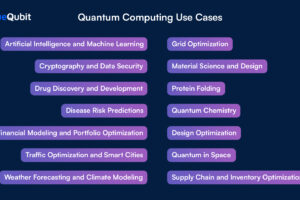
Quantum computers have the potential to break widely used encryption methods by rapidly factoring large numbers, which underpins the security of RSA and other cryptosystems. This capability necessitates the development of quantum-resistant cryptographic protocols.
Optimization Problems
Quantum algorithms excel at solving complex optimization challenges involving large datasets and numerous variables. Applications include optimizing logistics, supply chains, and financial portfolios, where quantum annealers and QAOA can provide significant improvements over classical methods.
Advancements in Machine Learning
Quantum machine learning integrates quantum computing with AI, enabling faster data processing and model training. Quantum-enhanced algorithms can potentially improve pattern recognition, classification, and predictive analytics beyond classical capabilities.
Pharmaceuticals and Material Science
Quantum simulations allow for precise modeling of molecular structures and interactions, accelerating drug discovery and the design of new materials. This capability helps researchers understand complex quantum states that classical computers struggle to simulate efficiently.
Challenges Facing Quantum Computing
- Decoherence:
Qubits are highly sensitive to environmental disturbances, causing loss of quantum information and errors in computation. - Error Correction:
Robust quantum error correction methods are essential but require significant overhead and technological advancements to implement effectively. - Scalability:
Building large-scale quantum computers with stable, coherent qubits remains a formidable engineering challenge.
Current Research and Future Outlook
Quantum computing is transitioning from theoretical research to practical implementation, with substantial investments from governments, academia, and industry. Collaborative efforts are accelerating progress in hardware development, algorithm design, and ecosystem building. As these advancements continue, quantum computing is expected to redefine computational standards and unlock new possibilities across science and technology.
Significance of Quantum Computing
The advent of quantum computing marks a transformative milestone in computational science. By harnessing quantum phenomena, it offers unprecedented processing power and problem-solving capabilities that can revolutionize encryption, optimization, artificial intelligence, and scientific research. Its development promises to impact technology infrastructure profoundly, driving innovation and expanding the frontiers of human knowledge.
FAQ
What is quantum computing?
Quantum computing is a technology that uses quantum mechanics to process information far more efficiently than classical computers.
What are qubits?
Qubits are the fundamental units of quantum information, capable of existing in multiple states at once, unlike classical bits.
What are the practical applications of quantum computing?
Quantum computing has applications in cryptography, optimization, machine learning, and pharmaceuticals.


Leave a Reply