
Short Answer
Understanding Quantum Computing
Quantum computing signifies a revolutionary advancement in computational technology, transcending the limitations imposed by classical physics and venturing into the domain governed by quantum mechanics. This innovative field bridges abstract theoretical physics with tangible technological applications, utilizing the unique behaviors of subatomic particles to process data at speeds far beyond those achievable by traditional computers. This article explores the fundamental structure and operational principles of quantum computers, revealing the complex phenomena that drive their extraordinary capabilities.
Core Concepts: Qubits and Superposition
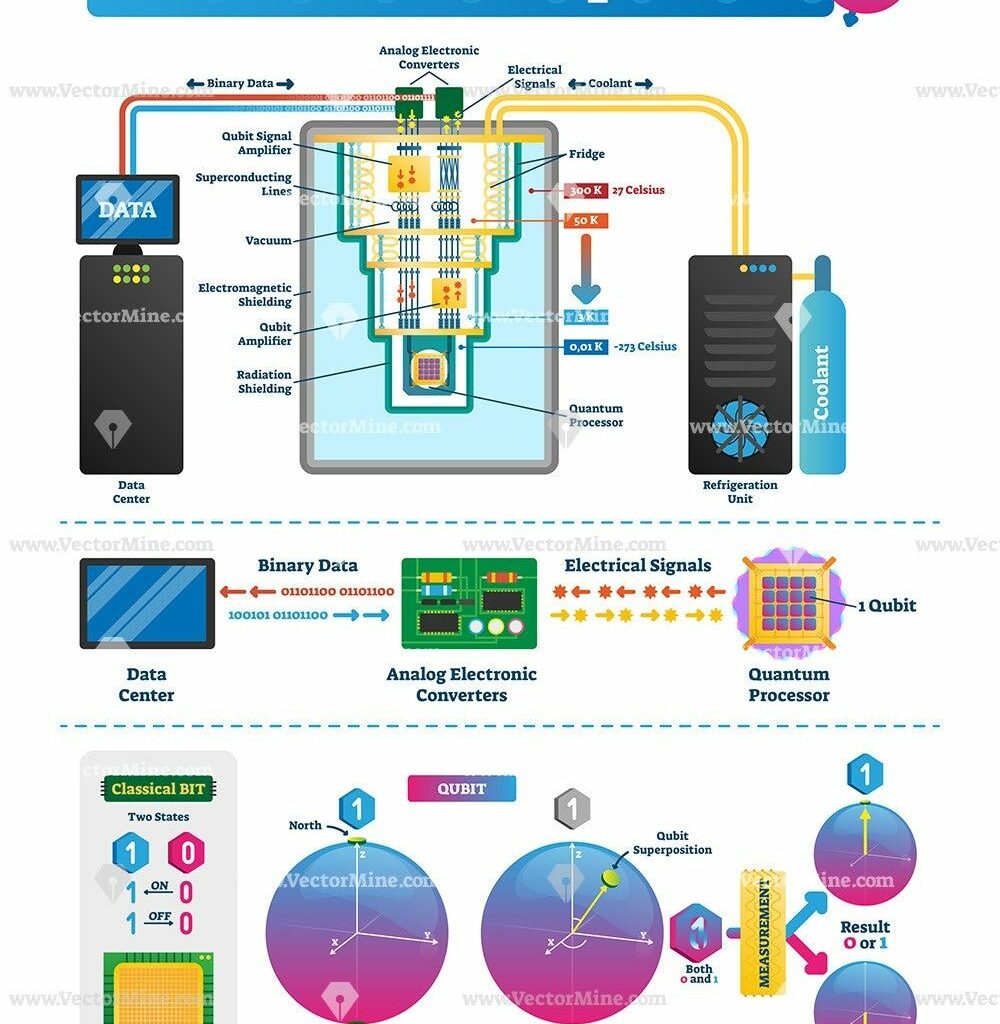
The fundamental unit of quantum information is the quantum bit, or qubit. Unlike classical bits, which are restricted to binary states of either 0 or 1, qubits can exist in a superposition-a combination of both states simultaneously. This property is analogous to the famous Schrödinger’s cat thought experiment, where the cat is considered both alive and dead until observed. Superposition allows quantum computers to represent and process multiple possibilities at once, enabling them to tackle intricate problems with a level of efficiency unattainable by classical systems.
Quantum Phenomena Enabling Computation
Quantum mechanics introduces several phenomena critical to quantum computing. Wave-particle duality, the concept that particles exhibit both wave-like and particle-like properties, underpins the manipulation of qubits. Additionally, quantum entanglement creates a profound connection between qubits, allowing their states to be interdependent regardless of the physical distance separating them. This instantaneous correlation is essential for scaling quantum systems and achieving enhanced computational power.
Quantum Parallelism: A New Computational Paradigm
To conceptualize how quantum computers operate, imagine a vast library containing countless books, each representing a potential solution to a complex problem. A classical computer is like a single person searching through the library one book at a time. In contrast, a quantum computer functions like a team of librarians who can simultaneously examine many books, dramatically accelerating the search process. This phenomenon, known as quantum parallelism, enables the exploration of numerous computational pathways concurrently, exponentially increasing the likelihood of finding optimal solutions.
Quantum Gates and Algorithmic Operations
Quantum gates serve as the fundamental tools for manipulating qubits, analogous to classical logic gates that control bits. These gates perform unitary transformations on qubits, which can be visualized as rotations on the Bloch sphere-a geometric representation of qubit states. By orchestrating sequences of quantum gates, complex algorithms can be executed, allowing quantum computers to efficiently factor large numbers, simulate molecular structures, and solve optimization problems much faster than classical machines.
Notable Quantum Algorithms
- Shor’s Algorithm:
This algorithm revolutionizes integer factorization, posing a significant threat to classical encryption methods by enabling efficient decryption of cryptographic keys. - Grover’s Algorithm:
It accelerates unstructured search tasks, providing a quadratic speedup over classical search techniques, thereby improving data retrieval processes.
Qubit Technologies and Their Characteristics
Various physical implementations of qubits exist, each with distinct advantages and challenges:
- Superconducting Qubits:
Utilize superconductivity to allow resistance-free electrical currents, typically requiring extremely low temperatures to maintain coherence. - Trapped Ion Qubits:
Employ electromagnetic fields to control individual ions with high precision, though they involve complex operational setups. - Topological Qubits:
Leverage exotic quantum states to enhance error resistance, representing a promising but still experimental approach. - Photonic Qubits:
Use particles of light to encode information, offering advantages in speed and room-temperature operation.
Challenges in Quantum Computing Development
Despite its transformative potential, quantum computing faces significant obstacles. Decoherence-the loss of quantum information due to environmental interactions-remains a primary challenge, threatening the stability of qubit states. To combat this, researchers are developing sophisticated quantum error correction codes and fault-tolerant architectures that help preserve quantum coherence over longer durations, essential for practical, large-scale quantum computing.
Quantum Information Science: A Multidisciplinary Frontier
The advancement of quantum computing has given rise to quantum information science, an interdisciplinary field merging quantum mechanics with information theory. This domain not only drives technological innovation but also prompts profound philosophical inquiries into the nature of reality, consciousness, and the limits of human understanding.
Implications and Future Prospects
The integration of quantum computing into various sectors promises to revolutionize fields such as cryptography, pharmaceutical research, and artificial intelligence. By unlocking computational capabilities previously deemed impossible, quantum technology holds the potential to solve longstanding scientific mysteries and transform industries, acting as a key to new realms of knowledge and innovation.
Conclusion: Embracing the Quantum Revolution
Quantum computing weaves together principles from physics, mathematics, and engineering to challenge traditional notions of computation. As this field evolves, it not only expands the horizons of what machines can calculate but also invites a deeper reflection on the essence of intelligence and reality itself. The quantum era heralds a future where the infinite complexities of the universe become accessible, reshaping our understanding of both technology and existence.
FAQ
What is a quantum computer?
A quantum computer is a device that uses quantum bits or qubits to perform computations based on quantum mechanics principles, enabling it to solve specific complex problems much faster than classical computers.
How do qubits differ from classical bits?
Unlike classical bits that represent either 0 or 1, qubits can exist in a superposition of both states simultaneously, allowing quantum computers to process multiple possibilities at once.
What is quantum entanglement?
Quantum entanglement is a phenomenon where qubits become interconnected such that the state of one instantly influences the state of another, regardless of the distance between them.
What are some challenges in building quantum computers?
Challenges include maintaining qubit coherence, overcoming decoherence, implementing effective quantum error correction, and scaling up the number of qubits in a stable manner.
What are some landmark quantum algorithms?
Shor's algorithm for integer factorization and Grover's algorithm for unstructured search are two prominent quantum algorithms demonstrating quantum advantage over classical approaches.






Leave a Reply