
Short Answer
Definition of Topological Insulators
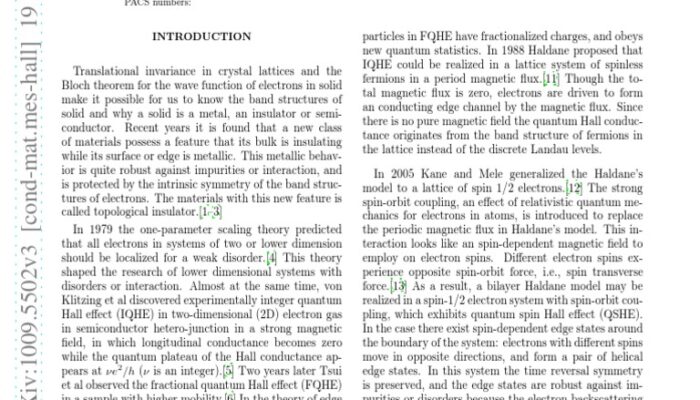
Topological insulators are a unique class of materials characterized by their ability to act as electrical insulators in their interior while simultaneously supporting conductive states on their surfaces or edges. This dual behavior arises from their distinctive electronic structure and topological order, which distinguishes them from conventional insulators and conductors.
- Bulk Insulation:
The interior (bulk) of these materials does not allow the flow of electric current, behaving as an insulator. - Surface Conduction:
The outer layers or edges conduct electricity, enabling electron transport along the material’s boundaries.
Fundamental Concepts: Topology and Electronic Structure
Understanding topological insulators requires a grasp of topology, a branch of mathematics concerned with properties that remain unchanged under continuous deformations, such as stretching or bending, but not tearing or gluing. In physics, this concept translates into the classification of materials based on their electronic band structures and topological invariants-integer values that categorize different topological phases.
- Topological Phases:
Materials are grouped into phases defined by these invariants, which determine whether a material behaves as a trivial insulator or a topological insulator. - Band Structure:
The arrangement of energy bands in a material influences its conductive properties, with topological insulators exhibiting protected surface states within the bulk band gap.
Mechanism Behind Surface Conductivity
The conductive surface states of topological insulators arise due to the interplay between the material’s symmetry properties and its topological order. Time-reversal symmetry plays a crucial role in protecting these surface states from scattering and localization caused by impurities or defects, ensuring robust electron transport along the edges or surfaces.
- Time-Reversal Symmetry:
This symmetry prevents backscattering of electrons, maintaining coherent conduction even in disordered environments. - Spin-Momentum Locking:
The electron’s spin is locked to its momentum direction, a phenomenon that underpins the stability and unique transport properties of surface states.
Mathematical Framework and Topological Invariants
The classification of topological insulators relies on mathematical constructs known as topological invariants, which remain constant under continuous transformations of the system. One common invariant is the Z2 index, used to distinguish trivial insulators from topological ones in two and three dimensions.
- Z2 Topological Invariant:
A binary value (0 or 1) indicating the presence or absence of topological order in time-reversal symmetric systems. - Dirac Cones:
In three-dimensional topological insulators, surface electronic states form linear energy-momentum relations called Dirac cones, reflecting massless Dirac fermion behavior.
Notable Examples and Material Systems
Several materials have been identified as topological insulators, with two-dimensional and three-dimensional examples demonstrating the principles discussed.
- Graphene:
A two-dimensional carbon allotrope that, under certain conditions, exhibits topological insulating behavior. - Bismuth Selenide (Bi2Se3):
A widely studied three-dimensional topological insulator known for its robust surface states and Dirac cone features. - Other Materials:
Research continues to identify new compounds and engineered structures that display topological insulating properties, expanding the material landscape.
Applications and Technological Implications
Topological insulators hold promise for revolutionizing various technological fields due to their unique electronic properties.
- Spintronics:
Devices that exploit electron spin rather than charge can benefit from the spin-momentum locking in topological insulators, potentially leading to more energy-efficient electronics. - Quantum Computing:
The robustness of surface states against decoherence makes these materials candidates for stable qubits and fault-tolerant quantum devices. - Advanced Electronics:
Their resilience to impurities and defects could enable electronic components that operate reliably under less-than-ideal conditions.
Challenges in Material Synthesis and Practical Use
Despite their theoretical appeal, the practical deployment of topological insulators faces significant hurdles.
- Material Fabrication:
Producing high-quality topological insulators with consistent properties remains complex and resource-intensive. - Operating Conditions:
Many topological insulators require low temperatures to maintain their unique properties, limiting their immediate applicability in everyday devices. - Scalability:
Integrating these materials into existing electronic infrastructures at scale is an ongoing challenge.
Future Directions and Research Frontiers
Ongoing research aims to overcome current limitations by discovering new materials and improving fabrication techniques.
- Room-Temperature Topological Insulators:
Efforts focus on identifying materials that exhibit topological properties at ambient conditions to facilitate practical applications. - Theoretical Advances:
Enhanced models and simulations guide experimentalists in tailoring materials with desired topological features. - Interdisciplinary Approaches:
Collaboration between physicists, chemists, and engineers accelerates the translation of topological insulator research into real-world technologies.
Common Misconceptions About Topological Insulators
Topological insulators conduct electricity throughout the entire material.
They conduct only on their surfaces or edges, while the bulk remains insulating.
All insulators are topological insulators.
Only materials with specific topological order and symmetry protections qualify as topological insulators.
Topological insulators are purely theoretical and have no practical applications.
They have promising applications in spintronics, quantum computing, and advanced electronics, though challenges remain.
Significance of Topological Insulators in Science and Technology
Topological insulators represent a paradigm shift in materials science and condensed matter physics. Their discovery has deepened our understanding of quantum states of matter and opened new pathways for technological innovation. By harnessing their unique surface conduction and spin properties, future devices could achieve unprecedented efficiency and functionality, impacting fields from computing to energy management.
FAQ
What is a topological insulator?
A material that behaves as an insulator in its bulk but has conducting states at its surface or edges due to its unique topological properties.
Why do topological insulators conduct electricity on the surface only?
Because their surface states are protected by time-reversal symmetry and exhibit spin-momentum locking, preventing scattering and enabling robust conduction.
What are common materials that are topological insulators?
Graphene (under certain conditions) and Bismuth Selenide (Bi2Se3) are well-known topological insulators.
What applications do topological insulators have?
They are promising for spintronics, quantum computing, and advanced electronics due to their robust surface conduction.
What are the main challenges in using topological insulators?
Challenges include difficulties in material synthesis, requirement for low temperatures, and scalability for practical device integration.




Leave a Reply