
Short Answer
Definition of Quarks
Quarks are fundamental particles that serve as the essential building blocks of matter. They are elementary constituents that combine to form protons, neutrons, and other hadrons, playing a pivotal role in the composition of the universe. As one of the core elements in particle physics, quarks provide critical insight into the structure and behavior of subatomic particles.
Classification and Fundamental Properties
Quarks belong to the family of fermions, particles that adhere to the Pauli exclusion principle, which prohibits identical fermions from occupying the same quantum state simultaneously. This contrasts with bosons, which can share quantum states freely. The fermionic nature of quarks underlies the complex interactions and stability of matter at the microscopic scale.
Color Charge and Quantum Chromodynamics
A unique quantum characteristic of quarks is their “color charge,” a property unrelated to visual color but essential to the strong nuclear force. Quarks come in three color charges: red, green, and blue. These charges must combine to form color-neutral particles, a principle analogous to mixing primary colors to achieve white light. This color neutrality is fundamental for the formation of stable particles such as protons and neutrons within atomic nuclei.
Quark Confinement and Hadron Formation
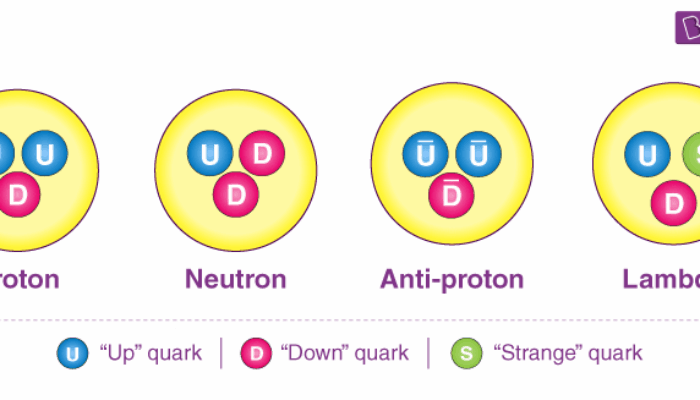
Quarks are never observed in isolation due to a phenomenon known as confinement, a key aspect of quantum chromodynamics (QCD), the theory describing the strong interaction. When attempts are made to separate quarks, the energy input results in the creation of quark-antiquark pairs rather than freeing individual quarks. This process ensures quarks remain bound within composite particles called hadrons, which include baryons (e.g., protons and neutrons) and mesons.
Varieties of Quarks: The Six Flavors
There are six distinct types, or “flavors,” of quarks, each with unique properties such as mass and electric charge:
- Up quark:
Possesses a charge of +2/3 and is a primary constituent of protons and neutrons. - Down quark:
Carries a charge of -1/3 and pairs with up quarks in nucleons. - Charm quark:
Heavier than up and down quarks, involved in forming heavier mesons and baryons. - Strange quark:
Similar to charm, contributes to particles with unusual properties. - Top quark:
The heaviest quark, playing a role in high-energy particle interactions. - Bottom quark:
Heavier than charm and strange, involved in rare particle decays.
The interplay of these flavors explains the diversity of subatomic particles and their electric charges, shaping the structure of matter.
Mass and Energy Relationship in Quarks
Although quarks themselves have relatively small intrinsic masses, they contribute only a fraction of the total mass of hadrons. The majority of the mass arises from the energy associated with the strong force binding quarks together, as described by Einstein’s equation E=mc². This equivalence between mass and energy highlights the dynamic nature of matter and the profound connection between these two fundamental concepts.
Quark Interactions and Flavor Transitions
Quarks can change from one flavor to another through weak interactions, a process that governs particle decay and transformation. For example, charm and strange quarks can interchange via the weak force, leading to the creation of different particle species. These flavor-changing processes are crucial for understanding the behavior of unstable particles and provide insight into the early universe’s evolution and nucleosynthesis.
Theoretical Framework and Experimental Pursuits
The Standard Model of particle physics encapsulates our current understanding of quarks and their interactions. It serves as a comprehensive theory describing fundamental particles and forces, excluding gravity. Cutting-edge experiments, such as those conducted at the Large Hadron Collider (LHC), aim to explore phenomena like the quark-gluon plasma-a state of matter thought to have existed shortly after the Big Bang. These investigations push the boundaries of knowledge, offering glimpses into the universe’s primordial conditions.
Significance of Quarks in Science and Beyond
Quarks are indispensable to the fabric of matter and the universe’s fundamental structure. Their study not only advances particle physics but also deepens our philosophical understanding of existence, matter, and energy. By unraveling the mysteries of quarks, scientists continue to expand the frontiers of knowledge, influencing technology, cosmology, and our comprehension of the natural world.
Common Misconceptions About Quarks
Quarks can be isolated and observed individually.
Due to confinement, quarks are always bound within hadrons and cannot exist freely.
The “color” of quarks refers to visible colors.
Color charge is a quantum property unrelated to visual color, essential for the strong force.
Quarks account for all the mass of protons and neutrons.
Most of the mass comes from the energy of the strong interaction binding quarks, not the quarks’ intrinsic mass.
Real-World Applications and Examples
Understanding quarks has practical implications in fields such as nuclear physics, particle accelerator technology, and cosmology. For instance, the study of quark interactions informs the development of nuclear energy and medical imaging techniques. Additionally, recreating quark-gluon plasma in particle colliders helps scientists simulate conditions of the early universe, shedding light on cosmic evolution.
FAQ
What is a quark?
A quark is a fundamental elementary particle that combines to form hadrons such as protons and neutrons.
How many types of quarks exist?
There are six types of quarks: up, down, charm, strange, top, and bottom.
Why can't quarks be found alone?
Due to confinement, quarks are always bound together within hadrons and cannot exist independently.
What is color charge?
Color charge is a property of quarks related to the strong force, coming in three types—red, green, and blue—that combine to form neutral particles.
What explains the mass of matter if quarks’ masses are small?
Most of the mass of matter arises from the energy of the strong force binding quarks, not from the quarks themselves.






Leave a Reply