
Short Answer
Definition of the Cyclotron
The cyclotron is a sophisticated particle accelerator that propels charged ions to high velocities using electromagnetic forces. It plays a crucial role in particle physics by enabling the study of atomic and subatomic particles through controlled acceleration, making the behavior of these particles accessible for scientific investigation.
Historical Background
Developed in the early 20th century amid rapid progress in quantum mechanics and atomic theory, the cyclotron represents a landmark achievement in experimental physics. It was designed to accelerate particles to speeds approaching the speed of light, a feat that was previously unattainable. This invention combined innovative engineering with fundamental electromagnetic principles to open new frontiers in the exploration of matter.
Operating Principles of the Cyclotron
The cyclotron’s operation is grounded in the interaction between charged particles and electromagnetic fields, particularly leveraging the Lorentz force and resonance phenomena.
- Lorentz Force:
Charged particles moving through a magnetic field experience a force perpendicular to their velocity, causing them to follow a circular path within the cyclotron’s chamber. - Resonance Frequency:
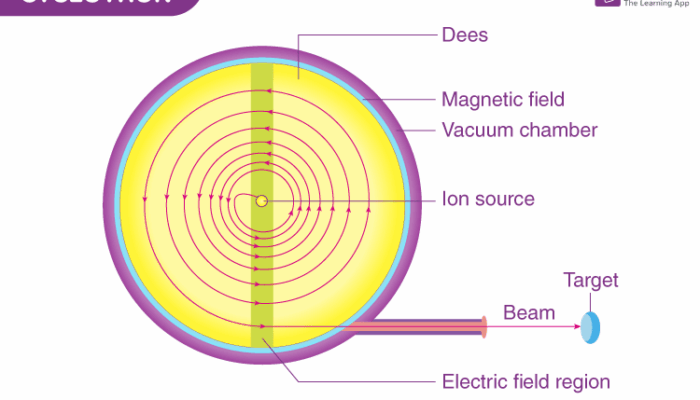
The cyclotron uses an oscillating electric field synchronized to the particle’s orbital frequency, ensuring that particles gain energy each time they cross the gap between the two semi-circular electrodes known as dees.
Particles are emitted from an ion source and injected into the vacuum chamber, where they spiral outward as they gain kinetic energy. The magnetic field maintains their circular trajectory, while the alternating electric field accelerates them incrementally, resulting in a spiral path that increases their speed and energy.
Frequency Synchronization and Particle Acceleration
The timing of the electric field oscillations is critical for efficient acceleration. The cyclotron frequency depends on the particle’s charge-to-mass ratio, dictating the pace at which the electric field must alternate to maintain resonance. Precise synchronization ensures that particles receive energy boosts at the optimal moment during each revolution. Any mismatch in frequency can lead to reduced acceleration efficiency or energy loss, disrupting the acceleration process.
Applications of Cyclotrons
Cyclotrons have a wide range of applications across scientific and medical fields:
- Nuclear Medicine:
Cyclotrons produce radioisotopes used in diagnostic imaging techniques such as positron emission tomography (PET), enabling detailed visualization of physiological processes and disease detection. - Materials Science:
They facilitate the study of material properties by generating particle beams that can modify or analyze substances at the atomic level. - Fundamental Physics Research:
High-energy cyclotrons enable experiments that probe the structure of matter, investigating particles like protons, neutrons, and quarks, and simulating conditions similar to those in the early universe.
Advancements and Future Directions
Modern cyclotron technology is evolving to become more compact, efficient, and accessible. Innovations include:
- Compact Designs:
Smaller cyclotrons are now available, allowing hospitals and research centers with limited space and resources to utilize this technology. - Superconducting Materials:
The use of superconductors enhances magnetic field strength while reducing energy consumption and operational costs. - Artificial Intelligence Integration:
Machine learning algorithms are being developed to optimize acceleration parameters in real time, improving performance and enabling adaptive control of the cyclotron.
Scientific Significance and Metaphorical Insight
The cyclotron exemplifies the unity of scientific disciplines, illustrating how electromagnetic forces govern particle motion much like gravity governs celestial orbits. This device symbolizes the continuous cycle of scientific discovery-where experimentation and theory intertwine to deepen our understanding of the universe’s fundamental laws.
Summary
Far beyond a simple particle accelerator, the cyclotron stands as a monument to human creativity and the relentless drive to explore the unknown. By bridging the gap between observable phenomena and the subatomic realm, it remains an essential tool in advancing physics, medicine, and technology. As research progresses, the cyclotron will continue to illuminate the mysteries of matter and energy, inspiring future generations of scientists.
FAQ
What is a cyclotron?
A cyclotron is a particle accelerator that uses electromagnetic forces to propel charged particles to high speeds along a spiral path.
What are the main applications of cyclotrons?
Cyclotrons are used in nuclear medicine for producing radioisotopes, materials science for analyzing substances, and fundamental physics research to study subatomic particles.
How does a cyclotron accelerate particles?
It accelerates particles using a magnetic field to keep them in a circular path and an oscillating electric field synchronized to the particles’ orbital frequency to increase their energy each revolution.
What advancements are being made in cyclotron technology?
Advancements include compact designs for easier use in hospitals, superconducting materials for stronger magnetic fields with lower costs, and AI integration for optimized acceleration control.






Leave a Reply