
Short Answer
Definition of Chemical Bonds
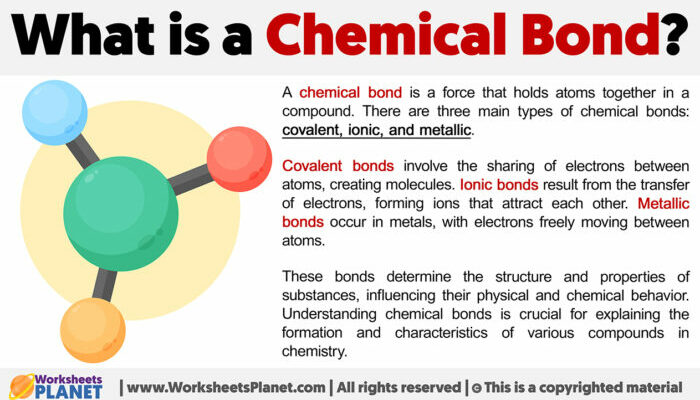
Chemical bonds are the fundamental forces that connect atoms, forming the structural framework of molecules. These bonds arise from interactions involving the sharing or transfer of electrons, creating stable associations between atoms. They are essential in shaping the physical and chemical properties of substances, influencing everything from molecular shape to reactivity.
- Nature of Chemical Bonds:
Forces that hold atoms together within compounds through electron interactions. - Types of Bonds:
Primarily categorized into ionic, covalent, and metallic bonds, each with distinct characteristics.
Types of Chemical Bonds
Ionic Bonds: Attraction Between Charged Ions
Ionic bonding occurs when electrons are completely transferred from one atom to another, resulting in the formation of oppositely charged ions. This electron exchange creates a strong electrostatic attraction between positively charged cations and negatively charged anions. The resulting ionic compounds often form highly ordered crystalline lattices.
- Electron Transfer:
One atom donates electrons, becoming positively charged, while the other accepts electrons, becoming negatively charged. - Example:
Sodium chloride (NaCl) forms when sodium transfers an electron to chlorine, producing stable ions that assemble into a solid lattice. - Properties:
Ionic compounds typically exhibit high melting and boiling points and conduct electricity when dissolved in water.
Covalent Bonds: Sharing Electron Pairs
Covalent bonding involves the mutual sharing of one or more pairs of electrons between atoms, creating a strong and directional connection. This type of bond can be further divided into polar and nonpolar covalent bonds, depending on the electronegativity difference between the bonded atoms.
- Nonpolar Covalent Bonds:
Occur when atoms share electrons equally, as seen in molecules like hydrogen (H₂) and nitrogen (N₂). - Polar Covalent Bonds:
Form when electrons are shared unequally due to differences in electronegativity, resulting in partial charges and dipole moments. - Multiple Bonds:
Double and triple covalent bonds involve sharing multiple electron pairs, increasing bond strength and affecting molecular geometry.
Metallic Bonds: Delocalized Electron Clouds
Metallic bonding is characterized by a lattice of metal cations immersed in a ‘sea’ of delocalized electrons that move freely throughout the structure. This electron mobility imparts metals with unique properties such as electrical conductivity, malleability, and ductility.
- Electron Delocalization:
Electrons are not bound to any single atom but flow freely, enabling conductivity and flexibility. - Physical Traits:
Metals exhibit high thermal and electrical conductivity, as well as the ability to be shaped without breaking. - Applications:
Metallic bonds underpin the functionality of materials used in electronics, construction, and jewelry.
Mechanism of Chemical Bonding
Chemical bonds form as atoms seek to achieve stable electron configurations, often resembling those of noble gases. This drive for stability leads to electron sharing or transfer, minimizing the system’s overall energy. Electrostatic forces between charged particles or shared electron pairs create the attractive interactions that hold atoms together.
Mathematical and Theoretical Perspectives
While chemical bonding is often described qualitatively, quantitative models such as Coulomb’s law and quantum mechanics provide deeper insight:
- Coulomb’s Law:
Describes the electrostatic force (F) between two charged particles:
F = k * (q₁ * q₂) / r²
where k is Coulomb’s constant, q₁ and q₂ are the charges, and r is the distance between charges. - Quantum Mechanical Models:
Explain bonding through wave functions and electron probability distributions, accounting for bond formation, bond length, and bond energy.
Practical Examples of Chemical Bonds
- Table Salt (NaCl):
An ionic compound formed by electron transfer between sodium and chlorine atoms. - Water (H₂O):
Contains polar covalent bonds between hydrogen and oxygen, resulting in unique solvent properties. - Diamond:
A network of covalent bonds between carbon atoms, giving rise to exceptional hardness. - Copper Wire:
Exhibits metallic bonding, allowing electrical conductivity and flexibility.
Common Misunderstandings About Chemical Bonds
- Misconception: Ionic bonds involve atoms sharing electrons.
Correction: Ionic bonds result from the complete transfer of electrons, not sharing. - Misconception: Covalent bonds always involve equal sharing of electrons.
Correction: Covalent bonds can be polar, with unequal electron sharing due to differences in electronegativity. - Misconception: Metallic bonds are simply strong covalent bonds.
Correction: Metallic bonds involve delocalized electrons moving freely, distinct from localized covalent bonds.
Significance of Chemical Bonds in Science and Life
Chemical bonds are foundational to the structure and function of all matter, influencing biological systems, materials science, and technology. In biology, bonds determine the shape and activity of proteins, DNA, and cellular membranes, directly impacting life processes. In industry and research, controlling chemical bonds enables the design of new materials, pharmaceuticals, and nanotechnologies, driving innovation and improving quality of life.
Summary
Chemical bonds are the invisible forces that unite atoms into the vast diversity of matter observed in the universe. Whether through electron transfer, sharing, or delocalization, these bonds dictate the stability, properties, and interactions of molecules. Understanding their nature and behavior provides profound insight into the material world and underpins advances across scientific disciplines.
FAQ
What is a chemical bond?
A chemical bond is the attraction that holds atoms together in a molecule or compound, resulting from the sharing or transfer of electrons.
What are the main types of chemical bonds?
The primary types of chemical bonds are ionic bonds, covalent bonds (including polar and nonpolar), and metallic bonds.
How do ionic bonds form?
Ionic bonds form when electrons are transferred from one atom to another, creating oppositely charged ions that attract each other.
What is the difference between polar and nonpolar covalent bonds?
Polar covalent bonds have unequal sharing of electrons due to differences in electronegativity, while nonpolar covalent bonds share electrons equally.
Why are metallic bonds important?
Metallic bonds provide metals with properties like conductivity, malleability, and ductility through a sea of delocalized electrons.






Leave a Reply