
Short Answer
Definition of Galaxy Clusters
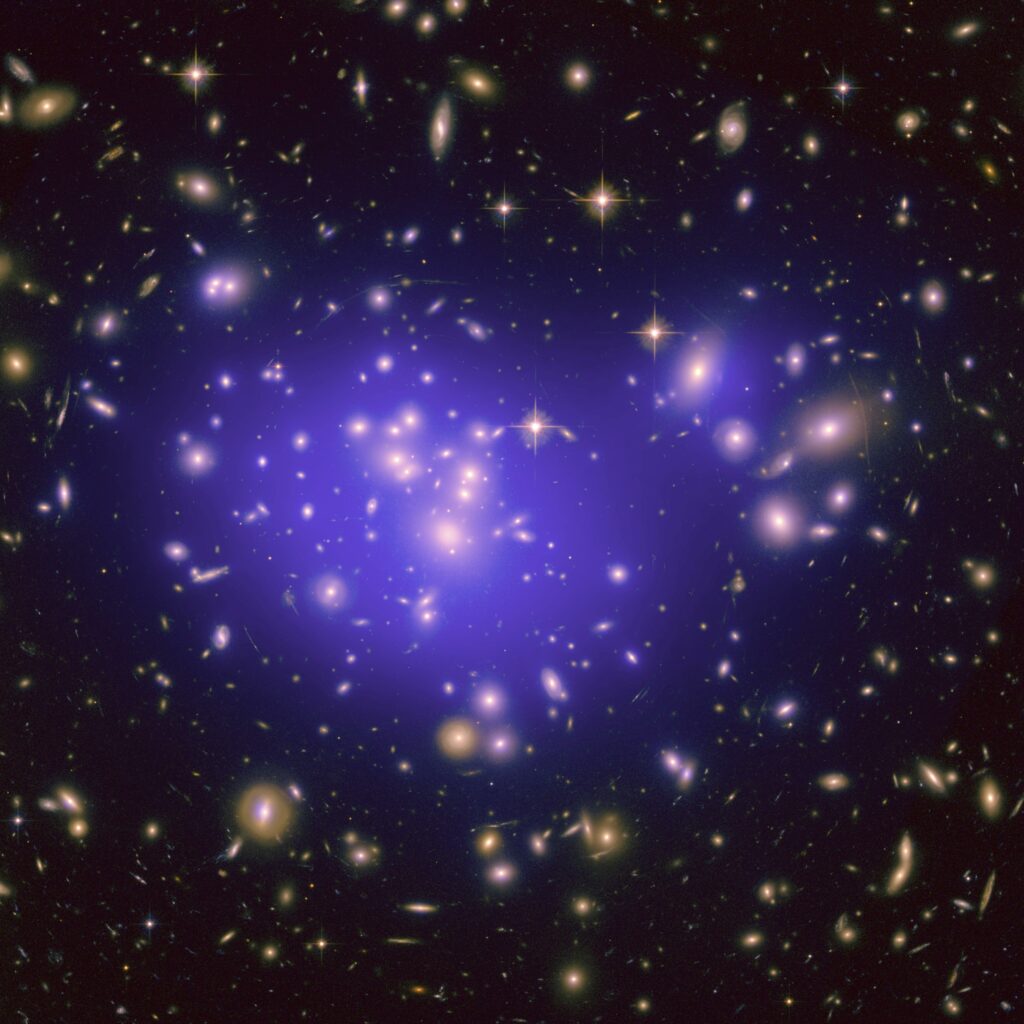
Galaxy clusters are immense cosmic structures comprising hundreds to thousands of galaxies gravitationally bound together. These vast assemblies span millions of light-years and represent some of the largest known formations in the universe. While they appear as collections of visible matter-such as stars, gas, dust, and galaxies-their true composition extends far beyond what can be directly observed.
Revealing the Hidden Mass: The Dark Matter Puzzle
Early studies of galaxy clusters uncovered a perplexing phenomenon related to the motion of their constituent galaxies. Astronomers found that the velocities of galaxies within clusters were significantly higher than what the gravitational pull of visible matter alone could sustain. According to classical physics, these galaxies should have dispersed over time, yet the clusters remain intact. This discrepancy pointed to the existence of a substantial amount of unseen mass, now known as dark matter.
Understanding Dark Matter
Dark matter is a form of matter that does not interact with electromagnetic radiation, making it invisible to conventional telescopes. Its presence is inferred solely through its gravitational effects on visible matter, radiation, and the large-scale structure of the universe. Unlike ordinary matter, dark matter neither emits nor absorbs light, rendering it undetectable by direct observation.
- Gravitational Influence:
Dark matter exerts gravitational forces that govern the motion of galaxies within clusters and the formation of cosmic structures. - Non-Interacting Nature:
It does not interact with electromagnetic forces, which is why it remains invisible across the electromagnetic spectrum.
Techniques for Investigating Galaxy Clusters
Astronomers utilize several advanced observational methods to study galaxy clusters and infer the distribution of dark matter within them.
Gravitational Lensing
One of the most powerful tools is gravitational lensing, a phenomenon predicted by Einstein’s theory of general relativity. Massive objects like galaxy clusters warp spacetime, bending the trajectory of light from more distant galaxies. By analyzing the resulting distortions, arcs, and multiple images, scientists can create detailed maps of the total mass distribution, revealing that most of the cluster’s mass resides in an invisible dark matter halo.
X-ray Observations
Galaxy clusters also contain enormous amounts of superheated gas in the intracluster medium, emitting X-rays due to temperatures of tens of millions of degrees. Although this hot gas contributes significantly to the cluster’s mass, it is insufficient to explain the gravitational binding observed. The combined mass of visible galaxies and hot gas still falls short, reinforcing the necessity of dark matter’s presence.
Hypotheses on the Nature of Dark Matter
Despite extensive research, the fundamental composition of dark matter remains unknown. Several theoretical candidates have been proposed:
- Weakly Interacting Massive Particles (WIMPs):
Hypothetical particles that interact via gravity and the weak nuclear force but not electromagnetically. - Axions:
Ultra-light particles predicted by certain extensions of the Standard Model of particle physics. - Primordial Black Holes:
Black holes formed in the early universe that could account for some or all dark matter.
Each candidate presents unique challenges and opportunities for detection, but none have been conclusively observed to date.
Significance of Galaxy Clusters in Cosmology and Astrophysics
Galaxy clusters serve as natural laboratories for testing theories in particle physics, gravity, and cosmology. Their study provides critical insights into the evolution of the universe, from the Big Bang to the present day. The interaction between dark matter and ordinary (baryonic) matter influences galaxy formation, star formation rates, and the large-scale cosmic web.
Implications for Fundamental Physics
Discrepancies between observations and theoretical models at cluster scales suggest that our understanding of gravity and fundamental forces may be incomplete. These anomalies have prompted investigations into possible modifications of gravitational laws or the existence of additional forces beyond the Standard Model.
Role in Measuring Cosmological Parameters
Galaxy clusters are instrumental in refining measurements of key cosmological parameters, such as the universe’s expansion rate and the influence of dark energy. The gravitational effects of dark matter within clusters help constrain models describing the universe’s shape, content, and ultimate fate.
Common Misconceptions About Dark Matter and Galaxy Clusters
Dark matter is simply ordinary matter that is hidden or faint.
Dark matter is fundamentally different from ordinary matter; it does not interact with light and cannot be detected by conventional means.
Dark matter has been directly observed.
Dark matter has not been directly detected; its existence is inferred from gravitational effects on visible matter and radiation.
Philosophical and Existential Reflections
The discovery that most of the universe’s mass is invisible challenges our perception of reality and highlights the limitations of human observation. Galaxy clusters, with their blend of luminous galaxies and vast dark matter halos, symbolize the duality of the known and unknown in the cosmos. This realization inspires both humility and curiosity, driving the ongoing quest to uncover the universe’s deepest secrets.
Summary
Galaxy clusters are monumental cosmic structures whose study has unveiled the profound mystery of dark matter. Through techniques like gravitational lensing and X-ray astronomy, scientists have mapped the unseen mass that dominates these clusters. While the nature of dark matter remains elusive, its gravitational role is crucial in shaping the universe’s architecture and evolution. The exploration of galaxy clusters continues to be a cornerstone in advancing our understanding of cosmology, fundamental physics, and the very fabric of reality.
FAQ
What are galaxy clusters?
Galaxy clusters are large structures in the universe composed of hundreds to thousands of galaxies bound together by gravity.
What is dark matter?
Dark matter is a type of matter that does not emit light or energy, making it invisible, and its presence is inferred through gravitational effects on visible matter.
How do scientists study dark matter in galaxy clusters?
Scientists use techniques like gravitational lensing and X-ray observations to infer the presence and distribution of dark matter in galaxy clusters.

Leave a Reply