
Short Answer
Definition of Charged Particles in Particle Accelerators
Charged particles are fundamental components in particle accelerators-complex machines engineered to propel these particles to extremely high speeds. This acceleration enables significant breakthroughs in various scientific domains, including high-energy physics, nuclear physics, and materials science. Charged particles are primarily classified based on their electric charge into two categories: positively charged ions (cations) and negatively charged ions (anions). The most commonly accelerated charged particles include protons, electrons, and various ions, each possessing distinct properties that make them suitable for specific experimental applications.
Types of Charged Particles and Their Characteristics
Protons
Protons are positively charged baryons that form a core part of atomic nuclei. Structurally, they are composed of three quarks-two up quarks and one down quark-held together by the strong nuclear force mediated by gluons. Protons have a mass approximately 1836 times greater than that of electrons, which allows them to penetrate dense materials and deliver substantial energy during collisions. In high-energy particle colliders like the Large Hadron Collider (LHC), protons are accelerated to probe fundamental forces and particles, leading to discoveries such as the Higgs boson. The acceleration process demands precise control over magnetic and electric fields to maintain a focused and stable proton beam, making proton accelerators highly sophisticated devices.
Electrons
Electrons are negatively charged elementary particles classified as leptons. Unlike protons, electrons are not confined within atomic nuclei and have a much smaller mass. This low mass enables electrons to achieve very high energies in circular accelerators such as synchrotrons, where they are repeatedly accelerated while maintaining a compact beam. One of the key applications of accelerated electrons is the generation of synchrotron radiation, which is widely used in fields like materials science, biology, and chemistry. The radiation produced is highly coherent and monochromatic, allowing scientists to perform detailed imaging and analysis of complex molecular structures.
Ions
Ions, which can be either stable or radioactive isotopes, are another important category of charged particles used in accelerators. Common ion species include helium nuclei (alpha particles), carbon ions, and heavier nuclei such as lead or gold. The acceleration of ions involves careful consideration of their mass-to-charge ratios and nuclear interactions during collisions. Heavy ion accelerators are particularly valuable for recreating extreme conditions similar to those just after the Big Bang. These experiments enable physicists to study quark-gluon plasma, a unique state of matter believed to have existed in the early universe.
Antimatter and Exotic Particles
Beyond the standard charged particles, antimatter particles like antiprotons and exotic particles such as hyperons and mesons are also subjects of acceleration research. Antiprotons, the negatively charged counterparts of protons, are instrumental in investigating matter-antimatter symmetries. Their production involves high-energy collisions that generate particle-antiparticle pairs, providing insights into why matter dominates the universe. Exotic particles, characterized by unusual quantum properties, represent a cutting-edge area of study. Their acceleration requires advanced techniques and innovative accelerator designs to harness their unique behaviors effectively.
Mechanisms of Particle Acceleration
Particle accelerators employ two primary methods to increase the kinetic energy of charged particles: electrostatic acceleration and electromagnetic acceleration.
- Electrostatic Acceleration:
This method uses static high-voltage electric fields to accelerate particles in a straight line. Devices like Van de Graaff generators exemplify this approach, where particles gain energy by moving through a constant electric potential difference. - Electromagnetic Acceleration:
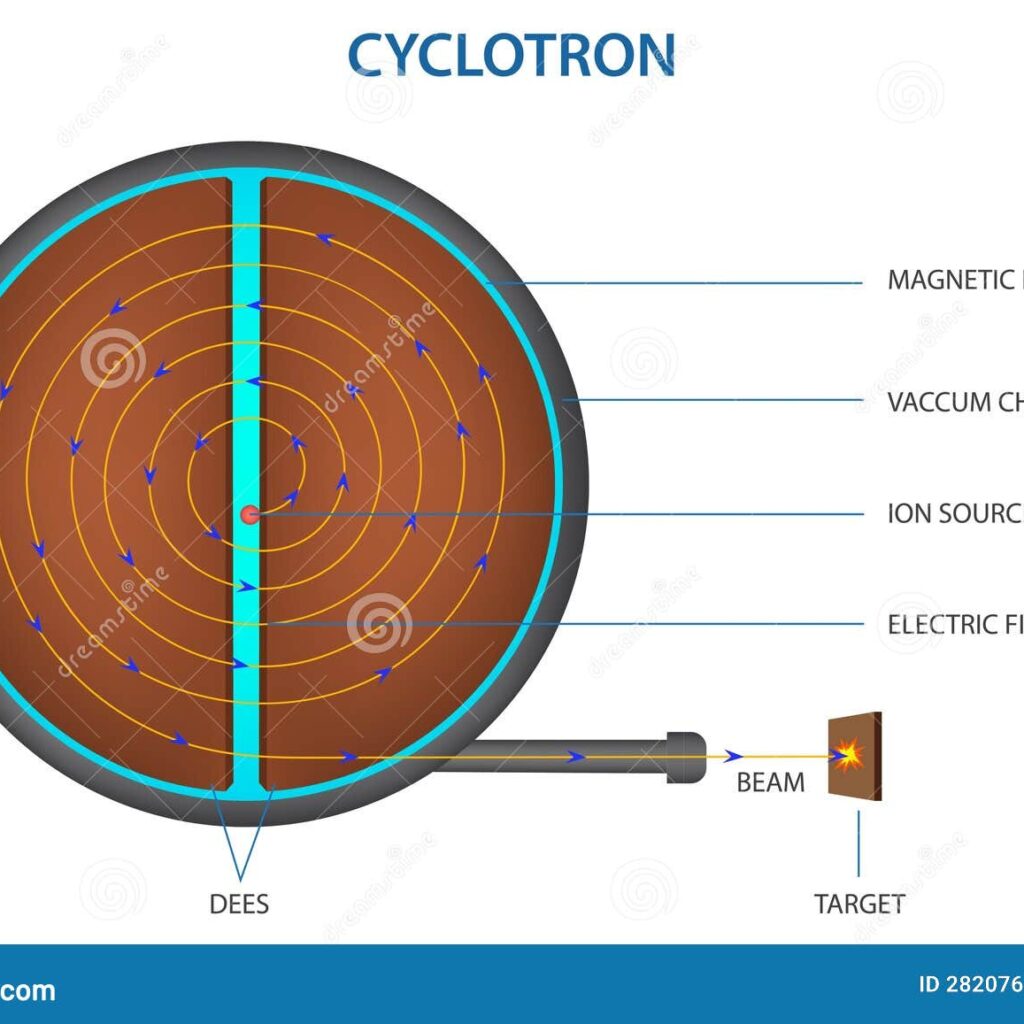
In this technique, rapidly oscillating electric fields combined with magnetic fields accelerate particles along circular or spiral paths. Cyclotrons and synchrotrons are typical examples, where synchronization between electric and magnetic forces is crucial to maintain beam stability and focus, enabling high collision rates essential for experimental success.
Scientific Significance and Applications
The manipulation and acceleration of charged particles have profound implications across multiple scientific disciplines. By enabling the study of fundamental particles and forces, particle accelerators contribute to our understanding of the universe’s building blocks. Additionally, the technology facilitates the exploration of novel materials and biological structures with unprecedented precision. As accelerator technology evolves, it continues to unlock new frontiers in physics, chemistry, biology, and materials science, driving innovation and expanding human knowledge.
Common Misconceptions About Charged Particles in Accelerators
Only protons are accelerated in particle accelerators.
While protons are common, electrons, ions, antimatter particles, and exotic particles are also accelerated depending on the experiment’s goals.
Particle accelerators only produce high-energy collisions.
Besides collisions, accelerators generate valuable radiation (e.g., synchrotron radiation) used in imaging and material analysis.
FAQ
What charged particles are used in particle accelerators?
Particle accelerators use protons, electrons, ions, antimatter particles like antiprotons, and exotic particles such as hyperons and mesons.
How do particle accelerators speed up charged particles?
They use electrostatic acceleration with static electric fields and electromagnetic acceleration with oscillating electric and magnetic fields to increase particle speeds.
Why are different particles accelerated in particle accelerators?
Different particles are chosen based on experimental goals, such as probing fundamental forces, generating radiation for imaging, or studying extreme matter states.
Are particle accelerators only used for collisions?
No, they also produce radiation used in scientific imaging and material analysis.





Leave a Reply