
Short Answer
Overview of the Large Hadron Collider
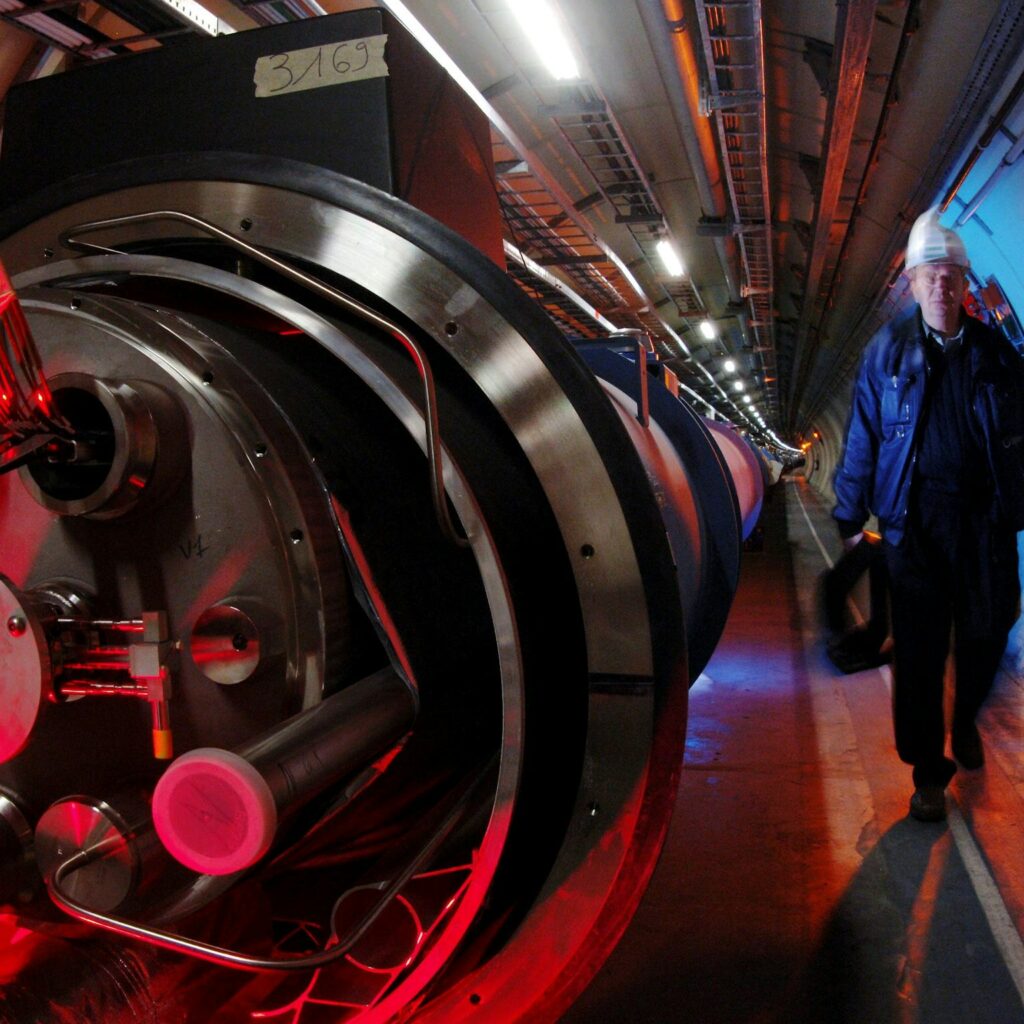
Located at CERN near Geneva, Switzerland, the Large Hadron Collider (LHC) stands as a monumental achievement in contemporary physics. This vast scientific instrument, encircling a tunnel approximately 27 kilometers (16.8 miles) in length, functions as a particle accelerator designed to propel protons and heavy ions to velocities nearing the speed of light. The immense energies generated within this complex facility enable physicists to investigate fundamental questions about the composition of matter, the structure of the universe, and potentially undiscovered dimensions of reality.
Fundamental Principles of the LHC
The operation of the LHC is grounded in the principles of particle acceleration and collision. Utilizing electromagnetic fields, the collider accelerates charged particles through multiple stages. Protons, the most commonly accelerated particles, are injected into the accelerator and guided by powerful superconducting magnets that generate intense magnetic fields. This process not only increases the particles’ speed but also significantly boosts their kinetic energy, reaching levels of several tera-electronvolts (TeV). Such high energies are essential for probing rare phenomena and processes that remain inaccessible at lower energy scales.
Mechanism of Particle Collisions
After acceleration, the protons are steered into head-on collisions. These high-energy impacts convert kinetic energy into mass, as described by Einstein’s equation, E=mc², resulting in the creation of new particles. One of the most notable achievements of the LHC was the discovery of the Higgs boson in 2012, a particle responsible for imparting mass to other fundamental particles. This breakthrough confirmed a critical component of the Standard Model of particle physics and revitalized research into the origins of mass.
Exploring Fundamental Forces and Early Universe Conditions
The LHC also provides valuable insights into the symmetries and unification of fundamental forces, particularly the electromagnetic and weak nuclear forces. By recreating conditions similar to those just moments after the Big Bang, the collider acts as a window into the early universe. The debris from particle collisions is meticulously analyzed using sophisticated detectors like ATLAS and CMS, which capture data on decay patterns and energy distributions, helping scientists understand the forces that shaped the cosmos.
Precision and Data Analysis in LHC Experiments
Achieving precise collisions within the LHC requires extraordinary accuracy, as particle beams must be aligned to within fractions of a millimeter. This fine-tuning of timing and positioning is crucial because only a tiny percentage of collisions produce meaningful data. Advanced detectors record these events, generating vast amounts of information that undergo extensive computational analysis to extract significant scientific findings.
Heavy-Ion Collisions and Quark-Gluon Plasma Research
In addition to proton collisions, the LHC conducts experiments involving heavy ions, such as lead-lead collisions. These experiments simulate the extreme conditions present shortly after the Big Bang, allowing physicists to study the quark-gluon plasma-a state where quarks and gluons exist freely rather than confined within protons and neutrons. Understanding this primordial matter enhances knowledge of the fundamental forces and the early stages of matter formation in the universe.
Investigations into Dark Matter and Dark Energy
The LHC also plays a pivotal role in exploring the mysteries of dark matter and dark energy, which together constitute about 95% of the universe’s total mass-energy content. These elusive components do not interact with electromagnetic forces, making them invisible to traditional detection methods. Through experiments that hint at the existence of supersymmetric particles or other exotic candidates, the LHC challenges current scientific models and inspires new theoretical frameworks.
Philosophical Implications and Theoretical Frontiers
Beyond its scientific contributions, the LHC stimulates philosophical discussions about the nature of reality. Discoveries such as potential extra dimensions or validation of novel theoretical models provoke reconsideration of established ontologies and invite profound questions about the universe’s fundamental structure. Concepts like the multiverse, while speculative, gain scientific interest, encouraging exploration beyond conventional physical laws.
Significance of the Large Hadron Collider
The Large Hadron Collider represents far more than a facility for particle collisions; it embodies a convergence of electromagnetism, quantum mechanics, and cosmology. The data derived from its experiments not only unlock secrets of the universe but also drive an evolution in human understanding, challenging us to rethink our place in the cosmos. Each collision and discovery underscores human ingenuity and the relentless quest for knowledge, pushing the boundaries of what is known and illuminating the mysteries that lie beyond.
FAQ
What is the purpose of the Large Hadron Collider?
The LHC is designed to accelerate particles to high energies to study fundamental physics questions, including the origins of mass and the conditions of the early universe.
What significant discovery was made at the LHC?
The LHC famously discovered the Higgs boson in 2012, confirming a key component of the Standard Model of particle physics.
How does the LHC simulate conditions of the early universe?
By recreating high-energy collisions that mimic the conditions just after the Big Bang, the LHC allows scientists to study fundamental forces and the formation of matter.






Leave a Reply