
Short Answer
Understanding Digital Logic Gates
Digital logic gates are fundamental components in modern electronics and computing, responsible for performing operations based on binary input signals. These gates process combinations of 0s and 1s to produce specific outputs, forming the building blocks of complex digital circuits. While the commonly known AND, OR, and NOT gates are widely used, there exists a variety of less conventional gates that offer unique functionalities and play critical roles in advanced electronic designs.
Core Universal Gates: NAND and NOR
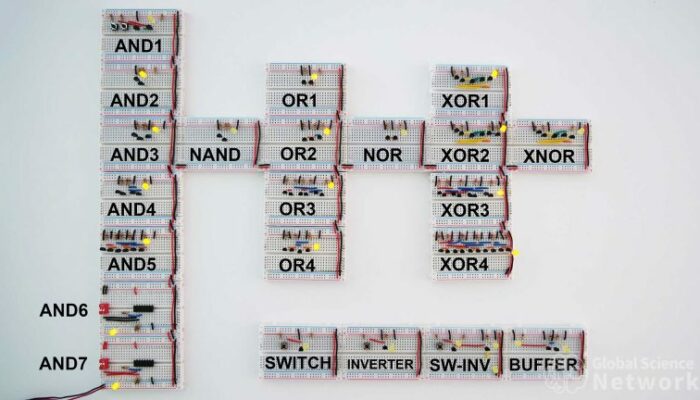
The NAND gate is often hailed as the cornerstone of digital logic due to its universality. This gate outputs a false signal only when all its inputs are true, making it possible to construct any other logic gate-including AND, OR, and NOT-using just NAND gates. This versatility is comparable to water’s ability to change states, symbolizing how a single gate type can adapt to fulfill multiple logical functions.
Similarly, the NOR gate serves as another universal gate, producing a true output only when all inputs are false. Acting as the logical opposite of the AND gate, the NOR gate can independently implement any logical operation. Its power lies in the ability to create complex circuits solely through negation, highlighting the elegance of oppositional logic in digital design.
Exclusive Logic Gates: XOR and XNOR
The XOR (exclusive OR) gate introduces a distinctive logic behavior by outputting true only when an odd number of inputs are true. This exclusivity mirrors decision-making scenarios where only one condition should be met, making XOR essential in applications like parity checking and error detection. Its function ensures that asymmetry in input signals is flagged, which is crucial for maintaining data integrity.
Complementing the XOR gate is the XNOR (exclusive NOR) gate, which outputs true when all inputs are equal-either all true or all false. This gate embodies the concept of logical equivalence and is widely used in binary arithmetic operations, digital signal processing, and toggle circuits. The XNOR gate’s ability to detect equality adds a nuanced layer to digital logic, balancing harmony and contrast within computational processes.
Specialized Components: Schmitt Trigger and Fanout
The Schmitt Trigger is a specialized circuit that converts noisy or slowly varying analog signals into clean, stable digital outputs. It achieves this through hysteresis, which introduces two distinct threshold voltages for switching states, thereby preventing erratic output changes caused by signal noise. This property makes the Schmitt Trigger indispensable in environments where signal clarity is paramount, acting as a stabilizing force in digital systems.
Fanout refers to the maximum number of inputs that a single gate output can drive without signal degradation. Although not a gate itself, fanout is a critical parameter in circuit design, as excessive fanout can lead to bottlenecks and instability. Managing fanout effectively ensures reliable signal distribution across complex electronic networks, balancing power consumption and performance.
Signal Routing Devices: Multiplexer and Demultiplexer
The Multiplexer (MUX), also known as a data selector, is a device that selects one input from multiple signals and forwards it to a single output line. This selection capability streamlines data flow within circuits, allowing efficient management of multiple data sources. The MUX functions like a conductor orchestrating an ensemble, enabling seamless switching and consolidation of information.
Conversely, the Demultiplexer (DEMUX) performs the opposite operation by distributing a single input signal to one of many outputs. This division of signals exemplifies the duality of combination and separation in digital logic, facilitating complex routing and signal management in communication and processing systems.
Programmable Logic Arrays: Flexibility in Digital Design
Programmable Logic Arrays (PLAs) represent a pinnacle of adaptability in digital logic. These configurable devices allow engineers to program custom logic functions by defining gate connections and arrangements. PLAs enable rapid prototyping and dynamic modification of circuits, akin to a sculptor shaping raw material into intricate forms. Their flexibility supports innovation and evolution in digital systems, accommodating changing technological demands.
Significance of Unconventional Logic Gates
While traditional gates like AND, OR, and NOT form the backbone of digital electronics, exploring less common gates reveals a richer landscape of logical operations. Each gate type contributes unique properties that enhance circuit functionality, efficiency, and reliability. Understanding these diverse components deepens insight into the principles of computation and electronic design, highlighting the intricate interplay between simplicity and complexity in digital technology.
Summary
Digital logic gates extend far beyond the familiar trio of AND, OR, and NOT. From universal gates like NAND and NOR to exclusive gates such as XOR and XNOR, and specialized components like Schmitt Triggers and multiplexers, each element plays a vital role in shaping modern electronics. Programmable devices like PLAs further expand the horizons of digital logic, enabling tailored solutions and innovation. Together, these gates form a dynamic ecosystem that underpins the digital age, reflecting both the practical and philosophical dimensions of logic and computation.
FAQ
What are digital logic gates?
Digital logic gates are fundamental components in electronics that perform operations based on binary inputs, forming the building blocks of digital circuits.
What is the significance of uncommon logic gates?
Uncommon logic gates like XOR, XNOR, and Schmitt Triggers provide unique functionalities that enhance circuit design and performance.






Leave a Reply