
Short Answer
Definition of Hadrons and Leptons
In particle physics, fundamental particles are broadly classified into two main categories: hadrons and leptons. These groups differ significantly in their composition, properties, and the forces they experience.
- Hadrons:
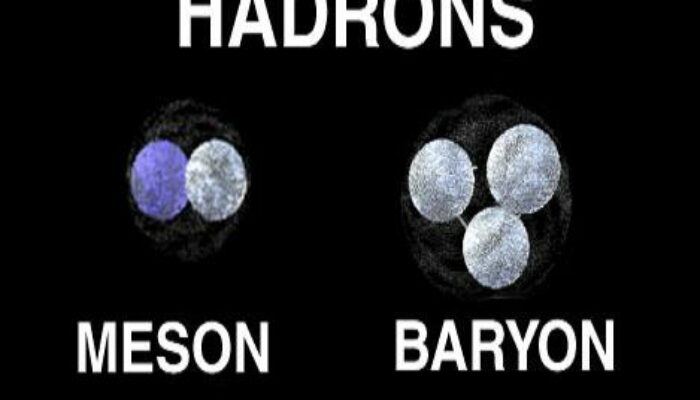
Composite particles made up of quarks bound together by the strong nuclear force, mediated by gluons. Hadrons are further divided into baryons (three quarks, e.g., protons and neutrons) and mesons (a quark-antiquark pair). - Leptons:
Elementary particles that are not composed of smaller constituents and do not participate in the strong interaction. This family includes electrons, muons, tau particles, and their associated neutrinos.
Fundamental Forces and Particle Interactions
The nature of the forces acting on hadrons and leptons highlights their fundamental differences.
- Strong Force in Hadrons:
Hadrons experience the strong nuclear force, which is the most powerful force at subatomic distances. This force binds quarks within hadrons and holds protons and neutrons together inside atomic nuclei, enabling the formation of matter. - Electromagnetic and Weak Forces in Leptons:
Leptons interact primarily through electromagnetic and weak nuclear forces. Electrons, for instance, are crucial in atomic structure and chemical reactions via electromagnetic interactions. Neutrinos, a type of lepton, interact only weakly, allowing them to pass through matter almost undisturbed.
Mass, Stability, and Lifespan
Mass and stability are key distinguishing features between hadrons and leptons.
- Mass Differences:
Hadrons generally have greater mass, largely due to the energy from quark interactions and the strong force binding energy. Leptons are lighter, with the electron being the lightest charged lepton. - Stability Variations:
Among hadrons, stability varies widely; protons are notably stable, while many mesons decay rapidly. Leptons like the electron are stable under normal conditions, whereas heavier leptons such as muons have finite lifetimes but typically outlive many hadronic particles.
Cosmic and Atomic Roles
Hadrons and leptons play essential but distinct roles in the structure and dynamics of the universe.
- Hadrons in Matter Formation:
Hadrons constitute the nuclei of atoms, forming the bulk of visible matter including stars, planets, and living organisms. They participate in nuclear fusion processes that power stars and synthesize heavier elements. - Leptons in Chemistry and Astrophysics:
Electrons enable chemical bonding and electricity, fundamental to life and technology. Neutrinos, though elusive, are abundant and provide valuable information about astrophysical events like supernovae and solar fusion.
Experimental Techniques and Discoveries
Modern experimental physics has advanced our understanding of hadrons and leptons through sophisticated detection methods.
- Particle Accelerators and Hadrons:
Facilities like the Large Hadron Collider accelerate particles to high energies, allowing scientists to observe hadron collisions, discover new particles, and test theoretical models such as the Standard Model. - Neutrino Detection:
Due to their weak interactions, neutrinos are detected using large-scale observatories filled with water or ice, capturing rare neutrino interactions. These experiments have uncovered phenomena like neutrino oscillations and provided insights into neutrino mass.
Common Misunderstandings About Hadrons and Leptons
- Misconception: All fundamental particles are indivisible.
Correction: While leptons are elementary, hadrons are composite particles made of quarks. - Misconception: Neutrinos interact frequently with matter.
Correction: Neutrinos interact very weakly, allowing them to pass through most matter without interaction.
Significance in Science and Everyday Life
Understanding hadrons and leptons is crucial for both theoretical physics and practical applications. Hadrons form the matter that constitutes the physical world, while leptons, especially electrons, are fundamental to chemistry, electricity, and technology. Research into these particles continues to deepen our comprehension of the universe’s fundamental structure and the forces shaping it.
FAQ
What are hadrons?
Hadrons are composite particles made up of quarks, bound together by the strong nuclear force. They include baryons, like protons and neutrons, and mesons, which are quark-antiquark pairs.
What are leptons?
Leptons are elementary particles that do not have substructure and do not participate in the strong interaction. This category includes electrons, muons, tau particles, and their associated neutrinos.
How do hadrons and leptons differ in mass?
Hadrons generally have greater mass due to quark interactions and binding energy, while leptons are lighter, with the electron being the lightest charged lepton.
What roles do hadrons and leptons play in the universe?
Hadrons form the nuclei of atoms and are essential for matter formation, while leptons, especially electrons, are fundamental to chemical bonding and electricity.






Leave a Reply