
Short Answer
Understanding Optical Computing
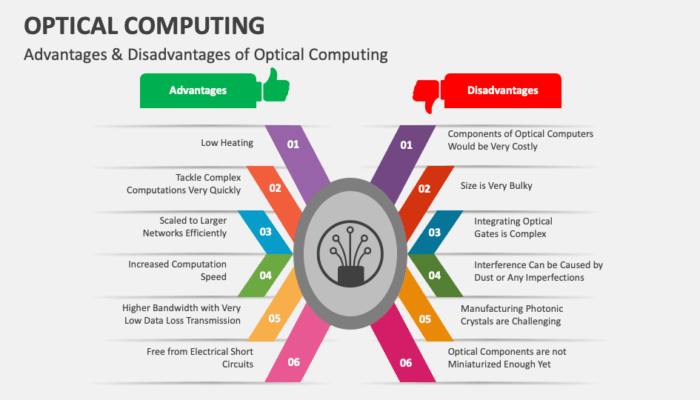
Optical computing represents an innovative approach to data processing and transmission, utilizing photons-particles of light-instead of electrons, which are the foundation of traditional electronic computing. This technology aims to significantly enhance computational speed and efficiency by leveraging the unique properties of light. As the demand for faster and more energy-efficient computing grows, optical computing emerges as a promising alternative, potentially transforming how information is handled across various applications.
Fundamental Challenges in Optical Computing
Material Limitations and Signal Integrity
One of the primary obstacles in optical computing arises from the physical properties of current optical materials. When light travels through optical fibers or photonic devices, it encounters phenomena such as dispersion and attenuation. Dispersion causes the spreading of light pulses over time, which can degrade the quality of the signal, especially over long distances. Attenuation refers to the gradual loss of signal strength as light propagates through a medium. These effects pose significant challenges in maintaining data accuracy and transmission speed across extensive networks.
Manufacturing and Material Science Constraints
Despite advances in photonic technology, producing efficient and dependable optical components remains a complex task. Materials like silicon photonics have demonstrated potential, but achieving optimal performance often requires intricate refinement and fabrication processes. The current state of material science may limit the scalability and practicality of optical computing, necessitating breakthroughs in both material properties and manufacturing techniques to transition from theoretical models to real-world applications.
Integration with Existing Electronic Systems
Most contemporary computing infrastructure is built around electronic components, making the integration of optical elements a sophisticated engineering challenge. Designing hybrid systems that effectively combine optical and electronic technologies demands careful adaptation to ensure compatibility and performance. This integration complexity raises concerns about whether the benefits of optical computing can be fully realized without compromising the efficiency and speed advantages it promises.
Complexity in Optical Data Processing
Optical computing employs various physical phenomena-such as interference, diffraction, and nonlinear optical effects-to perform logic operations and data manipulation. These methods are inherently more complex than traditional electronic logic gates, potentially introducing operational delays and increasing system complexity. The intricate nature of controlling and processing light signals may offset some of the speed gains expected from optical computing.
Precision Requirements for Optical Components
Key components like optical delay lines and modulators must operate with high precision to modulate light signals accurately and swiftly. Manufacturing these devices to function reliably under diverse environmental conditions is a demanding process. Variations in temperature, vibration, and other factors can affect the interaction of light with materials, impacting overall system stability and performance.
Economic and Security Considerations
Financial Barriers to Adoption
The transition to optical computing involves substantial upfront investments in research, development, and infrastructure. Although the long-term benefits may be significant, the initial costs can be prohibitive, creating a financial barrier for many organizations. Stakeholders must weigh the uncertain timeline for practical deployment against the potential advantages, which complicates decision-making in adopting this emerging technology.
Security Implications of Optical Networks
As optical communication systems become more widespread, they introduce new security challenges. While optical data transmission can offer resistance to certain types of cyberattacks, it also opens avenues for novel vulnerabilities unique to light-based communication. Protecting optical networks from emerging threats requires developing new security protocols that do not undermine the speed and efficiency benefits inherent to optical computing.
Transitioning to Optical Computing Standards
Current networking protocols and infrastructure are predominantly designed for electronic data transmission. Adapting these systems to accommodate optical data flows involves significant changes in network management and design. Establishing standardized optical communication protocols is essential but may prove to be a complex and time-consuming process. The success of optical computing depends in part on overcoming these standardization challenges to fully leverage its advantages.
Why Optical Computing Holds Promise
Despite the numerous challenges, optical computing offers a compelling vision for the future of technology. By harnessing the speed and bandwidth of light, it has the potential to dramatically improve computational performance and energy efficiency. Continued research and innovation are crucial to addressing the technical, economic, and security hurdles that currently limit its widespread adoption. The evolution of optical computing could redefine the landscape of information technology, making it a critical area of focus for scientists and engineers.
Common Misconceptions About Optical Computing
Optical computing will immediately replace electronic computing.
Optical computing is still in developmental stages and faces significant technical and practical challenges before it can complement or replace electronic systems.
Light-based data transmission is immune to security threats.
While optical systems may resist some hacking methods, they are vulnerable to unique security risks that require specialized protective measures.
Optical components are easy to manufacture and integrate.
Producing high-precision optical devices and integrating them with existing electronics is complex and demands advanced fabrication techniques and engineering solutions.
Conclusion: Balancing Potential and Practicality
The future of optical computing hinges on navigating a delicate balance between its promising capabilities and the practical challenges it faces. Material limitations, integration difficulties, economic costs, and security concerns all represent significant hurdles. However, with ongoing advancements in photonics, materials science, and network engineering, these obstacles may be overcome. The journey toward fully realizing optical computing’s potential is both challenging and exciting, offering opportunities for transformative breakthroughs in how we process and transmit information.
FAQ
What causes signal degradation in optical computing?
Signal degradation is mainly caused by dispersion, which spreads light pulses over time, and attenuation, which reduces signal strength.
Why is manufacturing optical components challenging?
Manufacturing requires high precision and advanced material science to produce reliable optical devices that function under varying environmental conditions.
How does optical computing differ from electronic computing?
Optical computing uses photons (light) instead of electrons to process and transmit data, offering potential speed and efficiency advantages.
What are the security concerns with optical networks?
Optical networks face unique vulnerabilities and require new security protocols to protect against emerging threats specific to light-based communication.
Is optical computing ready for widespread adoption?
No, it currently faces technical, economic, and standardization challenges that must be overcome before widespread practical use.





Leave a Reply