
Short Answer
Definition of Particles and Their Composition
Particles are the fundamental units that constitute all matter in the universe. Understanding what particles are made of involves exploring the intricate layers of atomic and subatomic structures, as well as the forces that govern their interactions. At the most basic level, particles include atoms, which themselves are composed of smaller entities such as protons, neutrons, and electrons. Delving deeper reveals even more elementary components, providing insight into the very fabric of reality.
Atomic Structure and Subatomic Components
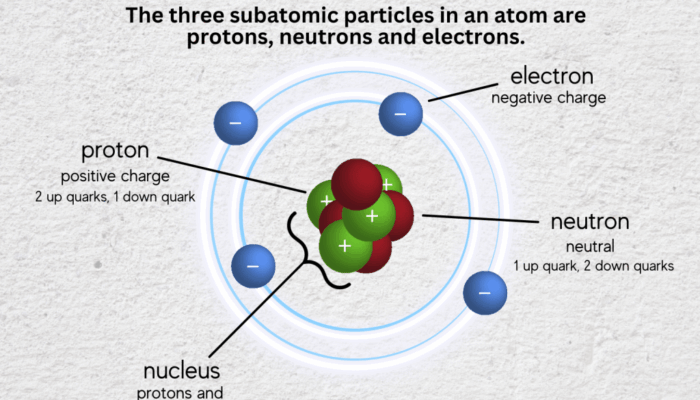
The atom serves as the foundational building block of matter. It consists of a dense nucleus surrounded by a cloud of electrons. The nucleus contains protons and neutrons, collectively known as nucleons. These nucleons are not indivisible; they are made up of even smaller particles called quarks. This hierarchical structure forms the basis of our understanding of matter’s composition.
Quarks: The Building Blocks of Nucleons
Quarks are elementary particles that combine to form protons and neutrons. There are six distinct types, or “flavors,” of quarks: up, down, charm, strange, top, and bottom. Protons are composed of two up quarks and one down quark, whereas neutrons consist of one up quark and two down quarks. These quarks are held together by the strong nuclear force, which is mediated by particles called gluons. Gluons act as the “glue” that binds quarks, creating the composite particles known as hadrons.
Classification of Fundamental Particles
Particles in the universe are broadly categorized into two groups based on their intrinsic properties: fermions and bosons.
- Fermions:
These include quarks and leptons, such as electrons, muons, and neutrinos. Fermions make up matter and follow the Pauli exclusion principle, which prevents identical fermions from occupying the same quantum state. - Bosons:
These particles act as force carriers, facilitating interactions between fermions. Examples include photons (electromagnetic force), gluons (strong nuclear force), and W and Z bosons (weak nuclear force).
Fundamental Forces and Their Role in Particle Interactions
The universe operates under four fundamental forces that dictate how particles interact and combine:
- Gravitational Force:
Governs attraction between masses; hypothesized to be mediated by gravitons, which remain undetected. - Electromagnetic Force:
Controls interactions between charged particles, mediated by photons. - Weak Nuclear Force:
Responsible for radioactive decay and neutrino interactions, mediated by W and Z bosons. - Strong Nuclear Force:
The force that binds quarks within nucleons and holds atomic nuclei together, mediated by gluons.
These forces are essential for the stability and behavior of matter, and their effects are described within the framework of quantum mechanics and quantum field theory.
Wave-Particle Duality and Quantum Behavior
Particles exhibit a dual nature, behaving both as discrete particles and as waves. This phenomenon, known as wave-particle duality, is famously demonstrated by the double-slit experiment. At the quantum scale, particles do not possess fixed positions or states but exist in superpositions-multiple potential states simultaneously-until measured. This challenges classical notions of reality and suggests that particles embody probabilities rather than definitive properties.
Virtual Particles and Quantum Fluctuations
Beyond observable particles, quantum field theory predicts the existence of virtual particles-transient entities that spontaneously appear and vanish within quantum fields. Although they cannot be directly detected, virtual particles influence measurable phenomena such as the Casimir effect, highlighting the complex and dynamic nature of particle interactions beyond classical understanding.
The Standard Model and Its Limitations
The Standard Model of particle physics is the prevailing theoretical framework that describes the known fundamental particles and forces (except gravity). It successfully explains a wide range of experimental results but leaves unanswered questions, such as the nature of dark matter and dark energy. These mysterious components suggest the existence of particles or forces beyond the Standard Model, indicating that our comprehension of particle composition remains incomplete.
Ongoing Quest for a Unified Theory
Modern physics strives to develop a Grand Unified Theory (GUT) or a Theory of Everything (ToE) that would integrate all four fundamental forces into a single coherent framework. Achieving this would resolve inconsistencies between quantum mechanics and general relativity, and potentially reveal deeper insights into the fundamental constituents and interactions of particles.
Why Understanding Particle Composition Is Crucial
Exploring what particles are made of is vital for advancing our knowledge of the universe. It informs fields ranging from cosmology to material science, enabling technological innovations and deepening philosophical reflections on existence. Recognizing particles as dynamic entities shaped by fundamental forces enriches our grasp of nature’s complexity and inspires ongoing scientific inquiry.
Summary: The Essence of Particles
In essence, particles are intricate assemblies of quarks and leptons, interconnected through fundamental forces mediated by bosons. They are not static building blocks but dynamic phenomena embodying the probabilistic and evolving nature of the cosmos. The pursuit to fully understand their composition continues to challenge and expand the boundaries of human knowledge, inviting us to explore the profound mysteries of the universe.
FAQ
What are fundamental particles?
Fundamental particles are the basic building blocks of matter, including quarks and leptons.
What is wave-particle duality?
Wave-particle duality is the concept that particles exhibit both wave-like and particle-like properties.
What is the Standard Model?
The Standard Model is a theoretical framework that describes the known fundamental particles and forces in the universe.






Leave a Reply