
Short Answer
Definition of Nuclear Physics and Atomic Nuclei
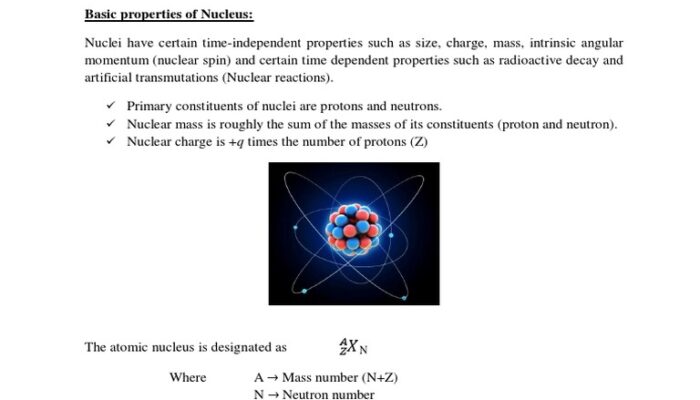
Nuclear physics is a branch of science dedicated to studying the core components of matter, focusing on the atomic nucleus-the dense center of an atom composed of protons and neutrons. These subatomic particles, collectively called nucleons, form the fundamental units that shape the universe’s matter. Understanding the nucleus involves exploring the forces and interactions that maintain its structure and govern its behavior.
Composition and Structure of the Atomic Nucleus
The nucleus serves as the atom’s central hub, containing positively charged protons and electrically neutral neutrons. Protons, akin to the sun in a miniature solar system, generate a repulsive electromagnetic force due to their positive charge. Neutrons, although uncharged, contribute significantly to the nucleus’s mass and help stabilize the structure by mitigating proton repulsion. The strong nuclear force, a powerful but short-range interaction, binds these nucleons tightly together, overcoming the electromagnetic forces that would otherwise push protons apart.
- Atomic Number:
Represents the count of protons in the nucleus, defining the chemical element. - Isotopes:
Variants of elements differing in neutron number, influencing nuclear stability and radioactive properties.
Fundamental Forces Governing Nuclear Stability
The stability of a nucleus depends largely on the balance between the strong nuclear force and electromagnetic repulsion. The strong force acts as a binding agent, holding nucleons together, while the electromagnetic force pushes protons apart. This delicate equilibrium determines whether a nucleus remains stable or undergoes radioactive decay.
Binding Energy and Nuclear Stability
Binding energy is the energy required to disassemble a nucleus into its individual protons and neutrons. It serves as a measure of nuclear stability, with higher binding energies indicating more stable nuclei. The binding energy per nucleon varies across elements, peaking near iron, which is the most stable nucleus. Elements lighter or heavier than iron tend to be less stable and more prone to radioactive decay.
Types of Nuclear Decay and Their Mechanisms
Unstable nuclei can transform through various decay processes, emitting particles or radiation to reach a more stable state:
- Alpha Decay:
Ejection of a helium nucleus (two protons and two neutrons), reducing the atomic number by two. - Beta Decay:
Conversion of a neutron into a proton or vice versa, accompanied by the emission of electrons or positrons. - Gamma Decay:
Release of high-energy electromagnetic radiation without changing the number of nucleons.
Quantum Chromodynamics and the Substructure of Nucleons
Delving deeper into the nucleus reveals that protons and neutrons themselves are composed of quarks, elementary particles bound by the strong interaction mediated by gluons. Quantum chromodynamics (QCD) is the theory describing these interactions, highlighting the complex and dynamic nature of nuclear matter at the most fundamental level.
Nuclear Models and Behavior Under Extreme Conditions
The nuclear liquid drop model conceptualizes the nucleus as a droplet of incompressible fluid, exhibiting properties such as surface tension and volume effects. This analogy helps explain phenomena like nuclear fission and fusion. In high-energy environments, such as particle accelerators or stellar cores, nuclei can fuse, releasing tremendous energy and synthesizing heavier elements-a process central to stellar nucleosynthesis.
Applications of Nuclear Physics in Medicine and Environmental Science
Nuclear physics has practical implications across various fields:
- Medical Treatments:
Radiotherapy utilizes radioactive isotopes to selectively destroy cancerous cells while minimizing damage to healthy tissue. - Environmental Studies:
Radioactive isotopes serve as tracers to study ecological processes and date archaeological artifacts. - Energy Production:
Nuclear reactions provide a powerful source of electricity through controlled fission and potential fusion technologies.
Common Misconceptions About Nuclear Physics
Nuclear energy is inherently unsafe.
While nuclear energy involves risks, stringent safety protocols and technological advancements have made it a reliable and clean energy source.
All radioactive decay is harmful.
Radioactive decay is a natural process, and controlled use of radioisotopes has beneficial applications in medicine and industry.
Significance of Nuclear Physics in Understanding the Universe
The study of atomic nuclei transcends mere particle analysis; it provides profound insights into the forces shaping matter and energy. By unraveling nuclear interactions, scientists gain a deeper understanding of elemental formation, cosmic evolution, and the fundamental principles governing the physical world. This knowledge not only advances technology but also enriches our comprehension of existence itself.
FAQ
What is a nucleus in nuclear physics?
A nucleus is the dense central core of an atom composed of protons and neutrons held together by the strong nuclear force.
What forces hold the nucleus together?
The strong nuclear force binds protons and neutrons tightly, overcoming the repulsive electromagnetic force between positively charged protons.
What causes nuclear decay?
Nuclear decay occurs when an unstable nucleus emits particles or radiation to reach a more stable state.
What role does quantum chromodynamics play in nuclear physics?
Quantum chromodynamics describes the interactions of quarks and gluons inside protons and neutrons, explaining the substructure of nucleons.
How is nuclear physics applied in medicine?
Nuclear physics is applied in radiotherapy for cancer treatment and in using radioactive isotopes as tracers in medical diagnostics.




Leave a Reply