
Short Answer
Definition of Leptons
Leptons are fundamental particles that form a crucial part of the Standard Model of particle physics. Characterized by their half-integer spin, these elementary particles are indivisible and not composed of smaller components. The lepton family includes six distinct particles: the electron, muon, tau, and their corresponding neutrinos-electron neutrino, muon neutrino, and tau neutrino. Each lepton type exhibits unique properties and plays a vital role in the structure and interactions of matter in the universe.
Classification and Properties
Leptons are organized into three generations, each consisting of a charged lepton and an associated neutrino:
- First Generation:
Electron (charged) and electron neutrino (neutral) - Second Generation:
Muon (charged) and muon neutrino (neutral) - Third Generation:
Tau (charged) and tau neutrino (neutral)
The charged leptons carry a negative electric charge, whereas neutrinos are electrically neutral, making them extremely difficult to detect due to their weak interaction with matter. This distinction highlights the different interaction mechanisms leptons undergo, primarily involving electromagnetic and weak nuclear forces.
Intrinsic Nature and Quantum Characteristics
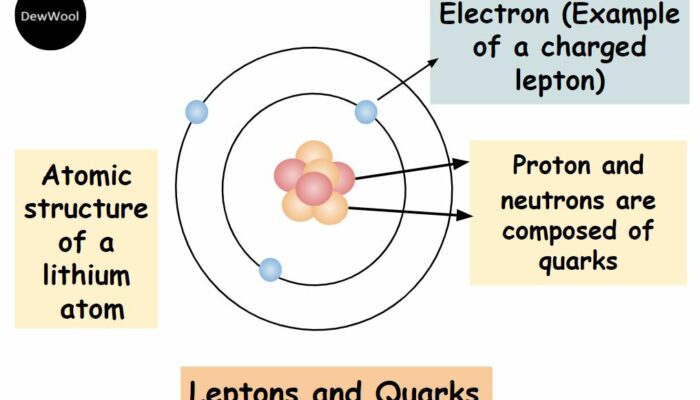
As point-like particles, leptons possess no internal structure or spatial dimensions in the classical sense. Unlike composite particles such as protons and neutrons, which are made up of quarks, leptons are elementary and indivisible. This fundamental nature means leptons cannot be broken down into smaller constituents and exhibit unique quantum behaviors. For example, the electron is stable and does not decay, a property essential for the formation of atoms and the existence of matter as we know it.
Lepton Interactions and Forces
Leptons interact through the weak nuclear force and, in the case of charged leptons, also via the electromagnetic force. Neutrinos, being electrically neutral, interact solely through the weak force, which accounts for their elusive nature and the nickname “ghost particles.” These interactions are critical in various physical processes, including radioactive decay and stellar phenomena.
Role of Leptons in Atomic and Subatomic Processes
Electrons are the most familiar leptons, serving as carriers of electric charge and mediators of electromagnetic interactions within atoms. Their behavior underpins the principles of chemistry and the complexity of biological systems. In contrast, muons and tau particles are heavier and unstable, decaying rapidly into lighter particles within microseconds, which illustrates the transient nature of higher-generation leptons.
Neutrinos: The Elusive Leptons
Neutrinos are unique leptons that interact very weakly with matter, making them difficult to detect. They play a pivotal role in nuclear processes such as beta decay, where a neutron transforms into a proton, emitting an electron and an antineutrino. Neutrinos are also fundamental in astrophysical phenomena, including the energy production in stars and nucleosynthesis, the process by which new atomic nuclei are created.
Mass Generation and the Higgs Mechanism
The masses of leptons arise through their interaction with the Higgs field, a fundamental concept in particle physics known as the Higgs mechanism. This interaction imparts mass to leptons, with each generation exhibiting vastly different mass values. Understanding why leptons have such diverse masses remains a significant question in the field, linked to the broader hierarchy problem in physics.
Neutrino Oscillations and Their Implications
One of the groundbreaking discoveries involving leptons is neutrino oscillation-the phenomenon where neutrinos switch between different types as they travel. This behavior implies that neutrinos possess mass, contradicting earlier assumptions within the Standard Model. The discovery of neutrino oscillations has profound implications, challenging existing theories and opening new avenues for exploring dark matter and the fundamental structure of the cosmos.
Conservation Laws and Symmetries in Lepton Physics
The conservation of lepton number is a fundamental principle stating that the total number of leptons remains constant in isolated systems. This conservation law is integral to many theoretical models but is subject to scrutiny in advanced theories that propose lepton number violation. Such violations could help explain phenomena like the matter-antimatter asymmetry observed in the universe.
Experimental Advances and Future Research
Modern particle accelerators, such as the Large Hadron Collider (LHC), provide powerful tools to investigate leptons and their interactions at unprecedented energy scales. These experiments aim to test the limits of the Standard Model and explore physics beyond it, potentially uncovering new particles or forces. Ongoing research continues to deepen our understanding of leptons and their role in the fundamental workings of the universe.
Significance of Leptons in Science and Technology
Leptons are indispensable to both theoretical and applied physics. Their properties and interactions form the foundation of atomic structure, chemistry, and many technological applications, including electronics and medical imaging. Moreover, studying leptons enhances our comprehension of the universe’s fundamental laws, bridging the gap between quantum mechanics and cosmology.
Summary
Leptons represent essential building blocks of matter, embodying simplicity and complexity simultaneously. Their elementary nature, diverse properties, and interactions reveal profound insights into the subatomic world and the universe’s fabric. By examining leptons, scientists continue to unravel the mysteries of particle physics, advancing our knowledge of the smallest constituents of reality and their cosmic significance.
FAQ
What are leptons?
Leptons are elementary particles that are fundamental constituents of matter, including electrons, muons, taus, and their neutrinos.
Are leptons made of smaller particles?
No, leptons are point-like and have no known substructure; they are not made of smaller particles.
What roles do leptons play in physics?
Leptons participate in fundamental interactions, contribute to atomic structure, and are essential in processes like beta decay.
How do leptons acquire mass?
Leptons acquire mass through their interaction with the Higgs field as described by the Higgs mechanism.
What is neutrino oscillation?
Neutrino oscillation is the phenomenon where neutrinos change between types, implying they have mass and challenging the Standard Model.






Leave a Reply