
Short Answer
Understanding Subatomic Particles
Imagine a puzzle where each piece not only fits together to form a picture but also exhibits unique behaviors and functions within a larger system. This analogy closely mirrors the structure of an atom, the fundamental unit of matter. At the core of this tiny universe are subatomic particles, each playing a vital role in defining the characteristics of elements. But what exactly are these particles, and how do they interact within the atom? This article explores the essential subatomic particles and their significance in the atomic framework.
Classification of Subatomic Particles
Subatomic particles are primarily divided into three well-known categories: protons, neutrons, and electrons. However, the realm of particle physics extends beyond these familiar components, encompassing additional fundamental particles that contribute to the atom’s complexity.
Protons: The Positive Core
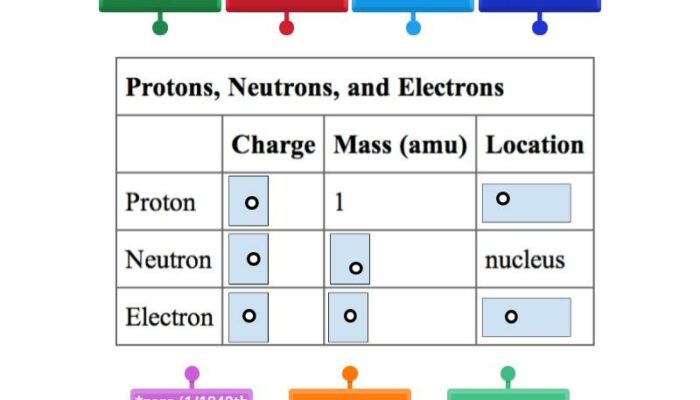
Protons are positively charged particles residing in the nucleus of an atom. Each proton carries a charge of +1 elementary charge and significantly contributes to the atom’s mass. The number of protons determines an element’s atomic number, which uniquely identifies the element. For example, hydrogen contains a single proton, making it the simplest element, whereas uranium has 92 protons, resulting in a much heavier and more complex atom. The quantity and presence of protons directly influence an element’s chemical behavior and reactivity.
Neutrons: The Neutral Stabilizers
Neutrons are electrically neutral particles also located within the nucleus alongside protons. Although they carry no charge, their mass is nearly equivalent to that of protons. Neutrons play a crucial role in stabilizing the nucleus by offsetting the repulsive forces between positively charged protons. The number of neutrons can vary within atoms of the same element, leading to different isotopes. These isotopes differ in nuclear stability, which affects their practical applications in fields such as medicine, archaeology, and nuclear energy.
Electrons: The Negative Orbiters
Electrons are negatively charged particles that orbit the nucleus at various energy levels. Each electron has a charge of -1 elementary charge, creating an electrostatic attraction with protons that helps maintain atomic stability. In a neutral atom, the number of electrons equals the number of protons, balancing the overall charge. Electrons are fundamental to chemical bonding, as they are shared or transferred between atoms, shaping the nature of chemical reactions and molecular structures.
Fundamental Constituents Beyond the Atom
Delving deeper into atomic structure reveals that protons and neutrons are not elementary particles themselves but are composed of even smaller entities known as quarks. Additionally, other fundamental particles such as leptons and bosons play critical roles in the subatomic world.
Quarks: Building Blocks of Protons and Neutrons
Quarks are elementary particles that combine in groups to form protons and neutrons. They possess unique properties, including fractional electric charges and a characteristic called color charge. There are six types, or “flavors,” of quarks: up, down, charm, strange, top, and bottom. The most common quarks in everyday matter are the up and down quarks, which assemble to create protons and neutrons. This layered complexity highlights the intricate nature of matter at the smallest scales.
Leptons: The Electron Family and Beyond
Leptons constitute another family of fundamental particles. The electron is the most familiar lepton, but this group also includes muons, tau particles, and their associated neutrinos. Neutrinos are particularly elusive, interacting very weakly with matter, which makes them difficult to detect. Despite their subtle presence, neutrinos are essential in nuclear processes such as beta decay, where a neutron transforms into a proton while emitting a neutrino. The study of leptons continues to reveal fascinating insights into particle physics.
Bosons: Force Carriers of the Universe
Bosons differ from the particles that make up matter; instead, they act as carriers of the fundamental forces that govern particle interactions. The photon is the most well-known boson, mediating electromagnetic forces. The W and Z bosons are responsible for the weak nuclear force, which plays a key role in radioactive decay. The Higgs boson, discovered in recent years, is crucial for imparting mass to particles, deepening our understanding of the universe’s fundamental structure.
The Interplay of Subatomic Particles
The subatomic realm is a dynamic interplay of various particles and forces. Each particle type-proton, neutron, electron, quark, lepton, and boson-contributes uniquely to the atom’s behavior and stability. This quantum dance challenges classical physics and opens doors to understanding the fundamental nature of reality.
Significance of Subatomic Particles
Studying subatomic particles is not merely an academic exercise; it is foundational to our comprehension of the universe. These particles explain the properties of all matter around us and underpin the forces that shape cosmic phenomena. Advances in this field drive technological innovation, medical breakthroughs, and deepen our philosophical understanding of existence. The ongoing exploration of the subatomic world promises to unveil new mysteries and inspire future generations of scientists.
FAQ
What are the three main subatomic particles?
The three main subatomic particles are protons, neutrons, and electrons.
What role do quarks play in atoms?
Quarks are the fundamental building blocks of protons and neutrons, combining in groups to form these particles.
What is the significance of leptons?
Leptons, such as electrons, are essential for chemical bonding and play significant roles in various nuclear processes.






Leave a Reply