
Short Answer
Definition of Dark Matter
Dark matter is a mysterious and invisible form of matter that constitutes approximately 27% of the universe’s total mass-energy content. Unlike ordinary matter, it does not emit, absorb, or reflect light, making it undetectable by conventional telescopes. Despite its invisibility, dark matter exerts a significant gravitational influence, shaping the structure and evolution of the cosmos.
- Invisible Substance:
Dark matter cannot be observed directly through electromagnetic radiation, rendering it undetectable by standard astronomical instruments. - Mass-Energy Contribution:
It accounts for over a quarter of the universe’s total mass-energy, vastly outweighing the ordinary matter that forms stars, planets, and living beings.
The Role of Dark Matter in Cosmic Structure
Dark matter acts as the fundamental gravitational framework that holds galaxies and larger cosmic structures together. Observations reveal that galaxies rotate at speeds that cannot be explained solely by the visible matter they contain. Without the gravitational pull of dark matter, these galaxies would disintegrate, as their stars and gas would be flung into space.
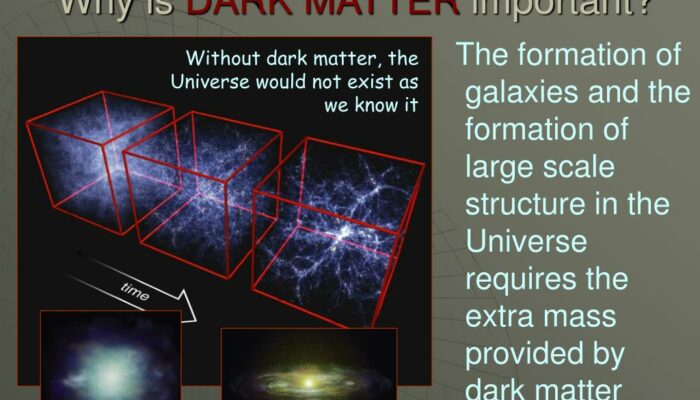
Moreover, dark matter forms an extensive cosmic web-a vast network of filaments and halos-upon which galaxies cluster and evolve. This web-like structure is essential for the aggregation of matter, facilitating the birth of stars, planets, and ultimately, life.

Galactic Stability and Dark Matter
The unexpectedly high rotational velocities of galaxies suggest the presence of an unseen mass. This “gravitational glue” provided by dark matter prevents galaxies from tearing apart, maintaining their spiral arms and overall integrity.
The Cosmic Web and Large-Scale Structure
On the grandest scales, dark matter organizes itself into a filamentary network that serves as the backbone for galaxy clusters. This scaffolding guides the distribution of visible matter, influencing the universe’s large-scale architecture.
Dark Matter and Cosmic Evolution
The universe is dynamic, continuously expanding and evolving over billions of years. Dark matter’s gravitational influence is a key driver in this cosmic evolution, shaping how matter coalesces and structures form. Without dark matter, the universe would lack the complex organization necessary for the formation of galaxies and planetary systems.
This unseen matter has played a pivotal role since the earliest epochs after the Big Bang, guiding the collapse of primordial gas clouds that eventually ignited into stars and galaxies.
Connection to Human Existence
Dark matter’s significance extends beyond abstract cosmology; it is intimately linked to the conditions that made life possible. The gravitational forces shaped by dark matter led to the formation of the Milky Way, the Sun, and Earth. Every atom in our bodies and every breath we take is a product of a universe sculpted by these invisible forces.
The stars that illuminate our skies are descendants of ancient clouds whose collapse was influenced by dark matter’s pervasive gravity, underscoring its role in the cosmic lineage that culminates in life on Earth.
Scientific Challenges and Exploration
The elusive nature of dark matter challenges existing physical theories and invites new scientific inquiry. Its detection remains one of the most profound quests in modern physics, driving innovation in experimental techniques and technology.
- Advanced Detection Methods:
Scientists employ underground particle detectors and space-based telescopes to search for indirect evidence of dark matter particles. - Expanding Theoretical Frameworks:
The mystery of dark matter encourages the development of new physics beyond the Standard Model, potentially revolutionizing our understanding of fundamental forces.
Philosophical and Perceptual Implications
Dark matter compels a reevaluation of what constitutes reality in the universe. Its invisibility highlights the limitations of human perception and challenges the assumption that all that exists can be directly observed.
Much like gravity was once an unseen force explained only through theory, dark matter represents a frontier where science meets philosophy, prompting deeper questions about the nature of existence and the unseen forces shaping it.
Dark Matter and the Fate of the Universe
Understanding dark matter is crucial for predicting the ultimate destiny of the cosmos. Its gravitational effects, in conjunction with dark energy and visible matter, influence whether the universe will expand indefinitely, accelerate towards a cold void, or eventually collapse.
Models of cosmic evolution rely heavily on the properties and distribution of dark matter to forecast the large-scale behavior of galaxies and the universe’s long-term trajectory.
Why Dark Matter Is Essential
Dark matter is fundamental to the cosmic narrative, bridging the gap between observable phenomena and hidden realities. It is integral to the formation and stability of the universe as we know it, directly impacting the conditions that allow life to exist.
Beyond its scientific importance, the study of dark matter embodies humanity’s enduring curiosity and drive to comprehend the unknown, expanding the horizons of knowledge and inspiring technological and philosophical advancements.
Summary
In essence, dark matter is more than a scientific enigma; it is a profound reminder of the unseen forces that govern the cosmos. Its presence shapes the universe’s structure, evolution, and fate, while its mystery fuels ongoing exploration and reflection on our place within the vast cosmic expanse.




Leave a Reply