
Short Answer
Definition of Dark Matter and Dark Energy
Dark matter and dark energy are two of the most mysterious and fundamental components of the universe, together accounting for about 95% of its total energy content. Despite their invisibility and elusiveness, they play crucial roles in shaping the cosmos.
- Dark Matter:
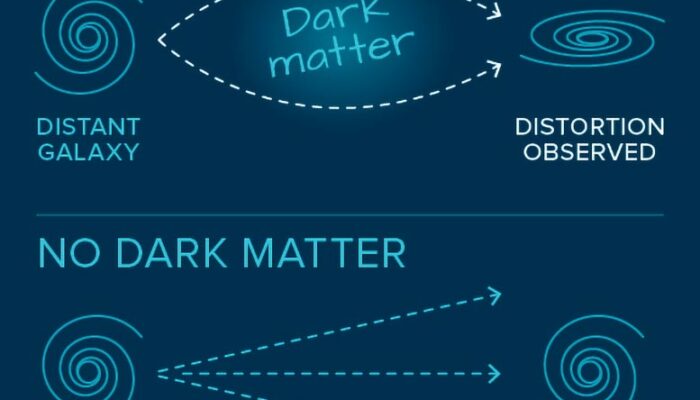
A form of matter that does not emit, absorb, or reflect light, making it undetectable by conventional telescopes. Its presence is inferred from gravitational effects on visible matter, radiation, and the large-scale structure of the universe. - Dark Energy:
A mysterious force responsible for the accelerated expansion of the universe, acting as a repulsive effect that counterbalances gravitational attraction on cosmic scales.
Distinct Roles in the Universe
While dark matter and dark energy appear to have contrasting influences, they are both essential to the universe’s evolution:
- Dark Matter’s Role:
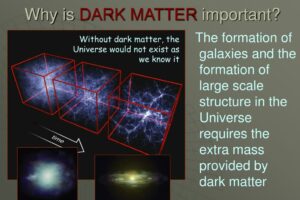
Constituting roughly 27% of the universe’s energy budget, dark matter acts as an invisible scaffold that provides the gravitational pull necessary for the formation and clustering of galaxies. - Dark Energy’s Role:
Making up about 68% of the universe, dark energy uniformly permeates space and drives the accelerated expansion of the cosmos, pushing spacetime apart.
Exploring the Interaction Hypothesis
Traditionally, dark matter and dark energy have been treated as independent phenomena. However, recent theoretical and observational developments suggest the possibility of a dynamic interaction between these two components, which could profoundly alter our understanding of cosmic evolution.

- Interaction Models:
Theories such as coupled quintessence propose that scalar fields mediate forces between dark matter particles and dark energy, allowing for energy or momentum exchange beyond gravitational effects. - Cosmological Implications:
Such interactions could modify the universe’s expansion history and affect the growth rate of cosmic structures, potentially resolving anomalies like the Hubble tension-the discrepancy in measured expansion rates from different observations.
Mechanisms Behind Dark Sector Coupling
In interacting dark sector models, dark matter and dark energy are linked through mechanisms that allow them to influence each other’s behavior:
- Energy Transfer:
Energy may flow between dark matter and dark energy, causing the density of dark energy to evolve differently than predicted by a simple cosmological constant. - Scalar Fields:
Fields such as quintessence or phantom energy can mediate forces that couple dark matter particles to dark energy, introducing new dynamics into cosmic evolution.
Observational Evidence and Data Analysis
Detecting interactions between dark matter and dark energy requires precise measurements and careful interpretation of cosmological data:
- Cosmic Microwave Background (CMB):
Variations in the temperature fluctuations of the CMB may carry subtle signatures of dark sector interactions. - Large-Scale Structure Surveys:
The distribution and growth patterns of galaxy clusters can reveal deviations from standard cosmological models indicative of coupling. - Supernova Luminosity Distances:
Observations of distant supernovae help trace the expansion history of the universe, potentially uncovering effects of dark sector interplay.
Significance of Dark Matter-Dark Energy Interaction
Understanding whether dark matter and dark energy interact is pivotal for several reasons:
- Cosmic Coincidence Problem:
Interaction models may explain why the densities of dark matter and dark energy are of similar magnitude today, a puzzling coincidence in standard cosmology. - Revised Cosmic Evolution:
Energy exchange could reshape the timeline of cosmic acceleration and structure formation, offering new insights into the universe’s past and future. - Implications for Particle Physics:
Interactions might hint at new fundamental forces or particles beyond the Standard Model, bridging cosmology with particle physics and inspiring novel experimental searches.
Challenges and Theoretical Constraints
Despite its promise, the hypothesis of dark matter-dark energy interaction faces significant obstacles:
- Observational Precision:
Detecting subtle interaction effects demands highly sensitive instruments and sophisticated data analysis techniques to separate signals from astrophysical noise. - Theoretical Consistency:
Models must comply with fundamental physical principles such as energy conservation and causality, limiting the range of viable interaction scenarios. - Computational Complexity:
Accurately simulating coupled dark sectors requires advanced numerical methods to predict observable consequences reliably.
Common Misconceptions About Dark Sector Interactions
Dark matter and dark energy are completely unrelated and cannot influence each other.
Emerging theories and data suggest possible interactions that could affect cosmic dynamics and structure formation.
Dark energy is simply a cosmological constant with no evolution.
Interaction models propose that dark energy density may change over time due to energy exchange with dark matter.
Future Prospects and Scientific Impact
The investigation into dark matter-dark energy interactions is a frontier of modern cosmology, with the potential to revolutionize our understanding of the universe:
- New Observatories:
Upcoming space missions and ground-based telescopes will provide higher precision data to test interaction models. - Theoretical Advances:
Improved models may unify cosmological observations with particle physics, offering a more comprehensive picture of fundamental forces. - Philosophical Implications:
Recognizing dark matter and dark energy as dynamic, interconnected components challenges traditional views of the cosmos as a static backdrop, highlighting a complex, evolving universe.




Leave a Reply