
Short Answer
Definition of the Early Universe
The early universe refers to the initial stages of cosmic history, a period marked by rapid and profound transformations that laid the groundwork for all matter and structure observed today. This epoch encompasses the moments immediately following the universe’s origin, characterized by extreme conditions and the formation of fundamental particles and elements. Understanding this era is essential for grasping the origins and evolution of the cosmos.
The Big Bang: Origin of the Universe
The Big Bang is the foundational event that signifies the birth of the universe, occurring approximately 13.8 billion years ago. Rather than a conventional explosion, it represents a swift expansion of spacetime itself from an initial state of infinite density and temperature known as a singularity. This expansion can be likened to the inflation of a balloon, where every point moves away from every other point, although this analogy simplifies the complex nature of the event.
Inflationary Epoch and Its Significance
Shortly after the Big Bang, the universe underwent a brief but dramatic phase called cosmic inflation, during which it expanded exponentially within fractions of a second. This rapid growth smoothed out irregularities and set the stage for the formation of large-scale cosmic structures such as galaxies and clusters. The inflationary period is thought to be driven by a hypothetical inflationary field, fundamentally altering our understanding of the universe’s early fabric.
Formation of Fundamental Particles and Elements
In the first few seconds after the Big Bang, the universe was an extremely hot and dense environment where elementary particles combined to form protons and neutrons. These nucleons later participated in Big Bang Nucleosynthesis, a critical phase during which the simplest atomic nuclei-primarily hydrogen and helium-were synthesized. This process established the elemental foundation necessary for the subsequent development of stars, planets, and ultimately life.
Cosmic Microwave Background Radiation
As the universe expanded and cooled, photons decoupled from matter during the recombination epoch, allowing electrons and protons to form neutral hydrogen atoms. This event produced the Cosmic Microwave Background (CMB), a faint, uniform radiation detectable in every direction. The CMB serves as a crucial observational pillar supporting the Big Bang theory, providing a snapshot of the universe approximately 380,000 years after its inception.
Dark Matter and Dark Energy: The Invisible Components
While visible matter forms stars and galaxies, the early universe’s evolution was heavily influenced by dark matter and dark energy-two mysterious constituents that remain undetectable through direct electromagnetic observation. Dark matter exerts gravitational effects that help shape galactic structures, whereas dark energy drives the accelerated expansion of the universe. Together, they compose the majority of the universe’s total mass-energy content and are fundamental to understanding cosmic evolution.
Technological Advances in Observing the Early Universe
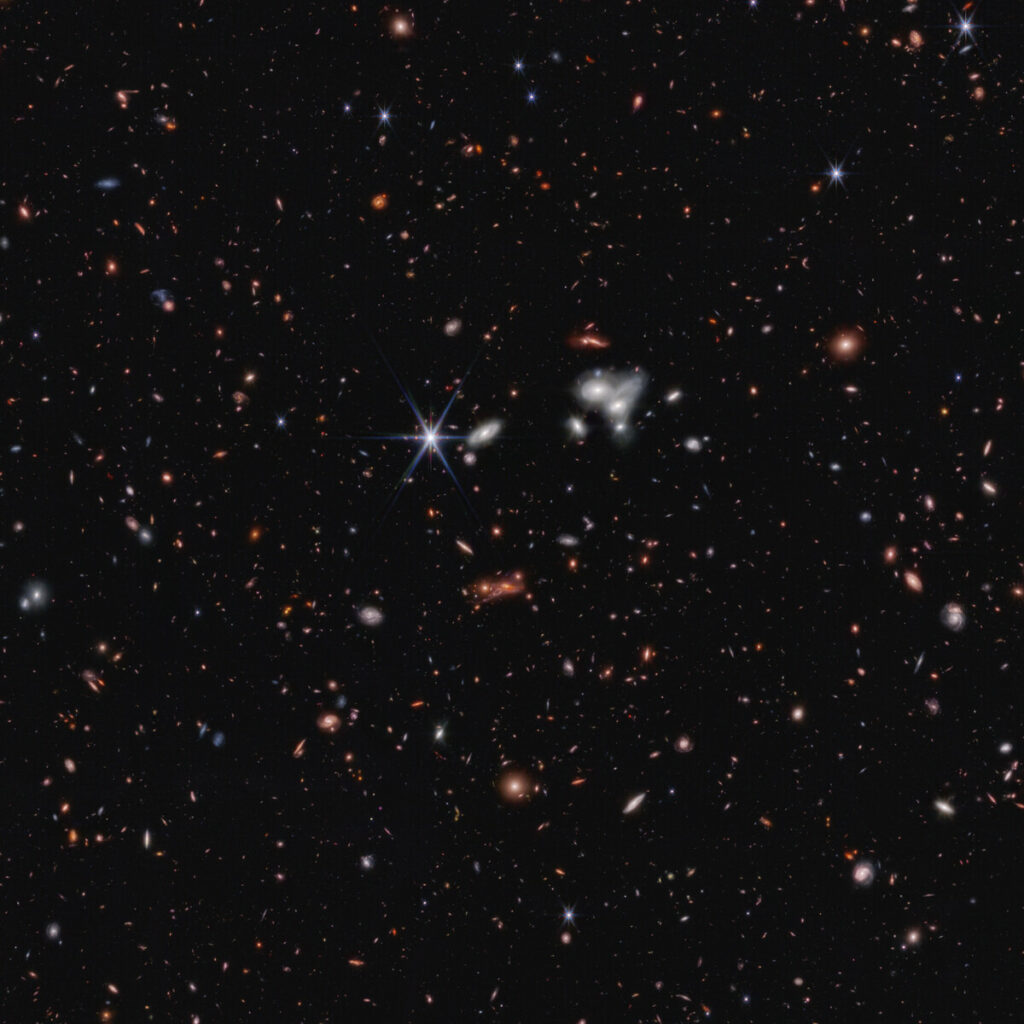
Modern telescopes and space observatories, such as the Hubble Space Telescope and the James Webb Space Telescope, act as time machines by capturing light from galaxies billions of light-years away. These observations allow scientists to study galaxies in their infancy, revealing details about their formation, growth, and the environmental factors influencing their development. Such data continuously refine our cosmological models and deepen our insight into the universe’s early stages.
Philosophical Reflections on Cosmic Origins
Exploring the early universe extends beyond scientific inquiry, inviting profound philosophical contemplation about existence, reality, and humanity’s place in the cosmos. Each discovery-from subatomic particles to cosmic radiation-illustrates the intricate interplay of forces shaping the universe. This pursuit of knowledge not only expands our scientific horizons but also enriches our understanding of the fundamental nature of reality and our connection to the vast cosmic expanse.
Why Studying the Early Universe Is Important
Investigating the early universe is vital for multiple reasons. It provides critical insights into the fundamental laws of physics, the origin of matter, and the processes that led to the formation of galaxies and life-supporting planets. Moreover, understanding cosmic inflation, nucleosynthesis, and dark components informs technologies and theories in astrophysics and cosmology, driving innovation and expanding humanity’s comprehension of the universe’s past, present, and future.
FAQ
What is the early universe?
The early universe refers to the initial stages of cosmic history, marked by extreme conditions and the formation of fundamental particles and elements.
Why is the study of the early universe important?
Studying the early universe provides insights into the fundamental laws of physics, the origin of matter, and the processes leading to the formation of galaxies and life.


Leave a Reply