
Short Answer
Definition of the Bullet Cluster
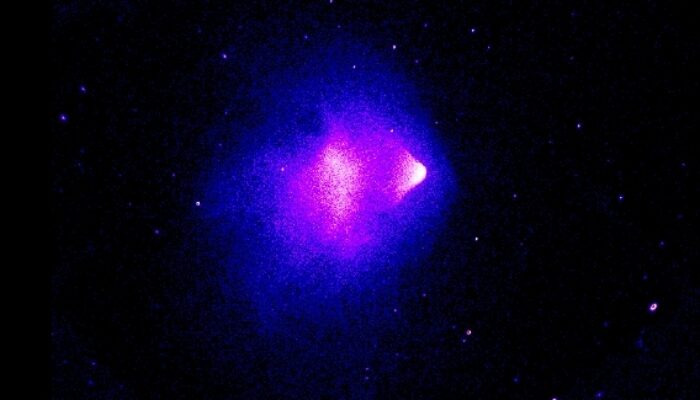
The Bullet Cluster is a remarkable astronomical system formed by the collision of two galaxy clusters. This cosmic event is not only visually striking but also serves as a critical piece of evidence in the study of dark matter. It represents a unique natural laboratory where the interaction between ordinary matter and dark matter can be observed and analyzed separately, providing insights into the fundamental composition of the universe.
Composition and Structure
The Bullet Cluster consists of two galaxy clusters that have recently collided, approximately 150 million years ago in cosmic terms. It contains three primary components:
- Galaxies:
These are the visible, luminous bodies composed of stars and other ordinary matter, which largely pass through each other during the collision due to the vast distances between them. - Hot Gas:
Detected through X-ray observations, this extremely hot plasma constitutes the majority of the ordinary (baryonic) matter in the cluster and behaves differently from the galaxies during the collision, slowing down due to friction. - Dark Matter:
An invisible form of matter that neither emits nor absorbs light, inferred from gravitational effects rather than direct observation. It forms the dominant mass component in the cluster and interacts weakly with both ordinary matter and itself.
How the Bullet Cluster Reveals Dark Matter
The Bullet Cluster provides compelling evidence for dark matter through the phenomenon of gravitational lensing. This effect occurs when the gravity of a massive object bends the light from more distant background sources, allowing astronomers to map the total mass distribution regardless of its visibility.
In the Bullet Cluster, gravitational lensing maps show that the majority of the mass is concentrated around the galaxies rather than the hot gas. This spatial offset indicates that most of the cluster’s mass is in a form that does not interact electromagnetically-dark matter-since the hot gas, which contains most of the ordinary matter, is displaced from the gravitational center.
Collision Dynamics and Dark Matter Behavior
The collision between the two clusters offers a rare glimpse into the behavior of dark matter under extreme conditions. Unlike the hot gas, which experiences drag and slows down, dark matter appears to pass through the collision unaffected, suggesting it interacts very weakly with itself and ordinary matter. This observation helps constrain the properties of dark matter particles, supporting candidates such as weakly interacting massive particles (WIMPs) or axions.
Scientific Significance and Challenges to Alternative Theories
The Bullet Cluster challenges alternative explanations for cosmic phenomena, such as Modified Newtonian Dynamics (MOND), which propose changes to gravitational laws instead of invoking dark matter. The clear separation between visible matter and gravitational mass in the Bullet Cluster cannot be easily explained without the presence of non-luminous matter, reinforcing the dark matter hypothesis.
Implications for Cosmology and Particle Physics
The insights gained from studying the Bullet Cluster extend beyond astrophysics, influencing cosmological models and particle physics theories. It highlights the dominance of dark matter in the universe’s mass budget and guides the search for its fundamental nature. Understanding dark matter is crucial for explaining galaxy formation, cosmic structure, and the ultimate fate of the universe.
Common Misconceptions About the Bullet Cluster
The Bullet Cluster is just a visual spectacle with no scientific importance.
While visually dramatic, it provides one of the most direct and robust pieces of evidence for dark matter’s existence and properties.
Dark matter interacts strongly with ordinary matter.
Observations show dark matter interacts very weakly, passing through collisions with minimal friction or drag.
Modified gravity theories can fully explain the Bullet Cluster observations.
The spatial separation of mass and visible matter in the Bullet Cluster is difficult to reconcile without dark matter, posing a significant challenge to such theories.
Why the Bullet Cluster Matters
The Bullet Cluster stands as a pivotal discovery in modern astrophysics, symbolizing a breakthrough in our understanding of the universe’s hidden components. It provides tangible, empirical evidence that dark matter is a real and dominant force shaping cosmic structures. This knowledge not only advances scientific inquiry but also reshapes our philosophical perspective on the universe, revealing that the visible matter we observe is only a small fraction of the total cosmic mass.
Real-World Analogies and Broader Context
To appreciate the Bullet Cluster’s significance, consider it as a cosmic “crime scene” where the evidence left behind allows scientists to deduce the presence of an invisible culprit-dark matter. Just as forensic experts reconstruct events from physical clues, astrophysicists use gravitational lensing and X-ray data to map unseen mass. This approach has broad implications, influencing technologies such as gravitational wave detection and informing the design of particle detectors searching for dark matter candidates on Earth.
FAQ
What is the Bullet Cluster?
The Bullet Cluster is a system formed by the collision of two galaxy clusters, providing critical evidence for the existence of dark matter.
How does the Bullet Cluster support dark matter theory?
It shows a spatial offset between visible matter and gravitational mass, indicating the presence of dark matter.
What are the main components of the Bullet Cluster?
The main components include galaxies, hot gas, and dark matter.


Leave a Reply