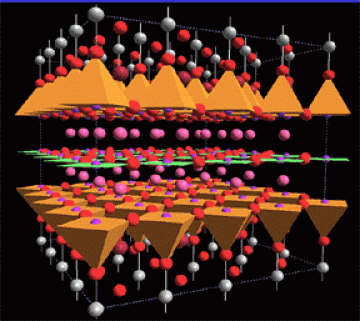
Why Superconductors Can’t Stand the Heat – Yet

The phenomenon of superconductivity presents one of the most intriguing areas of contemporary condensed matter physics. Superconductors exhibit the remarkable ability to conduct electric current without resistance when cooled below a characteristic critical temperature. Nevertheless, a significant limitation persists: conventional superconductors cannot withstand elevated temperatures. This article delves into the intricacies of superconductivity, elucidating the […]

Read More →

Directory of Radiotherapy Physics?

Radiotherapy physics is a specialized field at the intersection of physics, medicine, and health technology. This discipline plays a pivotal role in the treatment of cancer patients through the application of ionizing radiation to malignancies. With the rapid advancement in medical technology and an increasing understanding of oncological requirements, the domain of radiotherapy physics continues […]

Read More →

Can particle physics be proven without using mathematics?

Particle physics represents a frontier of scientific inquiry that seeks to unravel the fundamental constituents of matter and the forces governing their interactions. Engaging with concepts such as quarks, leptons, and the Higgs boson fascinates both scientists and enthusiasts alike. Yet, an intriguing and somewhat perplexing question persists: can the principles and phenomena of particle […]

Read More →

How to find a good research topic in physics?

Choosing a research topic in physics is a task that can instill both excitement and trepidation among budding researchers. The realm of physics is vast, encompassing everything from quantum mechanics to astrophysics, and emerging fields such as quantum computing and dark matter studies. Navigating through this expansive territory necessitates a systematic approach to identify a […]

Read More →

What’s your favorite introductory quantum field theory book?

When musing upon the vast cosmos that Quantum Field Theory (QFT) inhabits, one finds themselves confronted with an almost paradoxical challenge: the intricate yet alluring landscape of theoretical physics is peppered with esoteric concepts that can enthrall the curious mind, while simultaneously daunting the uninitiated. Therefore, a ponderous question emerges: What is your favorite introductory […]

Read More →

What is a particle collider and how does it work?

Particle colliders, sophisticated instruments at the frontier of high-energy physics, serve as windows into the fundamental constituents of the universe. They enable scientists to probe subatomic particles at unprecedented energy scales, thereby illuminating the fundamental forces and interactions that govern matter. The mechanisms of particle colliders are complex, integrating advanced technology, innovative engineering, and theoretical […]

Read More →

How is physics related to medicine?

Physics and medicine, two seemingly distinct disciplines, share an intricate and multifaceted relationship that has evolved over centuries. This interplay manifests through various applications, from diagnostic tools to therapeutic interventions, all grounded in fundamental physical principles. The admiration for this intricate relationship may stem from the profound impact that a deeper understanding of physics can […]

Read More →

Physics of Ice Shelf Collapse: A Meltdown Model Emerges

The phenomenon of ice shelf collapse has garnered increasing attention in the scientific community, raising urgent questions about global climate dynamics and its implications. Ice shelves, the floating extensions of glaciers, play a pivotal role in stabilizing land-based ice masses. This piece explores the intricate framework of physics underlying ice shelf collapse, a subject that […]

Read More →

Is neuroscience a logical area of research for a physicist?

The intersection of neuroscience and physics presents a captivating area of inquiry, inviting exploration from multiple scientific disciplines. As researchers seek to unravel the complexities of the human brain, the principles of physics can significantly enhance understandings of neurological functions and dysregulations. This examination posits that neuroscience is not only a logical area of research […]

Read More →

What is the ‘strong nuclear force’ in physics?

The quest to elucidate the intricacies of atomic structure invariably guides us into the realm of fundamental forces. Among these forces, the strong nuclear force—also known as the strong interaction—emerges as the paramount agent binding protons and neutrons in the nucleus. This force is indispensable for the stability of matter and influences various phenomena in […]

Read More →