Where does the energy in a nuclear reaction come from?

Definition of Nuclear Energy Nuclear energy refers to the power released during nuclear reactions, which involve changes in an atom’s nucleus. This energy originates from the conversion of mass into energy, a concept fundamentally described by Einstein’s mass-energy equivalence formula, E=mc². This principle underpins the understanding of how nuclear processes generate vast amounts of energy […]

Read More →

What exactly is nuclear physics?

Definition of Nuclear Physics Nuclear physics is a specialized area within physics dedicated to studying the components, behaviors, and interactions of atomic nuclei. This discipline combines theoretical models with experimental techniques to explore nuclear phenomena, which have significant implications ranging from fundamental scientific understanding to practical applications in energy generation and healthcare. Central to nuclear […]

Read More →

Is nuclear physics hard to learn?

Definition of Nuclear Physics Nuclear physics is a specialized branch of physics focused on studying the components and interactions within atomic nuclei. It explores the behavior, structure, and forces that govern protons and neutrons-the nucleons-inside the nucleus. This field encompasses a wide range of phenomena including nuclear reactions, radioactive decay, and the fundamental forces that […]

Read More →

How is a nuclear weapon activated?

Definition of Nuclear Weapons Nuclear weapons are highly advanced military devices that harness the immense energy released from atomic nuclei to produce devastating explosions. These weapons operate based on the nuclear reactions of fission and fusion, which release extraordinary amounts of energy. Their activation involves complex scientific principles and engineering techniques that enable the controlled […]

Read More →

Can I start nuclear physics before atomic physics in class 12?

Definition of Atomic and Nuclear Physics Atomic physics and nuclear physics are two closely related branches of physics that explore the fundamental components of matter, yet they focus on different scales and phenomena within the atom. Atomic Physics: This field investigates the structure and behavior of atoms, primarily focusing on electrons, protons, and neutrons. It […]

Read More →

Who is the father of nuclear physics?

Definition Ernest Rutherford, often hailed as the “Father of Nuclear Physics,” was a pioneering scientist whose research fundamentally transformed our understanding of the atomic nucleus. His work laid the cornerstone for modern nuclear physics by revealing the structure of the atom and the nature of radioactive phenomena. Early Life and Academic Background Born in 1871 […]

Read More →

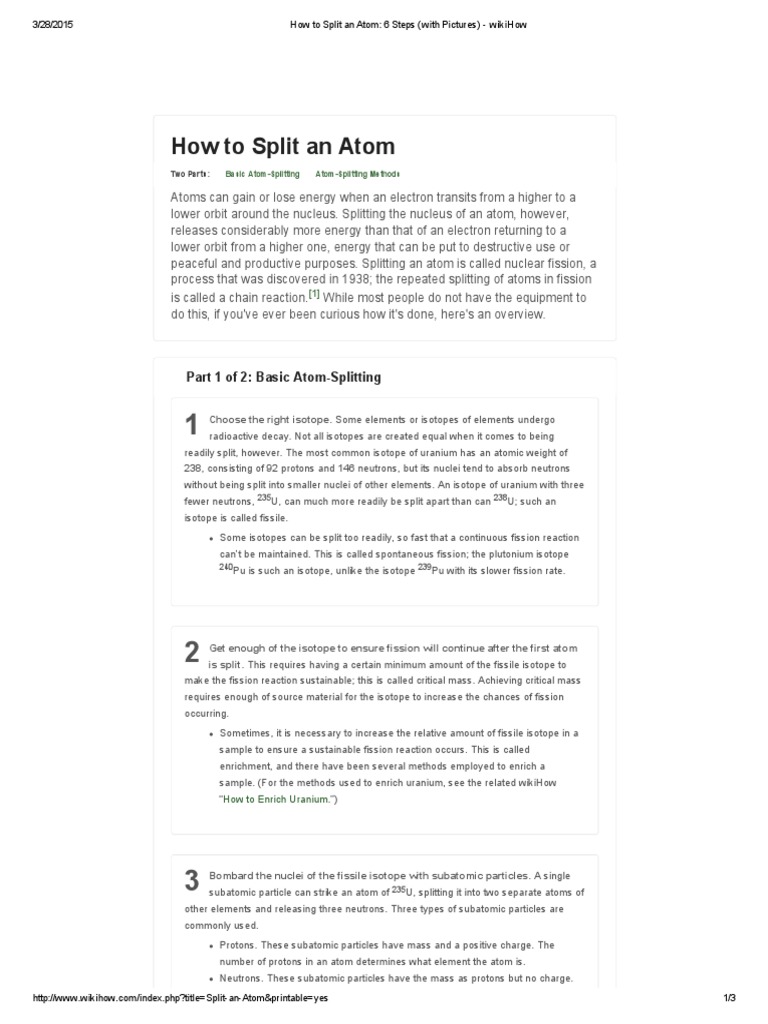
How to slice an atom?

Understanding the Atom: Structure and Composition Atoms, once thought to be the smallest indivisible units of matter, are now known to possess a complex internal architecture. At the center lies the nucleus, a dense core composed of protons and neutrons, which contains nearly all the atom’s mass. Surrounding this nucleus are electrons orbiting in defined […]

Read More →

What are nuclear forces?

Definition of Nuclear Forces Nuclear forces, also known as nuclear interactions, are the fundamental forces responsible for the behavior and stability of subatomic particles within atomic nuclei. These forces govern how protons and neutrons-collectively called nucleons-interact and bind together, shaping the structure and properties of atomic nuclei. Understanding nuclear forces is essential for explaining phenomena […]

Read More →

What is the scope of a degree in Nuclear Physics?

Definition of Nuclear Physics Nuclear Physics is a specialized branch of physics dedicated to studying the components and interactions within atomic nuclei. This field delves into the fundamental particles that constitute the nucleus, such as protons and neutrons, and explores the forces that govern their behavior. It bridges theoretical frameworks with practical applications, making it […]

Read More →

Which real life phenomenon is related to nuclear physics?

Definition of Nuclear Physics Nuclear physics is a specialized branch of physics focused on studying the properties, behaviors, and interactions of atomic nuclei. It investigates the forces and particles within the nucleus, providing critical insights into the fundamental structure of matter. This field extends beyond theoretical research, influencing numerous practical applications and natural phenomena. Atomic […]

Read More →