
Short Answer
Definition of Space and Ground Telescopes
Telescopes are optical instruments designed to observe distant celestial objects by collecting and magnifying light. They serve as vital tools in astronomy, enabling humans to explore the universe beyond the naked eye’s reach. These instruments are broadly categorized based on their location: space telescopes, which operate outside Earth’s atmosphere, and ground-based telescopes, which are situated on Earth’s surface.
- Space Telescopes:
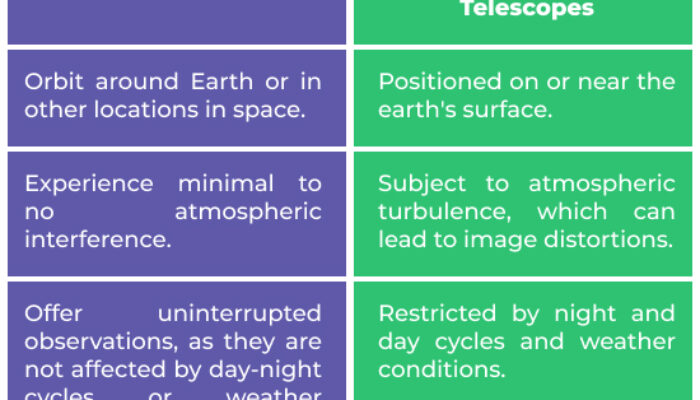
Positioned in orbit or deep space, these telescopes avoid atmospheric interference, providing clearer and broader wavelength observations. - Ground Telescopes:
Installed on Earth, often at high altitudes and remote locations, these telescopes contend with atmospheric effects but benefit from easier maintenance and upgrades.
Impact of Earth’s Atmosphere on Astronomical Observations
Earth’s atmosphere, while essential for sustaining life, poses significant challenges for astronomical imaging. It acts as a turbulent medium that refracts, absorbs, and scatters incoming light from celestial sources, leading to blurred and distorted images. This atmospheric distortion limits the resolution and clarity achievable by ground-based telescopes.
- Atmospheric Turbulence:
Causes stars to twinkle and images to blur, reducing observational precision. - Light Absorption and Scattering:
Certain wavelengths, such as ultraviolet and infrared, are partially or fully blocked by atmospheric gases. - Adaptive Optics:
A technology developed to counteract atmospheric distortion by dynamically adjusting telescope mirrors in real time, improving image sharpness but increasing system complexity and cost.
Advantages of Space Telescopes
Operating beyond the confines of Earth’s atmosphere, space telescopes enjoy an unobstructed view of the cosmos. This unique vantage point allows them to capture high-resolution images across a wide spectrum of electromagnetic radiation, including ultraviolet, visible, and infrared wavelengths that are otherwise absorbed or scattered by the atmosphere.
- Unhindered Wavelength Access:
Enables observation of phenomena invisible to ground-based instruments, such as ultraviolet emissions from young stars. - Stable Observing Conditions:
Free from weather, daylight, and atmospheric fluctuations, allowing continuous monitoring of transient cosmic events. - Enhanced Image Clarity:
Absence of atmospheric distortion results in sharper, more detailed images.
Challenges Faced by Space Telescopes
Despite their observational advantages, space telescopes encounter significant operational and logistical hurdles. Launching and deploying these instruments require enormous financial investment and precise engineering to withstand the harsh environment of space, including extreme temperatures and radiation exposure.
- High Launch Costs:
Transporting telescopes into orbit demands substantial resources and complex mission planning. - Limited Maintenance Opportunities:
Unlike ground telescopes, servicing space telescopes is difficult and rare, with missions like Hubble’s servicing being exceptional cases. - Finite Operational Lifespan:
Once deployed, space telescopes must function autonomously until their technology becomes outdated or mechanical failures occur.
Benefits and Limitations of Ground-Based Observatories
Ground-based telescopes offer flexibility and scalability that space telescopes cannot match. Their locations can be strategically selected to optimize atmospheric conditions, and they can be regularly maintained, upgraded, and expanded to incorporate the latest technological advancements.
- Ease of Maintenance and Upgrades:
Instruments can be repaired, replaced, or enhanced to extend operational life and improve capabilities. - Strategic Site Selection:
High-altitude, dry, and remote locations like the Atacama Desert and Mauna Kea minimize atmospheric interference. - Larger Aperture Sizes:
Ground telescopes can have massive mirrors, such as those planned for the Extremely Large Telescope (ELT) and Thirty Meter Telescope (TMT), enabling greater light collection and higher resolution. - Atmospheric Limitations:
Despite adaptive optics, atmospheric effects cannot be entirely eliminated, limiting some observational precision.
Specialized Observations: Infrared and Temporal Monitoring
Certain astronomical studies are uniquely suited to either space or ground telescopes due to environmental factors. Infrared astronomy, for example, benefits greatly from space-based platforms because Earth’s warm atmosphere emits infrared radiation that interferes with sensitive detectors.
- Infrared Astronomy in Space:
Space telescopes like the James Webb Space Telescope use cryogenically cooled instruments to detect faint infrared signals, revealing early star and planet formation processes. - Continuous Observation Capability:
Space telescopes can observe celestial events without interruption from daylight or weather, crucial for studying variable stars, supernovae, and transient phenomena. - Ground-Based Temporal Constraints:
Observations from Earth are limited by weather, daylight, and atmospheric changes, which can fragment data collection.
Collaborative Strengths of Ground-Based Networks
Ground observatories excel in their ability to rapidly respond to new astronomical events and coordinate with global networks. This flexibility supports multi-messenger astronomy, integrating data from electromagnetic signals, neutrinos, and gravitational waves to deepen understanding of complex cosmic phenomena.
- Rapid Reorientation:
Ground telescopes can quickly adjust to observe transient events like gamma-ray bursts or gravitational wave sources. - Global Coordination:
Networks of terrestrial observatories collaborate to provide comprehensive coverage and data sharing. - Multi-Messenger Astronomy:
Combining diverse observational methods enhances the study of astrophysical processes.
Complementary Roles and Synergy Between Space and Ground Telescopes
The relationship between space and ground telescopes is not competitive but synergistic. Each type of observatory compensates for the other’s limitations, creating a comprehensive system that advances astronomical research. Data integration from both sources enriches scientific discoveries and broadens our cosmic perspective.
- Data Fusion:
Combining high-resolution space imagery with the large collecting area and adaptability of ground telescopes enhances observational power. - Technological Innovation:
Developments in one domain often inspire improvements in the other, driving overall progress in astronomy. - Expanded Scientific Reach:
Together, they enable exploration across the electromagnetic spectrum and diverse astrophysical phenomena.
Significance of Telescopic Exploration in Human Understanding
The pursuit of astronomical knowledge through telescopes reflects humanity’s enduring curiosity and desire to comprehend our place in the universe. Whether stationed on Earth or orbiting in space, telescopes serve as extensions of human vision, unlocking the mysteries of the cosmos and inspiring wonder across cultures and generations.
Neither space nor ground telescopes alone can claim supremacy; instead, their combined efforts illuminate the vastness of the night sky, fostering discovery and expanding the horizons of scientific understanding.

Leave a Reply