

Short Answer
Understanding the Cosmic Enigma
The universe’s immense scale has captivated human curiosity for millennia, inspiring both wonder and scientific investigation. Despite monumental advances in astronomy and physics, the fundamental nature of the cosmos remains largely elusive. While breakthroughs such as the discovery of gravity’s role and the detection of cosmic microwave background radiation have deepened our knowledge, they also highlight how much remains beyond our comprehension. The universe presents a complex puzzle, inviting a paradigm shift that could revolutionize cosmology and our understanding of existence itself.
Composition of the Universe: Dark Matter and Dark Energy
Central to this cosmic mystery is the fact that about 95% of the universe is made up of dark matter and dark energy-two phenomena that defy conventional detection and understanding.
- Dark Matter:
This invisible substance is inferred from its gravitational influence on visible matter, shaping galaxy formation and rotation, and structuring the large-scale cosmic web. Despite extensive research, its true nature remains unknown, as it neither emits nor absorbs light. - Dark Energy:
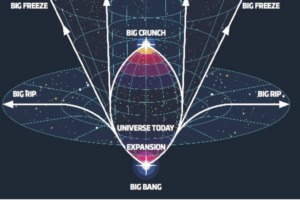
Accounting for roughly 68% of the universe’s total energy, dark energy is a mysterious force driving the accelerated expansion of the cosmos. It exerts a repulsive effect that counters gravity on vast scales, challenging existing physical theories and suggesting gaps in our understanding of fundamental laws.
Additional Cosmic Mysteries
Beyond dark matter and dark energy, several other profound questions continue to puzzle scientists:
- Cosmic Inflation:
A rapid exponential expansion that occurred moments after the Big Bang, cosmic inflation’s origins and mechanisms remain speculative, with no definitive evidence pinpointing the responsible fields or forces. - Neutrino Properties:
These nearly massless, weakly interacting particles exhibit oscillations and behaviors that complicate the standard model of particle physics, posing ongoing challenges to researchers.
Limitations of Current Theories
While the standard model of particle physics has been remarkably successful in explaining many phenomena, it falls short in several key areas:
- It does not incorporate gravity at the quantum level, leaving the quest for a unified theory-such as quantum gravity or a “theory of everything”-incomplete.
- This theoretical gap underscores the need for revolutionary scientific approaches and new frameworks to fully describe the universe’s workings.
The Significance of Cosmic Unknowns
The vast gaps in our cosmic knowledge are not mere obstacles but powerful motivators for scientific inquiry. They remind us that our current understanding is provisional and that reality is far richer than our present tools and theories reveal. Each unresolved question-from the essence of dark matter to the nature of dark energy’s acceleration-invites a reevaluation of assumptions and openness to novel ideas.
Interdisciplinary Efforts and Technological Advances
The pursuit of answers to these cosmic puzzles fosters collaboration across multiple scientific disciplines, including astrophysics, particle physics, mathematics, and philosophy. Cutting-edge instruments have been developed to probe these mysteries more deeply:
- James Webb Space Telescope:
Designed to observe the universe in unprecedented detail, enabling insights into early cosmic history and structure formation. - Underground Particle Detectors:
Facilities aimed at detecting rare particle interactions that could reveal the nature of dark matter. - Neutrino Observatories:
Specialized detectors that study neutrino properties and behaviors to refine our understanding of fundamental particles.
These tools not only enhance our observational capabilities but also highlight the complexity of the universe, as each discovery often leads to new questions.
Philosophical and Scientific Implications
Recognizing how little we truly know about the cosmos encourages a shift from viewing it as a solved puzzle to appreciating it as a dynamic, evolving mystery. This perspective has profound implications:
- It fosters openness to paradigm shifts in scientific thought.
- It acknowledges that the universe may be far stranger and more intricate than previously imagined.
- It inspires philosophical reflection on the nature of reality, existence, and the ultimate fate of the cosmos.
Speculative Questions and the Drive for Discovery
The unknown aspects of the universe stimulate imagination and scientific exploration alike. Some of the compelling questions include:
- Could dark matter consist of exotic, yet-undiscovered particles?
- Is dark energy a manifestation of new dimensions or unknown fields beyond current physics?
Though definitive answers remain out of reach, these inquiries fuel ongoing research and inspire future generations of scientists and thinkers.
The Universe as a Frontier of Knowledge
Far from being a static backdrop, the cosmos represents a vibrant frontier filled with profound mysteries and boundless potential. It challenges human cognition and technological innovation, urging us to rethink fundamental concepts and expand the horizons of understanding. The promise of future discoveries acts as a guiding light, illuminating a path filled with both challenges and opportunities for transformative insights.
Conclusion: Embracing the Cosmic Unknown
The universe’s complexity and inscrutability embody both limitations and opportunities. While many questions remain unanswered, these mysteries drive scientific progress and human curiosity. As new data and analytical methods emerge, the veil obscuring much of the cosmos may gradually lift, revealing previously unimaginable dimensions of reality. Embracing these profound gaps fosters a mindset that values wonder alongside certainty and questions alongside answers, underscoring humanity’s enduring quest to comprehend a universe far more intricate and mysterious than we currently perceive.
FAQ
What is dark matter?
Dark matter is an invisible substance that makes up about 27% of the universe, inferred from its gravitational effects on visible matter.
What role does dark energy play in the universe?
Dark energy is believed to account for approximately 68% of the universe’s energy, driving its accelerated expansion.
What is cosmic inflation?
Cosmic inflation refers to a rapid exponential expansion of the universe that occurred just after the Big Bang, whose exact mechanism remains speculative.


Leave a Reply