
Short Answer
Definition of Dark Matter
Dark matter is a mysterious and invisible form of matter that does not emit, absorb, or reflect light, making it undetectable by conventional telescopes. Despite its elusive nature, it constitutes the majority of the universe’s mass and plays a crucial role in shaping cosmic structures. It acts as an unseen framework that influences the formation and stability of galaxies and the large-scale architecture of the cosmos.
- Invisible Mass:
Dark matter cannot be observed directly through electromagnetic radiation but is inferred from its gravitational effects on visible matter. - Cosmic Scaffold:
It forms a vast, web-like structure that binds galaxies and clusters together, providing the gravitational backbone of the universe.
The Cosmic Web: Dark Matter’s Structural Role
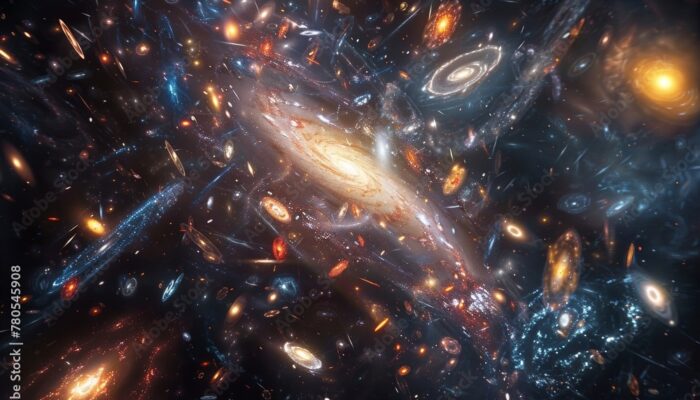
Imagine the universe as an immense, three-dimensional spiderweb stretching across unimaginable distances. This cosmic web is woven not from silk but from the gravitational influence of dark matter. It creates filaments and nodes where galaxies cluster, acting as the essential framework upon which ordinary matter-such as stars, planets, and gas clouds-accumulates and evolves.
Dark matter’s gravitational pull organizes matter into dense regions, facilitating the birth and growth of galaxies within these filaments. These structures evolve over billions of years, transforming the early universe’s diffuse particle soup into the intricate cosmic landscape observed today.
Dark Matter and Galactic Formation
At the core of every galaxy lies a profound mystery: the visible matter we observe accounts for only a small fraction of the total mass. The dominant component is dark matter, which exerts a gravitational force strong enough to hold galaxies together. Without this invisible mass, galaxies would disintegrate, with stars dispersing into space.
Dark matter forms halos around galaxies, creating gravitational wells that attract gas and dust from the surrounding intergalactic medium. These wells serve as the cradles for star formation, enabling the accumulation of baryonic matter necessary to ignite stellar nurseries. The size and density of these halos influence the characteristics of galaxies, from massive spirals to diminutive dwarfs.
Distribution and Diversity of Dark Matter Halos
Dark matter is not evenly spread throughout the universe. Instead, it clusters into dense halos enveloping galaxies and galaxy clusters. These halos vary in mass and size, directly affecting the evolution and appearance of the galaxies they surround.
- Massive Halos:
Galaxies within large dark matter halos tend to be more massive and luminous, with abundant star formation. - Smaller Halos:
Galaxies in less dense or smaller halos often struggle to retain gas, resulting in lower star formation rates and dwarf-like properties.
Dark Matter’s Influence on Cosmic Evolution
Over cosmic timescales, dark matter continues to guide the assembly and transformation of cosmic structures. It facilitates the merging of galaxies and clusters, processes that reshape the universe’s landscape and deepen gravitational wells. These mergers amplify the complexity of dark matter halos, fostering the growth of larger and more intricate galactic systems.
Detecting Dark Matter: Gravitational Lensing
Although dark matter cannot be seen directly, its presence is revealed through gravitational lensing-the bending of light caused by massive objects. Galaxy clusters act as natural lenses, distorting and magnifying the images of more distant galaxies behind them. By analyzing these distortions, astronomers map the distribution of dark matter, uncovering the hidden scaffolding that supports the visible universe.
Common Misconceptions About Dark Matter
Dark matter is the same as dark energy.
Dark matter and dark energy are distinct; dark matter exerts gravitational attraction, while dark energy drives the accelerated expansion of the universe.
Dark matter is made of ordinary matter that is simply invisible.
Dark matter is composed of non-baryonic particles that do not interact with light, unlike ordinary matter such as gas and dust.
Why Understanding Dark Matter Is Crucial
Dark matter is fundamental to our comprehension of the universe’s structure and evolution. It governs the formation and stability of galaxies, influences cosmic expansion, and shapes the large-scale distribution of matter. Unlocking its secrets promises to deepen our knowledge of fundamental physics and the origins of the cosmos, revealing the hidden forces that sculpt the universe’s grand design.


Leave a Reply