
Short Answer
Definition of Nuclear Reactions
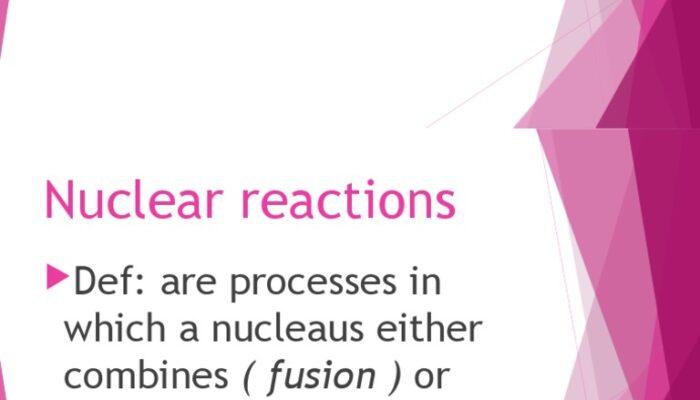
Nuclear reactions refer to processes that involve changes in the composition or structure of an atomic nucleus. Unlike chemical reactions, which affect the electron cloud surrounding atoms, nuclear reactions alter the nucleus itself, often resulting in the formation of new elements or isotopes. These reactions are fundamental to understanding the behavior of matter at the subatomic level and play a crucial role in both natural phenomena and technological applications.
- Fusion:
The merging of two light nuclei to form a heavier nucleus, releasing energy. - Fission:
The splitting of a heavy nucleus into lighter fragments, accompanied by energy release. - Radioactive Decay:
The spontaneous emission of particles or radiation from unstable nuclei. - Neutron Capture:
The absorption of a neutron by a nucleus, leading to the creation of a heavier isotope.
Types and Mechanisms of Nuclear Reactions
Nuclear Fusion
Nuclear fusion is a process where two light atomic nuclei combine to create a heavier nucleus, releasing a tremendous amount of energy. This reaction powers stars, including our Sun, by overcoming the electrostatic repulsion between positively charged nuclei through extremely high temperatures and pressures. A classic example involves the fusion of hydrogen isotopes-deuterium and tritium-forming helium, neutrons, and vast energy output. Researchers are actively pursuing controlled fusion as a promising, sustainable energy source that could provide abundant power with minimal environmental impact.
Nuclear Fission
In nuclear fission, a heavy nucleus such as uranium-235 or plutonium-239 absorbs a neutron and becomes unstable, causing it to split into smaller nuclei. This splitting releases significant energy and additional neutrons, which can trigger a self-sustaining chain reaction. Fission underpins the operation of nuclear reactors and atomic weapons. While it offers a potent energy source, fission also raises complex geopolitical and ethical issues related to nuclear proliferation and safety.
Radioactive Decay
Radioactive decay is a natural nuclear process where unstable nuclei emit radiation to reach a more stable state. This emission can take several forms:
- Alpha Decay: Emission of an alpha particle (two protons and two neutrons), reducing the atomic mass and changing the element.
- Beta Decay: Conversion of a neutron to a proton or vice versa, releasing a beta particle (electron or positron) and a neutrino.
- Gamma Decay: Emission of high-energy gamma photons as the nucleus transitions from an excited state to a lower energy state.
These decay modes are essential in fields such as radiometric dating, medical imaging, and cancer treatment.
Neutron Capture
Neutron capture occurs when a nucleus absorbs a neutron, resulting in a heavier isotope. This reaction is vital in astrophysics, particularly in the synthesis of elements within stars. Two main neutron capture processes are recognized:
- S-Process (Slow Neutron Capture): Neutrons are absorbed slowly, allowing beta decay to occur between captures, leading to the formation of stable isotopes.
- R-Process (Rapid Neutron Capture): Neutrons bombard nuclei rapidly during explosive events like supernovae, producing heavy, often unstable isotopes that contribute to the cosmic abundance of elements such as gold and uranium.
Scientific and Societal Implications
The study and application of nuclear reactions extend beyond pure science, intersecting with ethical, environmental, and political considerations. The dual-use nature of nuclear technology necessitates careful regulation to prevent misuse while maximizing benefits. Nuclear reactors, while providing substantial energy, pose challenges related to radioactive waste disposal and accident prevention. Meanwhile, the pursuit of nuclear fusion as a clean energy source demands international collaboration to overcome technical and financial hurdles, ensuring that advancements serve peaceful purposes.
Importance of Nuclear Reactions in Science and Technology
Nuclear reactions are central to numerous scientific disciplines and practical technologies. They explain the processes powering stars and the cosmic origin of elements, deepen our understanding of matter and energy, and enable innovations in medicine, energy production, and industry. The ability to harness nuclear reactions responsibly holds the promise of transformative benefits, from sustainable energy solutions to advanced medical treatments.
Common Misconceptions About Nuclear Reactions
Nuclear reactions are the same as chemical reactions.
Nuclear reactions involve changes in the nucleus, whereas chemical reactions involve electron interactions without altering the nucleus.
Nuclear fusion is already a widely available energy source.
Controlled fusion remains experimental and is not yet commercially viable, though it holds great potential for the future.
All radioactive decay is harmful.
While some radiation is dangerous, radioactive decay is also harnessed beneficially in medicine and scientific research.
Future Perspectives and Conclusion
As research advances, nuclear reactions continue to reveal new insights into the fundamental nature of the universe and offer promising avenues for innovation. The ongoing exploration of nuclear processes challenges humanity to balance scientific curiosity with ethical responsibility. By deepening our understanding and refining technologies, we can unlock the vast potential of nuclear reactions to address energy needs, improve health outcomes, and expand our knowledge of the cosmos.
FAQ
What is a nuclear reaction?
A nuclear reaction is a process in which the nucleus of an atom changes its composition or structure, often resulting in the formation of new elements or isotopes.
How does nuclear fusion differ from nuclear fission?
Nuclear fusion involves the merging of two light nuclei to form a heavier nucleus and release energy, while nuclear fission is the splitting of a heavy nucleus into lighter fragments, also releasing energy.
What are the main types of radioactive decay?
The main types of radioactive decay are alpha decay, beta decay, and gamma decay, each involving different particles or radiation emitted from unstable nuclei.
Why is neutron capture important in astrophysics?
Neutron capture is critical for the synthesis of elements in stars, with slow (s-process) and rapid (r-process) neutron capture pathways contributing to the cosmic abundance of many elements.
Are nuclear reactions dangerous?
While some nuclear reactions involve harmful radiation, they also have beneficial applications in medicine, energy production, and scientific research when managed responsibly.






Leave a Reply