
Short Answer
Definition of Quasars and Quasar Shocks
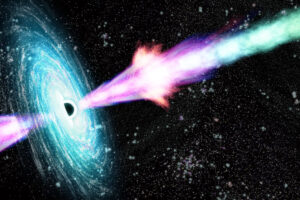
Quasars are extraordinarily bright remnants of ancient supermassive black holes, emitting vast amounts of energy that often surpass the luminosity of entire galaxies. These cosmic powerhouses have intrigued astrophysicists and cosmologists for decades due to their intense radiation and pivotal role in the universe’s early epochs. A particularly compelling aspect of quasars is the phenomenon of quasar shocks-shock waves generated by the interaction between energetic outflows from these black holes and the surrounding interstellar gas.
- Quasars:
Extremely luminous active galactic nuclei powered by accretion of matter onto supermassive black holes. - Quasar Shocks:
Shock waves formed when high-velocity outflows from quasars collide with ambient gas, influencing the surrounding medium.
Origins and Mechanisms of Quasar Shocks
The formation of quasar shocks is rooted in the dynamic processes occurring near accreting supermassive black holes. As matter spirals inward, gravitational forces heat it to extreme temperatures, causing the emission of intense radiation across the electromagnetic spectrum. This energetic output drives powerful outflows that compress, heat, and accelerate nearby gas clouds, creating shock fronts that propagate through the interstellar medium. These shocks are not confined to small regions but can extend their influence across entire galaxies, affecting various astrophysical processes.
Interaction with Baryonic Matter
Baryonic matter, composed mainly of protons and neutrons, constitutes the ordinary matter forming stars, planets, and gas clouds. Quasar shocks impact this matter by raising its temperature and pressure, which can either trigger new star formation by compressing gas or suppress it through feedback mechanisms that heat and disperse the gas. This dual effect highlights the complex role quasar shocks play in regulating galactic environments and evolution.
Prevalence and Distribution of Quasar Shocks
Initially, quasars and their associated shock phenomena were considered rare and confined to the universe’s earliest, most luminous objects. However, advances in observational technology have revealed that quasar shocks may be far more common, occurring even in lower-luminosity quasars that were previously underestimated. This expanded understanding suggests that quasar shocks are widespread and may significantly influence the thermal and dynamic state of intergalactic gas, thereby affecting galaxy formation and evolution on a broader scale.
Implications for Galaxy Evolution and Cosmology
The discovery of widespread quasar shocks has profound consequences for our comprehension of galaxy formation and the co-evolution of supermassive black holes and their host galaxies. One key area of interest is the M-sigma relation, which links the mass of a galaxy’s central black hole to the velocity dispersion of its stars. Quasar shocks, through their feedback effects, may help explain this correlation by regulating star formation and shaping galactic structures. Understanding these interactions opens new pathways for exploring how galaxies grow and evolve over cosmic time.
Future Directions in Quasar Shock Research
Emerging observational platforms, such as the James Webb Space Telescope, promise to deepen our insight into quasar behavior and their shock-induced interactions with the cosmic environment. These next-generation instruments will enable astronomers to refine theoretical models by incorporating quasar shock dynamics alongside galaxy mergers and star formation processes. This integrated approach is expected to enhance our knowledge of large-scale structure formation and the evolution of the universe from its earliest epochs to the present day.
Broader Significance in Astrophysics
The recognition that quasar shocks are more prevalent than once thought invites a reevaluation of the cosmic narrative, positioning quasars not only as distant beacons but as active agents shaping the universe. This paradigm shift encourages renewed theoretical and observational efforts to unravel the complexities of quasar-driven feedback and its role in cosmic evolution. As research progresses, these insights will likely redefine fundamental concepts in astrophysics and cosmology.
Summary: The Expanding Horizon of Quasar Studies
The growing evidence for the ubiquity of quasar shocks underscores the vastness and complexity of the cosmos, reminding us of the limits of our current understanding. Each new discovery about these enigmatic objects enriches our perspective on the universe’s intricate workings. By fostering continued exploration and inquiry into quasar dynamics, the scientific community stands poised to unlock transformative revelations that will reshape our grasp of both quasars and the broader cosmic fabric.
FAQ
What are quasars?
Quasars are extraordinarily bright remnants of ancient supermassive black holes, emitting vast amounts of energy that often surpass the luminosity of entire galaxies.
What is a quasar shock?
Quasar shocks are shock waves formed when high-velocity outflows from quasars collide with ambient gas, influencing the surrounding medium.
How do quasar shocks affect galaxy formation?
Quasar shocks can trigger or suppress star formation by raising the temperature and pressure of baryonic matter, impacting galactic environments and evolution.

Leave a Reply