
Short Answer
Definition of Quantum Locking
Quantum locking is a striking physical phenomenon that occurs at the crossroads of quantum mechanics and classical physics, where an object appears to defy gravity by maintaining a fixed position and levitating within a magnetic field. This effect is not only visually captivating but also holds significant scientific and technological importance, offering insights into the behavior of superconductors and magnetic interactions at the quantum level.
Fundamental Principles Behind Quantum Locking
The foundation of quantum locking lies in the unique properties of superconductivity. Superconductors are materials that, when cooled below a certain critical temperature, exhibit zero electrical resistance and expel magnetic fields-a phenomenon known as the Meissner effect. This state arises because electrons pair up into Cooper pairs, allowing them to flow through the material’s lattice without scattering, thus enabling the superconductor to interact with magnetic fields in extraordinary ways.
Type-II Superconductors and Magnetic Flux Pinning
Quantum locking is typically demonstrated using type-II superconductors, often composed of ceramic compounds. Unlike type-I superconductors, type-II materials allow magnetic fields to partially penetrate through quantized vortices-tiny whirlpools of magnetic flux trapped within the superconductor. These vortices create a pinning effect that locks the superconductor in place relative to the magnetic field, enabling stable levitation and suspension in midair.
Mechanism of Quantum Locking
When a type-II superconductor is cooled below its critical temperature and placed near a magnet, it expels most magnetic field lines but allows some to penetrate as quantized vortices. These vortices become pinned to defects or impurities in the superconductor’s structure, effectively anchoring the material in space. This pinning prevents the superconductor from moving freely, resulting in a locked position that can resist gravitational forces and external disturbances, producing the levitation effect.
Mathematical Explanation and Key Variables
The behavior of quantum locking can be described using the Ginzburg-Landau theory and the concept of flux quantization. The magnetic flux through each vortex is quantized in units of the magnetic flux quantum, Φ₀, given by:
Φ₀ = h / (2e)
- Φ₀ (Magnetic flux quantum): The smallest unit of magnetic flux that can penetrate a superconductor.
- h (Planck’s constant): A fundamental constant in quantum mechanics.
- e (Elementary charge): The charge of an electron.
The pinning force arises from the interaction between these quantized vortices and material defects, which can be modeled to predict the stability and strength of the locking effect.
Illustrative Demonstrations of Quantum Locking
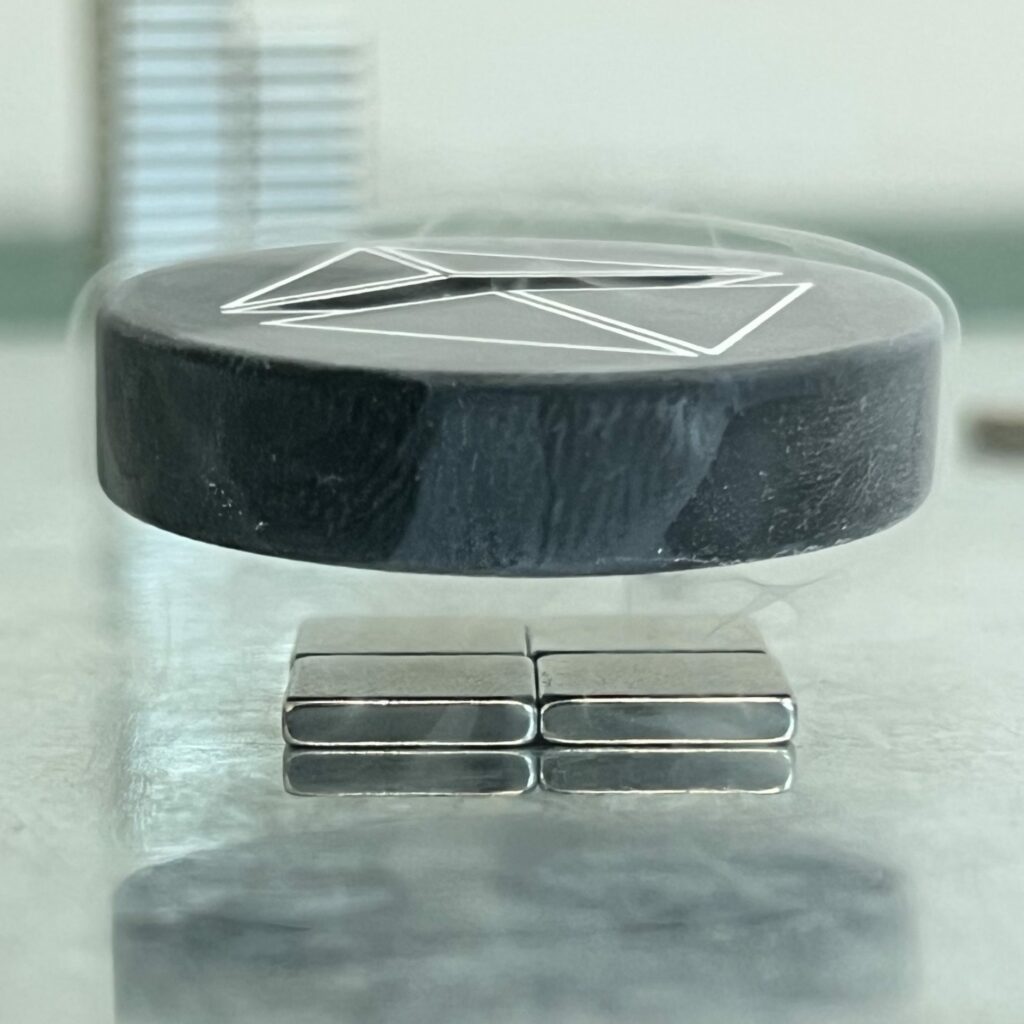
One of the most compelling visualizations of quantum locking involves a superconducting disc levitating above a magnet. As the disc is cooled below its critical temperature using liquid nitrogen, it becomes locked in the magnetic field, allowing it to hover and even move along predetermined paths without falling. This demonstration vividly showcases the principles of quantum mechanics and the non-dissipative nature of superconductivity, captivating observers with its seemingly magical suspension.
Applications and Technological Implications
Revolutionizing Transportation
Quantum locking has promising applications in transportation, particularly in enhancing magnetic levitation (maglev) train technology. By integrating superconductors that exhibit quantum locking, maglev trains could achieve higher speeds with greater energy efficiency due to the elimination of friction and electrical resistance. This advancement could transform urban infrastructure, enabling faster, cleaner, and more sustainable public transit systems.
Energy Storage and Transmission
Beyond transportation, quantum locking and superconductivity offer potential breakthroughs in energy systems. Superconducting circuits can transmit electricity with minimal losses, and the stability provided by quantum locking could improve the efficiency and reliability of energy storage devices. These innovations are critical for advancing sustainable energy solutions and reducing waste in power grids.
Philosophical and Cultural Reflections
Quantum locking challenges conventional perceptions of reality by demonstrating how quantum phenomena can produce effects that seem to contradict everyday experiences of space, time, and motion. This interplay between deterministic classical physics and probabilistic quantum mechanics invites deeper philosophical inquiry into the nature of the universe. Additionally, the aesthetic appeal of levitating superconductors has inspired collaborations between scientists and artists, blending scientific discovery with creative expression.
Educational and Societal Impact
The captivating nature of quantum locking serves as a powerful tool for science education and public engagement. By illustrating complex quantum concepts through tangible demonstrations, it helps demystify advanced physics and fosters curiosity. Promoting accurate understanding of such phenomena is essential to counteract skepticism and misinformation, ensuring informed public discourse and support for scientific progress.
Common Misconceptions About Quantum Locking
Quantum locking is simply magnetic levitation.
While related, quantum locking involves the pinning of magnetic flux vortices within a superconductor, which stabilizes its position, unlike ordinary magnetic levitation that relies solely on repulsive forces.
The levitating object defies gravity through magic or unknown forces.
The effect is fully explained by quantum mechanics and superconductivity, involving well-understood physical principles rather than supernatural forces.
Significance of Quantum Locking in Modern Science and Technology
Quantum locking represents a remarkable convergence of quantum physics and practical engineering, offering pathways to revolutionary technologies in transportation, energy, and beyond. Its study deepens our comprehension of superconductivity and magnetic interactions, while its applications promise to enhance efficiency and sustainability in various industries. As research advances, quantum locking continues to inspire innovation and expand the horizons of human knowledge.
FAQ
What is quantum locking?
Quantum locking is a phenomenon where a superconductor maintains a fixed position in a magnetic field, appearing to defy gravity.
How does quantum locking work?
It works through the interaction of magnetic flux vortices and defects in a superconductor, which stabilizes its position.
What are the applications of quantum locking?
Applications include enhanced magnetic levitation for trains, improved energy storage systems, and advancements in transportation technologies.






Leave a Reply