
Short Answer
Definition and Overview
Quantum computing and quantum cryptography represent cutting-edge fields that merge principles of quantum physics with information technology. These disciplines aim to significantly enhance computational power and revolutionize secure communication methods. To grasp their full impact, it is essential to understand their foundational theories, operational mechanisms, and practical applications.
Fundamental Principles of Quantum Computing
Unlike classical computers that use binary bits (0 or 1) to process data, quantum computers utilize quantum bits, or qubits, which can exist in multiple states simultaneously due to the quantum phenomenon called superposition. This unique property enables quantum computers to tackle complex problems much faster than traditional systems.
- Superposition:
Qubits can represent both 0 and 1 at the same time, allowing parallel computation on a massive scale. - Entanglement:
A quantum correlation where the state of one qubit instantly influences another, regardless of distance, enhancing computational power and enabling advanced cryptographic protocols.
Quantum Cryptography: Principles and Protocols
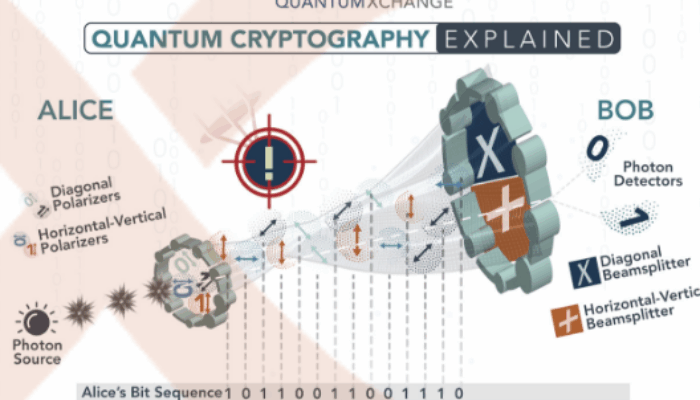
Quantum cryptography applies quantum mechanics to secure data transmission, with Quantum Key Distribution (QKD) being its most prominent protocol. QKD leverages the laws of quantum physics to establish a communication channel that is theoretically immune to interception.
- BB84 Protocol:
Developed by Charles Bennett and Gilles Brassard in 1984, this protocol uses the uncertainty principle to detect eavesdropping. Any attempt to measure the quantum bits alters their state, alerting the communicating parties to potential security breaches. - Key Generation:
QKD does not encrypt data directly but creates a shared secret key used in classical encryption methods, combining the strengths of both quantum and traditional cryptography.
Mechanisms Behind Quantum Computing and Cryptography
Quantum computing operates by manipulating qubits through quantum gates, exploiting superposition and entanglement to perform multiple calculations simultaneously. Quantum cryptography, on the other hand, relies on the fundamental quantum principle that measurement disturbs the system, ensuring any interception attempts are detectable.
Mathematical Foundations and Formulas
Quantum states are represented mathematically as vectors in a complex Hilbert space. A qubit’s state can be expressed as:
|ψ⟩ = α|0⟩ + β|1⟩
- α and β: Complex probability amplitudes where |α|² + |β|² = 1, representing the probabilities of the qubit being in state 0 or 1 upon measurement.
- Entanglement: Described by tensor products of individual qubit states, creating composite states that cannot be factored into separate qubit states.
Practical Applications Across Industries
The integration of quantum computing and cryptography is poised to transform multiple sectors:
- Finance:
Quantum algorithms can optimize portfolio management, risk assessment, and real-time trading by processing complex financial models more efficiently. - Healthcare:
Quantum simulations enable precise modeling of molecular interactions, accelerating drug discovery and personalized medicine development. - Telecommunications:
Quantum cryptography enhances data security, protecting against threats posed by quantum-enabled cyberattacks and ensuring confidentiality in communication networks.
Challenges and Limitations in Quantum Technologies
Despite their promise, quantum technologies face significant hurdles:
- Qubit Coherence:
Qubits are highly sensitive to environmental disturbances, leading to decoherence and errors in computation. - Scalability:
Constructing large-scale quantum networks and quantum repeaters to extend communication distances remains technologically demanding. - Integration Issues:
Merging quantum systems with existing infrastructure involves overcoming compatibility challenges, workforce training needs, and transitional cybersecurity risks.
Common Misconceptions About Quantum Technologies
Quantum computers can instantly solve all problems.
While quantum computers excel at specific tasks, they are not universally faster for every computational problem.
Quantum cryptography encrypts data directly.
Quantum cryptography primarily secures key distribution, which is then used in classical encryption algorithms.
Significance and Future Outlook
The advancement of quantum computing and cryptography holds transformative potential for science, technology, and everyday life. By pushing the boundaries of computation and security, these technologies promise to redefine how information is processed and protected. Ongoing research aims to overcome current limitations, paving the way for innovations that could revolutionize digital communication and computational methodologies.
Interdisciplinary Impact and Innovation
The interplay between quantum computing and quantum cryptography exemplifies the necessity of interdisciplinary collaboration. Combining insights from physics, computer science, and engineering fosters breakthroughs that enhance security and computational efficiency, challenging traditional paradigms and opening new frontiers in technology.
FAQ
What is quantum computing?
Quantum computing uses quantum bits or qubits to process information in complex ways, allowing for faster problem-solving compared to classical computers.
How does quantum cryptography work?
Quantum cryptography utilizes quantum mechanics principles, particularly Quantum Key Distribution (QKD), to secure data transmission by detecting eavesdropping.






Leave a Reply