When will atomic clocks become a common thing?

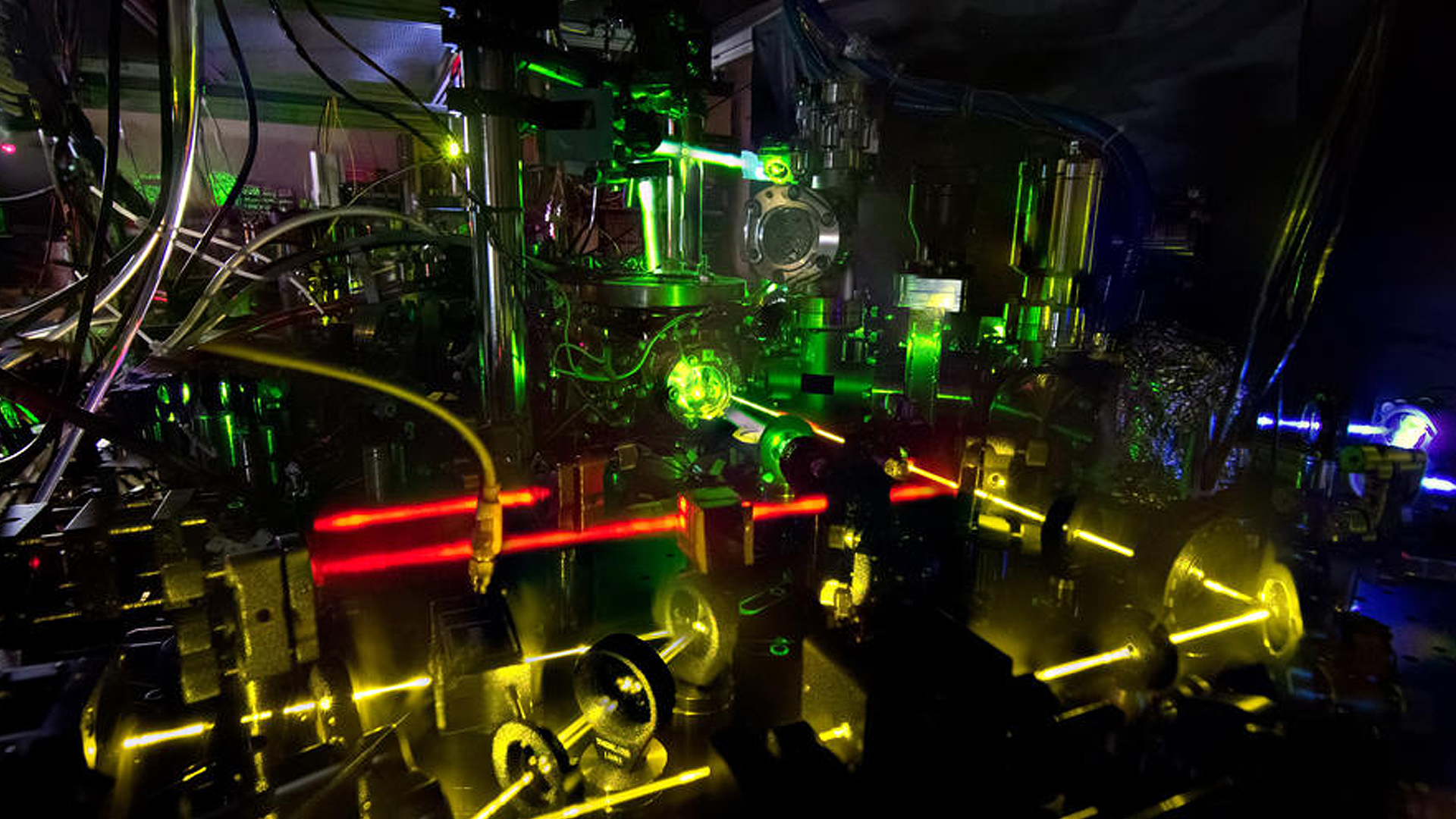
Understanding Atomic Clocks Atomic clocks represent the pinnacle of precision in time measurement, harnessing the natural oscillations of atoms-most commonly cesium or rubidium-to maintain extraordinarily accurate timekeeping. These devices have become indispensable in various scientific and technological fields, including telecommunications, navigation, and global positioning systems (GPS). As technology advances, the prospect of atomic clocks becoming […]


Read More →

How can a large scale quantum computer be built?

Definition of Large-Scale Quantum Computing Large-scale quantum computing refers to the development and operation of quantum computers that utilize thousands to millions of quantum bits (qubits) to perform computations far beyond the capabilities of classical supercomputers. These advanced machines harness the principles of quantum mechanics to process information in fundamentally new ways, promising breakthroughs in […]

Read More →

One Amazing Moment: When Science Redefined Everything

Definition The phrase “when science redefined everything” refers to pivotal moments in scientific history that fundamentally altered our understanding of the natural world. These transformative events challenge established paradigms, prompting a comprehensive reassessment of scientific principles and reshaping humanity’s worldview. Scientific Paradigm Shift: A profound change in the basic concepts and experimental practices of a […]

Read More →

How will you describe quantum mechanics to a 10 year old?

Definition of Quantum Mechanics Quantum mechanics is a fundamental branch of physics that explores the behavior and properties of the smallest constituents of matter and energy. It reveals how particles at the atomic and subatomic levels operate in ways that defy classical intuition, often appearing strange or counterintuitive compared to everyday experiences. Quantum Particles: These […]

Read More →

Why the current obsession with big data?

Understanding Big Data Big data refers to the immense and continuously growing volumes of information generated from diverse sources such as social media, sensors, and digital transactions. It is distinguished by three primary characteristics often called the “3 Vs”: volume, variety, and velocity. These attributes enable big data to reveal complex patterns and insights that […]

Read More →

Can we reach absolute zero temperature in laboratories?

Definition of Absolute Zero Absolute zero is the theoretical temperature at which all classical molecular motion ceases, defined as 0 Kelvin (K) or -273.15 degrees Celsius (°C). It represents the lowest limit of the thermodynamic temperature scale, where entropy reaches its minimum and quantum mechanical effects dominate. This temperature is a fundamental concept in cryogenics […]

Read More →

Are matters made up of atomic particles? Is this true or false?

Definition of Atomic Matter The concept that all matter consists of atomic particles is a foundational principle in modern science, particularly in physics and chemistry. Atoms are traditionally understood as the smallest units of matter that retain the properties of an element. However, this idea extends beyond simple indivisibility, encompassing a complex structure of subatomic […]

Read More →

Is it theoretically possible to have atom level powder?

Definition of Atom-Level Powder Atom-level powder refers to a material composed of particles whose size approaches the scale of individual atoms. Unlike conventional powders, which consist of aggregates of fine particles, atom-level powders are envisioned as collections of isolated atoms or atomically dispersed units. This concept challenges traditional views of material composition by pushing the […]

Read More →

Is the Wilson Loop Just for Particle Physics? Not Anymore!

Definition and Origin of the Wilson Loop The Wilson loop is a fundamental gauge-invariant quantity in theoretical physics, originally introduced by Kenneth Wilson in the early 1970s. It is defined as the path-ordered exponential of the gauge field integrated along a closed loop in spacetime. This mathematical construct captures essential information about gauge fields and […]

Read More →

Why are lasers so inefficient?

Understanding Laser Inefficiency Despite their reputation as cutting-edge devices, lasers often suffer from notable energy losses, sparking curiosity among scientists and engineers. The question arises: why do lasers, which convert electrical energy into coherent light, frequently operate with less than ideal efficiency? To address this, it is essential to delve into the fundamental principles of […]

Read More →