
Short Answer
Definition of the Higgs Boson and Its Significance
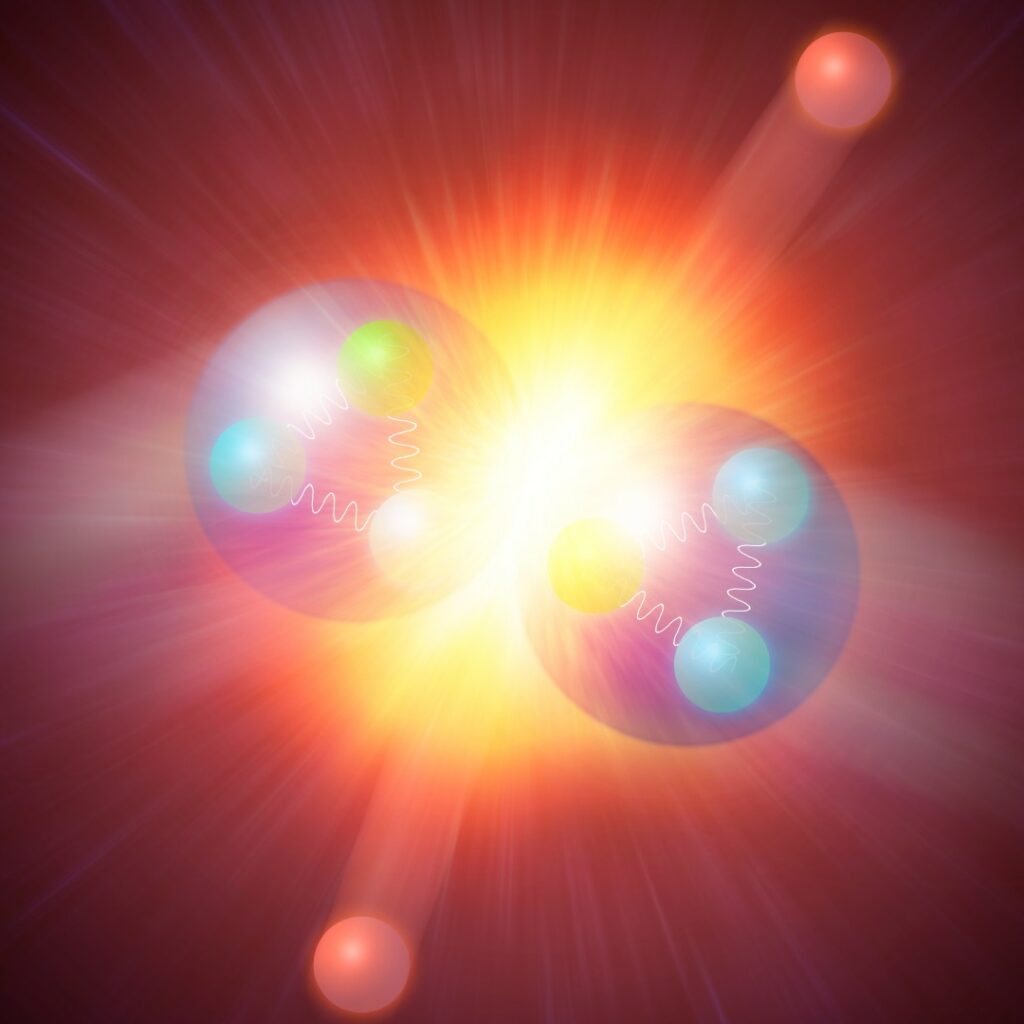
The Higgs boson is a fundamental particle intimately connected to the Higgs field, a pervasive energy field that exists throughout the universe. Discovered in 2012, this particle plays a pivotal role in the mechanism that endows certain elementary particles with mass. Understanding the Higgs boson requires exploring its relationship with the Higgs field and how this interaction influences the properties of matter and fundamental forces.
The Higgs Field and Mass Generation
The Higgs field is a continuous field that fills all of spacetime, acting as a medium through which particles acquire mass. This process occurs via spontaneous symmetry breaking, a phenomenon where the symmetrical state of the field shifts to a lower-energy configuration, allowing particles to interact with the field and gain mass.
- Spontaneous Symmetry Breaking:
This is the mechanism by which the Higgs field transitions from a symmetric state to one that imparts mass to particles, breaking the symmetry of the electroweak interaction. - Particle Interaction:
Fundamental particles such as quarks and leptons gain mass by coupling with the Higgs field, absorbing energy that manifests as mass.
How Particles Acquire Mass Through the Higgs Mechanism
Particles differ in how strongly they interact with the Higgs field, which determines their mass. A useful analogy is to imagine the Higgs field as an ocean and particles as boats moving through it. Some boats experience more resistance, analogous to particles acquiring greater mass, while others move freely with little to no interaction.
- Massive Particles:
Quarks and leptons interact significantly with the Higgs field, resulting in their nonzero masses. - Massless Particles:
Photons, the carriers of electromagnetic force, do not interact with the Higgs field and thus remain massless, traveling at the speed of light.
Role of the Higgs Boson in the Standard Model
The Higgs boson itself is a quantum excitation of the Higgs field and acts as a mediator in the mass-giving process. It ensures the consistency of the Standard Model by preserving gauge invariance while allowing certain particles, such as the W and Z bosons responsible for the weak nuclear force, to acquire mass.
- W and Z Bosons:
These particles interact with the Higgs field, gaining mass and enabling the weak force to have a finite range. - Gauge Invariance:
The Higgs mechanism maintains the symmetry principles underlying electromagnetic and weak interactions, crucial for the Standard Model’s integrity.
Particles Unaffected by the Higgs Field
Not all particles are influenced by the Higgs field. Photons, for example, remain massless and unaffected, while hypothetical particles like gravitons, which would mediate gravity, have an uncertain relationship with the Higgs field due to their speculative nature.
- Photons:
These particles do not couple with the Higgs field, allowing them to travel at light speed without mass. - Gravitons:
If they exist, gravitons are expected to mediate gravity but their interaction with the Higgs field remains unknown and is a subject of ongoing theoretical research.
Exploring Beyond the Standard Model
Current research in particle physics investigates phenomena that extend beyond the Standard Model, such as supersymmetry, dark matter, and quantum gravity. These areas raise questions about whether other fields similar to the Higgs field exist and whether the Higgs boson is unique or part of a broader spectrum of mass-generating mechanisms.
- Supersymmetry:
A theoretical framework proposing partner particles for every Standard Model particle, potentially involving new interactions with the Higgs field. - Dark Matter:
Unknown particles that may interact with the Higgs field or other fields, influencing mass and cosmic structure. - Quantum Gravity:
The quest to unify gravity with quantum mechanics may reveal new particles or fields that challenge the current understanding of the Higgs boson’s role.
Experimental Insights from the Large Hadron Collider
The Large Hadron Collider (LHC) continues to be instrumental in probing the properties of the Higgs boson. Experiments focus on how the Higgs boson decays and whether it interacts with particles outside the Standard Model, potentially uncovering hidden sectors of the universe.
- Decay Channels:
Studying the ways the Higgs boson decays helps physicists identify new particles or forces. - Hidden Sectors:
The possibility that the Higgs boson connects to unknown particles or fields, expanding our understanding of fundamental physics.
Alternative Theories: Higgsless Models
Some theoretical models propose mechanisms for mass generation that do not rely on the Higgs boson. These “Higgsless” frameworks challenge the conventional narrative and suggest that the Higgs boson might be part of a more complex picture yet to be fully understood.
- Higgsless Theories:
Propose alternative ways to explain particle masses without invoking the Higgs field or boson. - Implications:
If validated, these models would necessitate a major revision of particle physics and our understanding of mass.
Common Misconceptions About the Higgs Boson
The Higgs boson is present inside every particle.
The Higgs boson is a particle associated with the Higgs field, which imparts mass to some particles, but it is not a constituent of all particles.
The Higgs boson gives mass to all particles.
While it provides mass to many fundamental particles, some, like photons, remain massless and do not interact with the Higgs field.
Why Understanding the Higgs Boson Is Crucial
The discovery and study of the Higgs boson have profound implications for physics, offering insights into the origin of mass and the fundamental structure of matter. It bridges gaps in the Standard Model and opens pathways to new physics, influencing technology, cosmology, and our comprehension of the universe’s fabric.
FAQ
Is the Higgs boson present in every particle?
No. The Higgs boson is linked to the Higgs field, which only interacts with certain fundamental particles to give them mass. Some particles, like photons, do not interact with the Higgs field and remain massless.
How does the Higgs boson give particles mass?
The Higgs boson is a quantum excitation of the Higgs field, which imparts mass to particles through a process called spontaneous symmetry breaking, allowing particles like quarks and leptons to acquire mass.
Why don’t photons have mass?
Photons do not interact with the Higgs field, so they do not acquire mass and can travel at the speed of light.
What is the significance of the Higgs boson discovery?
The discovery confirmed the existence of the Higgs field, a key part of the Standard Model, explaining how particles acquire mass and validating decades of theoretical physics.
Are there theories beyond the Standard Model related to the Higgs boson?
Yes, theories like supersymmetry and Higgsless models explore new physics beyond the Standard Model, potentially involving new particles or mechanisms related to mass generation.






Leave a Reply