
Short Answer
Understanding Quantum Cryptography
Quantum cryptography represents a cutting-edge approach to securing communication by harnessing the unique properties of quantum mechanics. Unlike traditional encryption methods, it aims to create communication channels that are fundamentally resistant to interception and tampering. The most prominent technique within this field is Quantum Key Distribution (QKD), which uses pairs of quantum particles-commonly photons-to generate and share encryption keys securely between two parties.
Fundamental Principles Behind Quantum Cryptography
The security of quantum cryptography is deeply rooted in several quantum mechanical phenomena:
- Quantum Superposition:
This principle allows quantum particles, such as photons, to exist in multiple states simultaneously. It enables the encoding of information in a way that is inherently uncertain until measured. - No-Cloning Theorem:
A cornerstone of quantum security, this theorem states that it is impossible to create an exact copy of an unknown quantum state. Consequently, any attempt to intercept or duplicate the quantum key disturbs the system, alerting the communicating parties to potential eavesdropping.
Mechanics of Quantum Key Distribution (QKD)
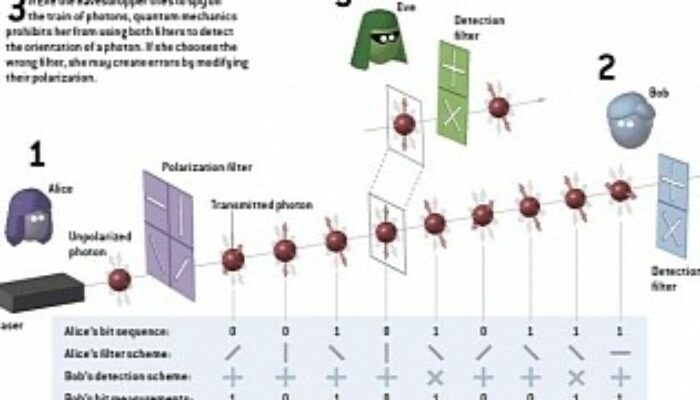
QKD operates by transmitting quantum particles between two users, often referred to as “Alice” and “Bob.” The quantum states of these particles encode the cryptographic key. Due to the fragile nature of quantum states, any interception by an eavesdropper (“Eve”) inevitably alters the particles’ states, which can be detected by Alice and Bob. This detection mechanism ensures that the key exchange remains confidential or is aborted if tampering is suspected.
Challenges in Practical Implementation
While the theoretical framework of quantum cryptography is robust, real-world application faces several obstacles:
- Hardware Limitations:
The technology requires specialized equipment such as single-photon emitters, quantum repeaters, and ultra-sensitive detectors. These components are expensive and complex, limiting widespread adoption. - Environmental Interference:
Quantum signals are highly susceptible to noise and loss during transmission, which can degrade security guarantees. - Scalability Issues:
Current infrastructure is not yet capable of supporting large-scale deployment, posing logistical and financial challenges.
Potential Vulnerabilities and Threats
Despite its promise, quantum cryptography is not invulnerable. Several factors can undermine its security:
- Technological Exploits:
Imperfections in hardware or software implementations can introduce loopholes that attackers might exploit. - Advances in Quantum Computing:
While quantum computers threaten classical encryption, they may also enable sophisticated attacks on quantum cryptographic systems by uncovering weaknesses in practical setups. - Human Factors:
Social engineering tactics, such as phishing, can compromise users and reveal cryptographic keys, bypassing the quantum security layer entirely.
Ethical and Regulatory Considerations
The rise of quantum cryptography also brings complex socio-political questions:
- Privacy vs. Surveillance:
As governments and corporations develop quantum encryption capabilities, debates intensify over balancing secure communication with lawful oversight. - Regulatory Challenges:
The lack of clear international standards and regulations complicates the deployment and governance of quantum cryptographic technologies. - Potential for Misuse:
The powerful nature of quantum encryption could be exploited for illicit activities, raising ethical concerns about its control and accessibility.
Emerging Research and Future Directions
Ongoing advancements continue to enhance the resilience of quantum cryptography:
- Entanglement-Based QKD:
Utilizing quantum entanglement, this approach offers improved resistance to eavesdropping and may overcome some limitations of earlier methods. - Improved Quantum Repeaters:
Development of more efficient repeaters aims to extend the range and reliability of quantum communication networks. - Hybrid Systems:
Combining quantum cryptography with classical security measures to create layered defenses against evolving threats.
Why Quantum Cryptography Is Significant
Quantum cryptography holds transformative potential for securing information in an increasingly digital world. By leveraging the laws of quantum physics, it offers a fundamentally different approach to encryption that could safeguard sensitive data against both current and future computational threats. Its development is crucial for protecting privacy, securing financial transactions, and maintaining national security in the quantum computing era.
Common Misunderstandings About Quantum Cryptography
- Misconception: Quantum cryptography is completely unbreakable.
Correction: While theoretically secure, practical implementations can have vulnerabilities due to hardware flaws, environmental factors, and human error. - Misconception: Quantum computers will render quantum cryptography obsolete.
Correction: Quantum computers threaten classical encryption but quantum cryptography is designed to resist such attacks, though ongoing research is needed to address emerging challenges. - Misconception: Quantum cryptography eliminates all security risks.
Correction: Human factors and social engineering remain significant risks that quantum technology alone cannot mitigate.
FAQ
Is quantum cryptography completely unbreakable?
No, while it is theoretically secure, practical implementations can have vulnerabilities.
Will quantum computers render quantum cryptography obsolete?
Quantum computers threaten classical encryption but are designed to resist attacks on quantum cryptographic systems.
Does quantum cryptography eliminate all security risks?
No, human factors and social engineering remain significant risks.






Leave a Reply