
Short Answer
Definition of the Strong Nuclear Force
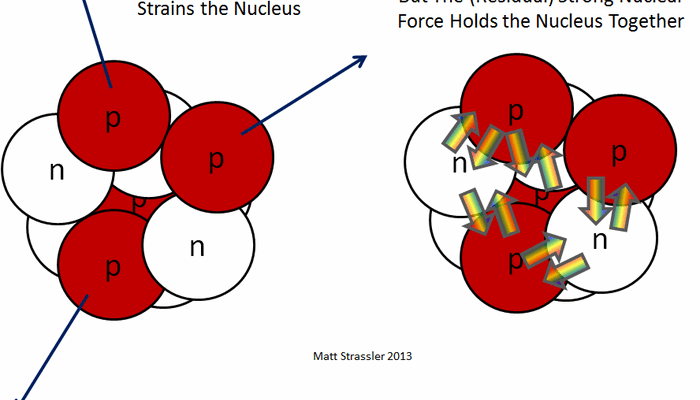
The strong nuclear force is one of the four fundamental interactions that govern the natural world. It is the primary force responsible for holding protons and neutrons together within an atomic nucleus, thereby ensuring the stability of matter. This force operates at an incredibly short range, approximately on the scale of femtometers (10-15 meters), and is considerably more powerful than both the electromagnetic and weak nuclear forces.
- Fundamental role:
It binds quarks together to form protons and neutrons and subsequently holds these nucleons tightly within the nucleus. - Mediators:
The force is transmitted by gluons, which facilitate interactions between quarks, the elementary constituents of matter. - Significance:
Without this force, atomic nuclei would disintegrate, making the existence of atoms and, consequently, all matter impossible.
Mechanism Behind the Strong Nuclear Force
The strong nuclear force arises from the principles of quantum chromodynamics (QCD), the theory describing the interactions of quarks and gluons. Gluons act as exchange particles that “glue” quarks together, overcoming the repulsive electromagnetic force between positively charged protons within the nucleus. This force is characterized by its short-range nature, becoming negligible beyond the scale of a few femtometers, yet it is the strongest of the fundamental forces at these distances.
Is It Possible to Disable the Strong Nuclear Force on Earth?
The concept of “turning off” the strong nuclear force is a profound theoretical question that challenges our understanding of the universe’s fundamental laws. Since the strong force is an intrinsic aspect of the Standard Model of particle physics, it is deeply embedded in the fabric of matter. Altering or disabling it would require changing the fundamental constants or symmetries that govern particle interactions.
Current scientific knowledge suggests that such manipulation is beyond our technological reach. Theoretical models indicate that the strong force could be affected under extreme conditions, such as those present in the early universe or during high-energy particle collisions in facilities like the Large Hadron Collider (LHC). However, replicating or sustaining these conditions on Earth to effectively “turn off” the strong force remains purely speculative.
Symmetry and Theoretical Considerations
In particle physics, symmetry principles play a crucial role in defining the behavior of fundamental forces. The strong nuclear force is linked to a type of symmetry known as color charge symmetry in QCD. Theoretical explorations into symmetry breaking suggest that under certain extreme environments, the characteristics of the strong force might change, potentially weakening or becoming ineffective temporarily.
Despite these theoretical possibilities, such phenomena require energy scales and conditions far beyond what can be achieved naturally or artificially on Earth. Consequently, the strong nuclear force remains effectively immutable under normal terrestrial circumstances.
Consequences of Disabling the Strong Nuclear Force
Should it ever become possible to negate the strong nuclear force, the consequences would be catastrophic for matter and the universe. Atomic nuclei would lose their cohesion, causing protons and neutrons to separate. This breakdown would dismantle all elements, from hydrogen to heavier atoms like carbon, leading to the collapse of matter as we know it.
On a cosmic scale, stars would no longer sustain nuclear fusion, planets would disintegrate, and life itself would cease to exist. The strong nuclear force is thus fundamental not only to atomic stability but also to the very existence of the cosmos and biological entities.
Philosophical and Ethical Reflections
The fascination with controlling fundamental forces such as the strong nuclear force reflects humanity’s deep-seated desire to master nature. This pursuit raises profound ethical questions about the limits of scientific exploration and the responsibilities that come with such power. The potential to manipulate forces that underpin reality challenges our understanding of existence and evokes awe at the universe’s complexity.
Current Research and Future Prospects
Ongoing research in nuclear physics and quantum mechanics continues to deepen our understanding of the strong nuclear force. Experiments involving high-energy particle collisions, as well as theoretical frameworks extending beyond the Standard Model-such as string theory and loop quantum gravity-offer promising avenues for new insights.
While the idea of disabling the strong nuclear force remains theoretical and beyond current capabilities, it highlights the broader quest to unravel the fundamental principles that govern the universe.
Summary: The Importance of the Strong Nuclear Force
The strong nuclear force is the cornerstone of matter’s stability and the universe’s structure. Although the notion of turning it off sparks intriguing scientific and philosophical discussions, it remains an unattainable concept with today’s technology and understanding. This force exemplifies the intricate balance of nature’s laws and reminds us of our modest place within the cosmic order.
FAQ
What is the strong nuclear force?
The strong nuclear force is a fundamental interaction that holds protons and neutrons together within an atomic nucleus, making it essential for the stability of matter.
Can we turn off the strong nuclear force?
Current scientific understanding suggests that we cannot turn off the strong nuclear force on Earth, as it is a fundamental aspect of the universe governed by the Standard Model of particle physics.






Leave a Reply