

Short Answer
Definition of Dark Energy
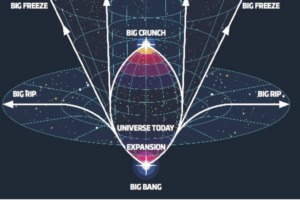
Dark energy is a mysterious and pervasive component of the universe that drives its accelerated expansion. First identified in the late 1990s through observations of distant Type Ia supernovae, dark energy appears to exert a repulsive influence on the fabric of space, counteracting the attractive force of gravity. Unlike conventional forces that pull matter together, dark energy pushes the cosmos apart, making it one of the most intriguing puzzles in contemporary cosmology.
Historical Context and Discovery
The discovery of dark energy emerged from precise measurements of distant supernovae, which revealed that the universe’s expansion is not slowing down as previously expected but accelerating. This unexpected finding challenged the long-held assumption that gravity would gradually decelerate cosmic expansion. The concept of dark energy was introduced to explain this acceleration, reshaping our understanding of the universe’s large-scale dynamics.
Physical Nature and Theoretical Interpretations
Physicists traditionally define forces as interactions that cause acceleration or changes in velocity, such as gravity, electromagnetism, and the strong and weak nuclear forces. Gravity, described by Einstein’s general relativity, attracts masses by curving spacetime. In contrast, dark energy produces a repulsive effect that accelerates the expansion of space itself, opposing gravitational attraction.
- Cosmological Constant (Λ):
One leading explanation models dark energy as the cosmological constant, a uniform energy density filling space homogeneously. Originally introduced by Einstein to maintain a static universe, Λ represents a constant vacuum energy that exerts negative pressure, causing space to expand at an increasing rate. - Dynamic Fields (Quintessence):
Alternative theories propose that dark energy is a dynamic scalar field, known as quintessence, which evolves over time and space. Unlike the static cosmological constant, quintessence can vary, potentially interacting with other cosmic components and causing fluctuations in the acceleration rate. - Modified Gravity Theories:
Some hypotheses suggest that the observed acceleration arises not from a new energy form but from modifications to general relativity on cosmological scales. These models imply that gravity itself behaves differently over vast distances, potentially eliminating the need for dark energy as a separate entity.
How Dark Energy Influences the Universe
Dark energy affects the universe by altering the geometry of spacetime. Its repulsive pressure warps spacetime in a way that causes galaxies to move away from each other at an accelerating pace. This effect is not a force in the classical Newtonian sense acting on matter directly but a geometric phenomenon embedded in the expansion of space itself.
Mathematical Framework
In Einstein’s field equations, the cosmological constant Λ is incorporated as an additional term representing a uniform energy density with negative pressure:
Gμν + Λgμν = (8πG/c⁴) Tμν
- Gμν: Einstein tensor describing spacetime curvature
- Λ: Cosmological constant representing dark energy density
- gμν: Metric tensor of spacetime
- Tμν: Energy-momentum tensor of matter and radiation
The negative pressure associated with Λ leads to accelerated expansion, as it effectively counteracts the gravitational attraction of matter.
Magnitude and Cosmic Significance
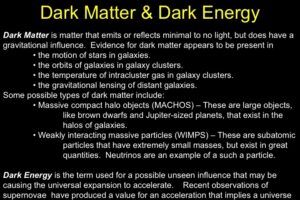
Dark energy constitutes approximately 68% of the total energy content of the universe, vastly exceeding the combined contributions of ordinary matter and dark matter. This dominance implies that any comprehensive cosmological model must account for its repulsive influence and reconcile its observed density with theoretical predictions. Notably, quantum field theory estimates of vacuum energy density exceed observed values by many orders of magnitude, presenting a profound theoretical challenge known as the cosmological constant problem.
Common Misconceptions About Dark Energy
Dark energy is simply anti-gravity.
While dark energy produces a repulsive effect, it is not a force that directly opposes gravity in the Newtonian sense but a geometric property of spacetime causing accelerated expansion.
Dark energy has a known particle mediator like other forces.
Unlike forces such as electromagnetism, dark energy has no confirmed carrier particle; its presence is inferred from its gravitational effects on cosmic expansion.
Why Understanding Dark Energy Is Crucial
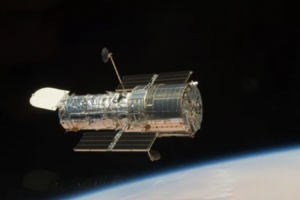
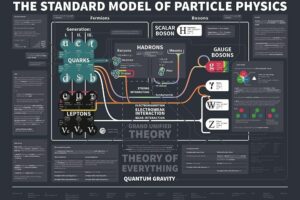
Deciphering the nature of dark energy is vital for comprehending the ultimate fate of the universe and the fundamental laws governing it. Its discovery has revolutionized cosmology, prompting the development of advanced observational techniques such as space-based telescopes, galaxy surveys, and cosmic microwave background measurements. The quest to understand dark energy also drives theoretical innovation, inspiring new physics beyond the standard models of particle physics and gravitation.
Real-World Observational Evidence
Key empirical support for dark energy comes from multiple cosmological probes:
- Type Ia Supernovae:
Standard candles used to measure cosmic distances revealed the accelerating expansion. - Cosmic Microwave Background (CMB):
Temperature fluctuations in the CMB provide constraints on the universe’s composition, supporting the presence of dark energy. - Large-Scale Structure Surveys:
Mapping galaxy distributions helps trace the influence of dark energy on cosmic evolution.
Future Directions in Dark Energy Research
Ongoing and upcoming missions aim to refine measurements of dark energy’s properties and test competing theories. These include next-generation space telescopes, ground-based observatories, and experiments designed to probe the nature of gravity on cosmic scales. The ultimate goal is to integrate dark energy into a unified framework of physics, potentially revealing new dimensions of reality and deepening our understanding of the cosmos.
FAQ
What is dark energy?
Dark energy is a form of energy that contributes to the accelerated expansion of the universe.
Is dark energy the same as anti-gravity?
No, dark energy is not a force opposing gravity but rather a geometric property of space causing expansion.
What percentage of the universe is dark energy?
Dark energy constitutes about 68% of the total energy content of the universe.
Leave a Reply