
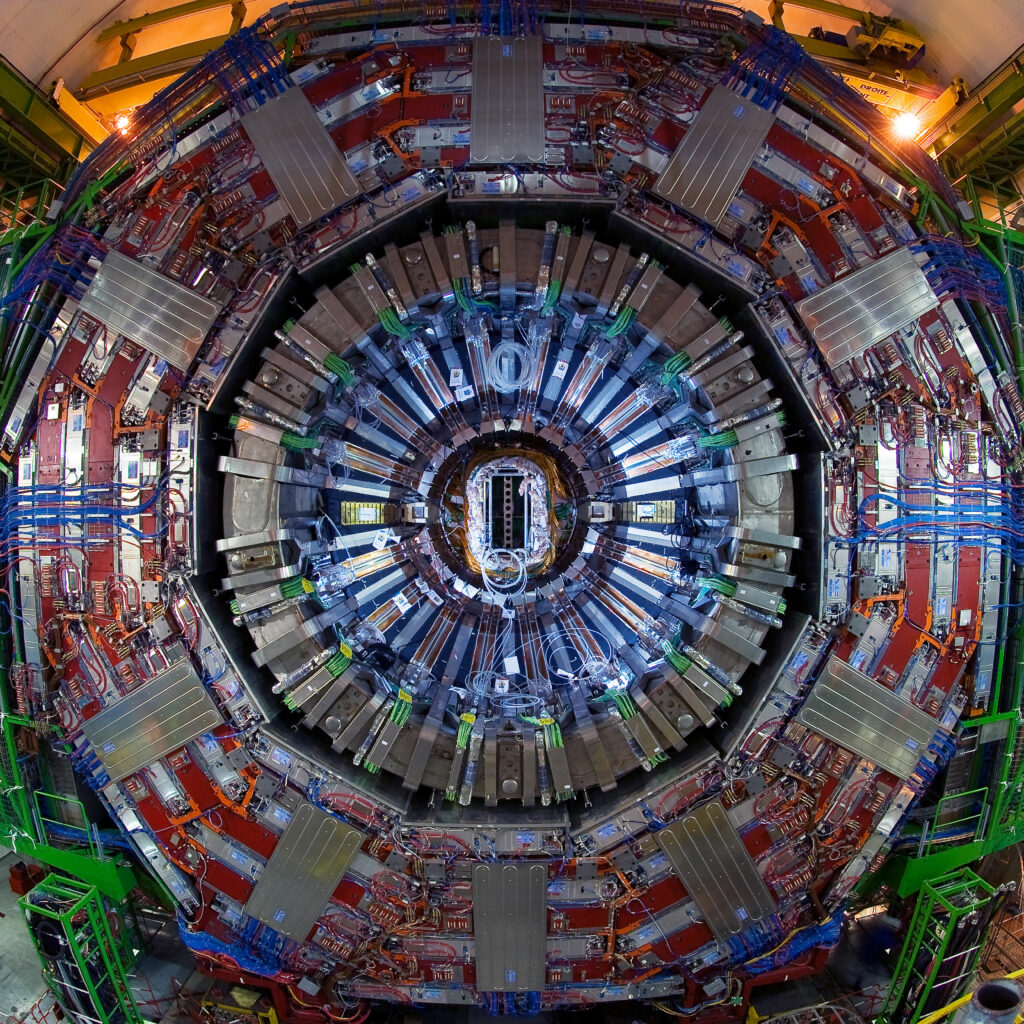
Short Answer
Overview of CERN
The European Organization for Nuclear Research, commonly referred to as CERN, is a leading institution in the field of particle physics. Founded in 1954, CERN’s primary objective is to explore the fundamental building blocks of matter and the forces governing them. Central to its research is the Large Hadron Collider (LHC), the world’s most powerful particle accelerator, which has enabled groundbreaking experiments and discoveries in high-energy physics.
Definition and Mission
CERN is an international research organization dedicated to advancing our understanding of the universe at its most elementary level. Its mission encompasses:
- Fundamental Research:
Investigating the smallest particles and forces that constitute the fabric of reality. - Technological Innovation:
Developing cutting-edge technologies to facilitate experiments and data analysis. - Global Collaboration:
Fostering cooperation among scientists, engineers, and institutions worldwide.
Scientific Achievements and Milestones
One of CERN’s most celebrated accomplishments is the 2012 discovery of the Higgs boson, a particle integral to the Standard Model of particle physics. This breakthrough confirmed long-standing theoretical predictions and was the result of a massive international collaboration involving thousands of experts across multiple disciplines. The discovery not only validated existing theories but also opened new avenues for exploring phenomena beyond the Standard Model.
Operational Mechanisms and Experimental Approach
CERN’s research methodology revolves around high-energy particle collisions facilitated by the LHC. Protons and heavy ions are accelerated to near-light speeds and collided, producing conditions similar to those just after the Big Bang. These collisions generate vast amounts of data, which require sophisticated computational infrastructure and advanced algorithms to analyze. This iterative process of experimentation and refinement allows scientists to test hypotheses, confirm theoretical models, and potentially uncover new physics.
Collaborative Environment and Knowledge Sharing
Beyond particle physics, CERN serves as a hub for interdisciplinary innovation. It brings together physicists, data scientists, engineers, and educators, fostering an environment where diverse expertise converges. The technologies developed at CERN have far-reaching applications, including advancements in medical imaging and novel computing techniques inspired by the demands of particle physics research. This collaborative spirit enhances both scientific progress and technological development.
Public Engagement and Educational Outreach
Recognizing the importance of public interest in science, CERN actively engages in educational outreach and science communication. Through various programs and initiatives, it aims to inspire curiosity and enthusiasm about the universe among diverse audiences. These efforts are crucial for nurturing the next generation of scientists and engineers, ensuring the continuity of scientific exploration and innovation.
Challenges and Scientific Frontiers
Despite its successes, CERN faces significant challenges. The quest to understand elusive phenomena such as dark matter, dark energy, and antimatter remains ongoing. These mysteries highlight the limitations of current theories and call for new conceptual frameworks. Additionally, the complexity of particle physics experiments demands continuous technological advancements and substantial resource allocation.
Funding and Resource Allocation Considerations
Investment in fundamental research at CERN often sparks debate regarding the allocation of public funds. Critics question the tangible benefits relative to costs, especially when compared to pressing societal needs like healthcare and education. Advocates emphasize the long-term value of fundamental science in expanding human knowledge and driving technological innovation. Effective communication of CERN’s impact is essential to justify continued support and foster public understanding.
Why CERN’s Mission is Crucial
CERN’s endeavors are vital for pushing the boundaries of human knowledge and technology. By probing the universe’s most fundamental aspects, CERN not only enriches scientific understanding but also stimulates technological progress with broad societal benefits. Its role as a beacon of international cooperation and scientific curiosity exemplifies the spirit of discovery that drives humanity forward.
Conclusion: Embracing the Unknown
Evaluating CERN’s success involves considering scientific breakthroughs, societal impact, and philosophical implications. The organization has significantly advanced our comprehension of the cosmos through collaborative research and innovation. As CERN continues to explore uncharted territories in physics, it challenges us to embrace uncertainty and expand our horizons. This relentless pursuit of knowledge fuels humanity’s quest to unravel the deepest mysteries of existence and inspires future generations to continue exploring the universe’s vast and enigmatic realms.
FAQ
What is CERN?
CERN is the European Organization for Nuclear Research, specializing in particle physics and known for the Large Hadron Collider.
What are CERN's main objectives?
CERN aims to explore fundamental particles and forces, foster global collaboration, and drive technological innovations.
What is the significance of the Higgs boson?
The Higgs boson, discovered in 2012, is crucial to the Standard Model of particle physics, confirming key theoretical predictions.
How does CERN engage with the public?
CERN conducts educational outreach and science communication initiatives to inspire interest in science and technology.






Leave a Reply