
Short Answer
Definition of Hydrocarbons
Hydrocarbons are organic compounds composed exclusively of carbon and hydrogen atoms. They serve as fundamental molecules in organic chemistry and play a pivotal role in various scientific fields such as materials science, energy production, and biological systems. Unlike atoms, which are the smallest units of matter, hydrocarbons are molecules formed by the covalent bonding of multiple atoms.
- Atom:
The basic unit of matter consisting of a nucleus (protons and neutrons) surrounded by electrons. - Molecule:
A chemical structure made up of two or more atoms bonded together. - Hydrocarbon:
A molecule containing only carbon and hydrogen atoms bonded covalently.
Classification of Hydrocarbons
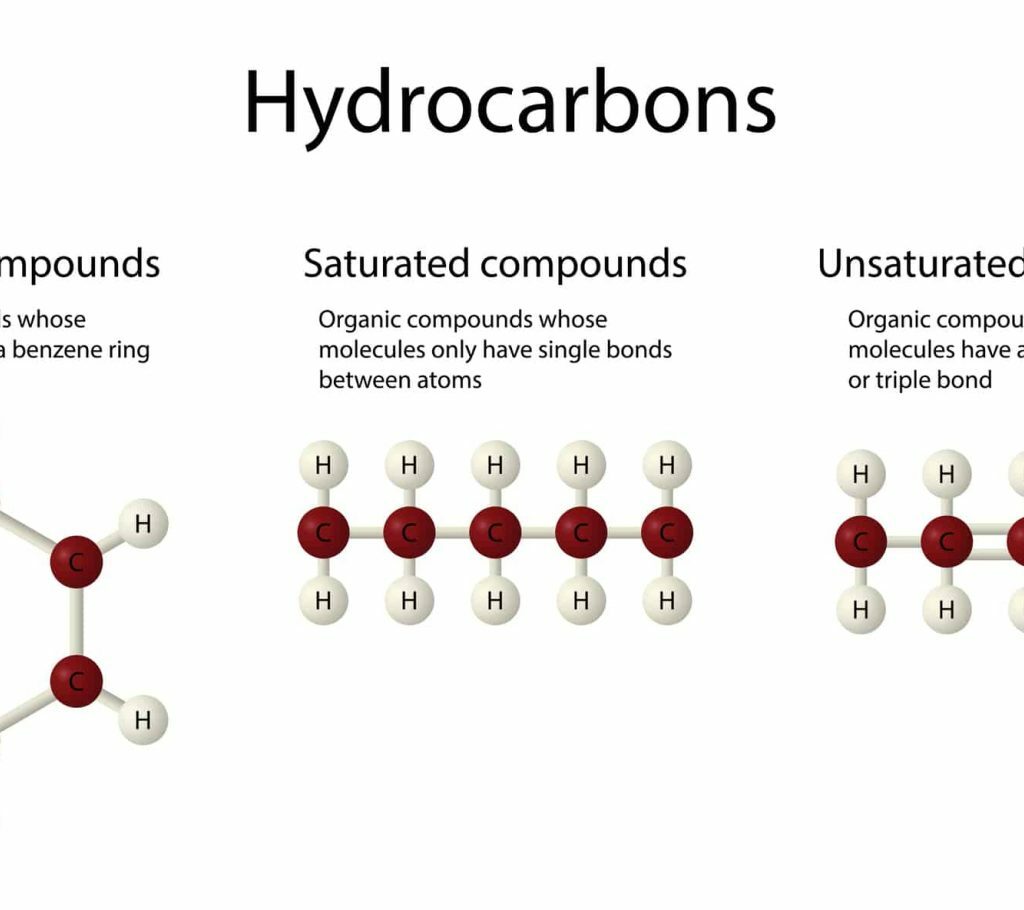
Hydrocarbons are broadly categorized into two main types based on their structural features: aliphatic and aromatic hydrocarbons.
- Aliphatic Hydrocarbons:
These include alkanes, alkenes, and alkynes, characterized by linear or branched chains of carbon atoms. Alkanes have single bonds, alkenes contain double bonds, and alkynes possess triple bonds between carbon atoms. - Aromatic Hydrocarbons:
These molecules contain one or more benzene-like rings with delocalized pi electrons, which contribute to their unique stability and chemical behavior.
Structural Characteristics and Bonding
The carbon atom’s tetravalency allows it to form four stable covalent bonds, enabling the creation of a vast variety of hydrocarbon molecules. This versatility results in structures ranging from the simplest methane (CH4) to complex polycyclic aromatic hydrocarbons. The geometry and bonding angles within these molecules influence their chemical reactivity and physical properties.
Hydrocarbon Saturation and Reactivity
Hydrocarbons differ in their saturation levels, which significantly affect their chemical behavior:
- Saturated Hydrocarbons (Alkanes):
Contain only single bonds between carbon atoms, making them relatively less reactive. - Unsaturated Hydrocarbons (Alkenes and Alkynes):
Contain double or triple bonds, respectively, which introduce sites of higher reactivity and enable diverse chemical transformations.
Examples of Hydrocarbons
Simple hydrocarbons illustrate the diversity within this class of molecules:
- Methane (CH4):
The simplest hydrocarbon with one carbon atom bonded to four hydrogen atoms, widely used as a natural gas fuel. - Ethane and Propane:
Slightly larger alkanes with two and three carbon atoms, respectively, each exhibiting distinct physical and chemical properties. - Polycyclic Aromatic Hydrocarbons:
Complex molecules with multiple interconnected aromatic rings, often found in fossil fuels and environmental pollutants.
Hydrocarbons in Energy and Industry
Hydrocarbons are integral to energy production, primarily as components of fossil fuels such as natural gas, petroleum, and coal. Their combustion releases energy used to power engines, generate electricity, and produce heat. Additionally, hydrocarbons serve as raw materials in manufacturing a wide array of products, including plastics, pharmaceuticals, and synthetic chemicals.
Environmental Impact of Hydrocarbon Use
The widespread use of hydrocarbon fuels has significant environmental consequences. Burning hydrocarbons emits carbon dioxide, a greenhouse gas that contributes to global warming and climate change. This environmental challenge has spurred research into sustainable alternatives like biofuels and renewable energy sources, aiming to reduce dependence on fossil fuels and mitigate ecological damage.
Hydrocarbons in Advanced Technologies
Beyond traditional applications, hydrocarbons and their derivatives are foundational in cutting-edge fields such as nanotechnology and materials science. Carbon-based nanomaterials like graphene and carbon nanotubes, derived from hydrocarbon structures, exhibit exceptional electrical, mechanical, and thermal properties. These materials are revolutionizing electronics, medicine, and engineering.
Molecular Interactions and Solubility
Hydrocarbons exhibit unique molecular interactions, particularly their hydrophobic nature and limited solubility in polar solvents like water. These properties are crucial in separation techniques used in organic chemistry and influence drug absorption and distribution in pharmacology.
Common Misconceptions About Hydrocarbons
Hydrocarbons are single atoms.
Hydrocarbons are molecules composed of multiple carbon and hydrogen atoms bonded together.
All hydrocarbons have the same chemical reactivity.
Hydrocarbon reactivity varies widely depending on saturation and molecular structure.
Significance of Hydrocarbons
Hydrocarbons are fundamental to understanding organic chemistry and have far-reaching implications in energy, industry, environmental science, and advanced technology. Their molecular complexity and versatility make them indispensable in both natural processes and human innovation, while also presenting challenges that drive ongoing scientific research and sustainable development efforts.
FAQ
What is a hydrocarbon?
A hydrocarbon is a molecule made up entirely of carbon and hydrogen atoms.
Are hydrocarbons atoms?
No, hydrocarbons are molecules, which are formed from two or more atoms.
What are the main types of hydrocarbons?
The main types of hydrocarbons are aliphatic hydrocarbons and aromatic hydrocarbons.
What is the significance of hydrocarbons?
Hydrocarbons are fundamental in energy production, materials science, and understanding organic chemistry.





Leave a Reply