
Short Answer
Definition of the Strong Force
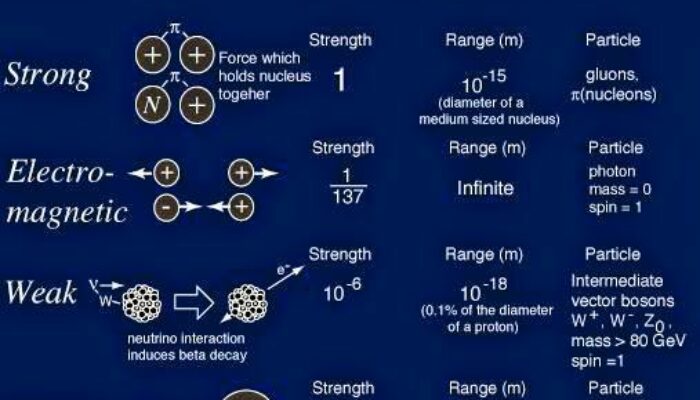
The strong force, also known as the strong nuclear interaction, is one of the four fundamental forces in nature. It is the primary force responsible for holding quarks together to form protons and neutrons, and subsequently binding these nucleons within atomic nuclei. This force operates at extremely short ranges but is incredibly powerful, overcoming the electromagnetic repulsion between positively charged protons to maintain nuclear stability.
- Fundamental Role:
It binds quarks inside protons and neutrons and holds these nucleons together in the nucleus. - Range and Strength:
Acts over distances on the order of femtometers (10-15 meters) and is the strongest of the four fundamental forces at this scale. - Force Carriers:
Gluons mediate the strong force by exchanging color charge between quarks.
Historical Development and Early Discoveries
The journey to understand the strong force began in the early 20th century, a transformative era for physics marked by the emergence of quantum mechanics. This new theoretical framework provided the tools to describe particle behavior at microscopic scales. Early nuclear research, spearheaded by scientists such as Ernest Rutherford, revealed that atomic nuclei were complex structures held together by forces far stronger than electromagnetism.
Wolfgang Pauli’s exclusion principle laid foundational groundwork, but the discovery of the neutron by James Chadwick in 1932 was pivotal. It raised critical questions about how protons and neutrons could remain bound despite the repulsive electromagnetic forces between protons, prompting the hypothesis of a powerful nuclear force acting at short distances.
Nature and Characteristics of the Strong Force
The strong force exhibits a unique dual behavior: it is attractive at short distances, ensuring nucleons remain bound, but becomes repulsive when particles are extremely close, preventing the collapse of the nucleus. This balance is essential for nuclear stability.
Unlike electromagnetic or weak forces, the strong interaction is governed by the property known as color charge, a quantum characteristic of quarks. The force carriers, gluons, facilitate the exchange of color charge, binding quarks together within hadrons such as protons and neutrons.
Quantum Chromodynamics: The Theoretical Framework
Quantum Chromodynamics (QCD), developed in the 1970s, revolutionized the understanding of the strong force. QCD is a gauge theory describing how quarks and gluons interact through color charge. It explains phenomena such as confinement, where quarks are perpetually bound inside hadrons and cannot be isolated, and asymptotic freedom, where the strong force weakens at very short distances.
Key Concepts in QCD
- Color Charge:
Analogous to electric charge but comes in three types (red, green, blue), which quarks carry. - Gluons:
Massless particles that mediate the strong force by exchanging color charge between quarks. - Confinement:
The phenomenon preventing quarks from existing freely outside hadrons. - Asymptotic Freedom:
The property that quarks interact weakly at very short distances, allowing perturbative calculations.
Experimental Advances and Particle Accelerators
The development of particle accelerators such as Fermilab and CERN enabled physicists to probe the subatomic world at unprecedented energies. By accelerating protons and neutrons to near-light speeds and colliding them, researchers observed a plethora of particles, including baryons and mesons, which supported the quark model proposed by Murray Gell-Mann and George Zweig.
Deep inelastic scattering experiments at DESY in the late 1960s provided compelling evidence for the existence of point-like constituents within protons, confirming that protons are composed of quarks held together by gluons. These findings validated the QCD framework and deepened the understanding of the strong force’s role in particle interactions.
Computational Techniques: Lattice QCD
To tackle the complexities of the strong force, especially confinement, physicists developed lattice QCD, a numerical simulation method that discretizes space-time into a lattice. This approach allows for precise calculations of hadron properties such as mass and decay rates, overcoming analytical challenges posed by the non-perturbative nature of QCD at low energies.
Interconnections with Other Fundamental Forces
The discovery of the Higgs boson at the Large Hadron Collider in 2012 provided additional insights into particle physics, indirectly influencing the understanding of the strong force. The Higgs mechanism explains how particles acquire mass, which complements the study of fundamental interactions, including the strong, electromagnetic, and weak forces, highlighting the unified nature of the universe’s fundamental forces.
Common Misconceptions About the Strong Force
The strong force acts only between protons and neutrons.
The strong force primarily acts between quarks inside protons and neutrons, and the nuclear force between nucleons is a residual effect of this fundamental interaction.
Quarks can be isolated and observed independently.
Due to confinement, quarks cannot exist freely and are always bound within hadrons.
Significance of the Strong Force
The strong force is crucial for the existence of matter as we know it. Without it, atomic nuclei would not hold together, and atoms could not form, making the universe vastly different. Its study has driven advances in quantum field theory, particle physics, and cosmology, shaping our understanding of the fundamental structure of matter and the forces governing the cosmos.
Summary and Future Outlook
The exploration of the strong force represents a remarkable scientific achievement, combining theoretical innovation with experimental breakthroughs. From early nuclear discoveries to the sophisticated framework of QCD and lattice simulations, physicists have unraveled many mysteries of this powerful interaction. Yet, questions remain, and ongoing research continues to probe deeper into the subatomic world, promising new revelations about the universe’s fundamental fabric.
FAQ
What is the strong force?
The strong force is a fundamental interaction that holds quarks together inside protons and neutrons and binds these nucleons inside atomic nuclei.
How was the strong force discovered?
It was discovered through nuclear stability studies, neutron discovery, and later confirmed by high-energy physics experiments and theoretical developments in quantum chromodynamics.
What role does quantum chromodynamics play?
Quantum chromodynamics is the theory that explains how quarks and gluons interact via the strong force using the concept of color charge.
Why can’t we isolate individual quarks?
Quarks are permanently confined inside hadrons due to the strong force property called confinement, preventing their isolation.
How do particle accelerators help study the strong force?
They enable collisions at high energies to probe quark and gluon interactions, revealing the structure of matter and confirming theoretical models.






Leave a Reply