
Short Answer
Definition of the Strong Nuclear Force
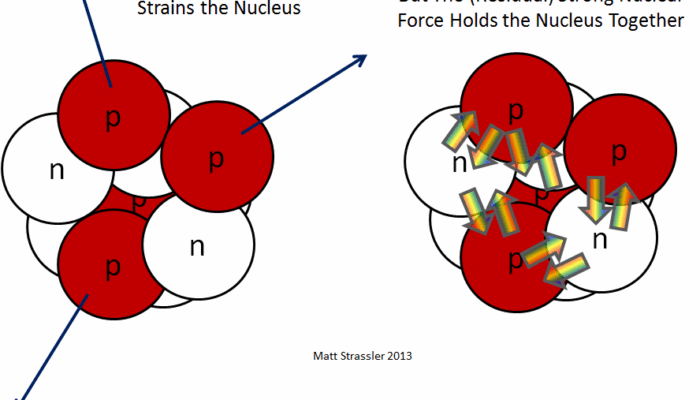
The strong nuclear force is a fundamental interaction responsible for binding protons and neutrons within an atomic nucleus. It overcomes the electromagnetic repulsion between positively charged protons, ensuring the stability of the nucleus. This force operates at extremely short ranges, typically on the order of femtometers (10-15 meters), and is one of the four fundamental forces in nature.
- Nature:
A powerful, short-range force that acts between nucleons (protons and neutrons). - Role:
Maintains the integrity of atomic nuclei by counteracting electrostatic repulsion. - Range:
Effective only at subatomic distances, diminishing rapidly beyond the size of the nucleus.
Historical Background and Early Discoveries
The journey to uncover the strong nuclear force is deeply connected to the evolution of atomic theory and quantum mechanics. At the dawn of the 20th century, scientific focus was primarily on understanding the atom’s structure. John Dalton’s atomic theory laid the foundation, but it was Ernest Rutherford’s 1911 gold foil experiment that revolutionized the atomic model by revealing a dense, positively charged nucleus at the atom’s center.
Rutherford’s findings raised a critical question: how do protons, which repel each other due to their positive charges, remain bound within such a tiny nucleus? This puzzle highlighted the need for a force stronger than electromagnetism to hold the nucleus together, sparking decades of research into nuclear stability and interactions.
Key Developments in Nuclear Physics
The 1930s marked significant progress in understanding nuclear components and forces. James Chadwick’s 1932 discovery of the neutron, a neutral particle residing in the nucleus, was instrumental. Neutrons contribute to nuclear mass and help mediate the strong force without adding to electrostatic repulsion, clarifying the composition and stability of nuclei.
Building on this, Hideki Yukawa in 1935 proposed a theoretical model suggesting that the strong nuclear force is transmitted by a new particle, which he named the meson. Yukawa’s hypothesis introduced the concept of force-carrying particles within quantum field theory, positing that mesons act as intermediaries facilitating the attraction between nucleons.
Experimental Confirmation and Particle Discoveries
Validating Yukawa’s theory required advanced experimental techniques, which became feasible after World War II with the development of particle accelerators. In 1947, Cecil Powell and his collaborators detected the pion, the meson predicted by Yukawa, through cosmic ray experiments. This discovery provided concrete evidence for the existence of the strong nuclear force and linked nuclear physics with the emerging field of particle physics.
Modern Understanding: Quantum Chromodynamics
The 1970s ushered in a deeper comprehension of the strong interaction through the formulation of quantum chromodynamics (QCD). QCD describes how quarks, the fundamental constituents of protons and neutrons, interact via the exchange of gluons, the carriers of the strong force. This theory introduced the concept of color charge, a property analogous to electric charge but unique to the strong interaction, explaining how quarks are confined within nucleons.
QCD not only elucidated the mechanisms behind nuclear binding but also became a cornerstone of the Standard Model of particle physics, which systematically categorizes elementary particles and their interactions.
Applications and Significance in Science
The strong nuclear force is crucial beyond atomic stability. It plays a vital role in astrophysical phenomena such as stellar nucleosynthesis-the process by which stars generate heavier elements-and the dynamics of supernova explosions. Additionally, ongoing research at facilities like the Large Hadron Collider (LHC) continues to probe the strong force under extreme conditions, testing theoretical models and searching for new physics.
Common Misconceptions About the Strong Nuclear Force
The strong nuclear force acts over long distances.
The strong force is effective only at very short ranges, approximately the size of an atomic nucleus.
The strong nuclear force is the same as the electromagnetic force.
While both act within atoms, the strong force is fundamentally different, binding nucleons together, whereas the electromagnetic force causes repulsion between like charges.
Protons alone determine nuclear stability.
Both protons and neutrons contribute to nuclear stability, with neutrons playing a key role in mediating the strong force without adding repulsive charge.
Summary: The Legacy of the Strong Nuclear Force Discovery
The identification and understanding of the strong nuclear force represent a landmark achievement in physics, shaped by the collaborative efforts of numerous scientists over decades. From Rutherford’s pioneering nuclear model to Yukawa’s theoretical insights and the experimental breakthroughs that followed, this force exemplifies the intricate interplay between theory and experiment. Today, the strong nuclear force remains a fundamental concept that not only explains atomic cohesion but also drives ongoing exploration into the fundamental nature of matter and the universe.
FAQ
What is the strong nuclear force?
The strong nuclear force is the fundamental interaction that binds protons and neutrons within the atomic nucleus, overcoming the electromagnetic repulsion between protons.
Who proposed the existence of the strong nuclear force?
Hideki Yukawa proposed the existence of the strong nuclear force in 1935, introducing the concept of mesons as force carriers.
How was the strong nuclear force experimentally confirmed?
It was confirmed through the discovery of pions (mesons) by Cecil Powell and colleagues in 1947 using cosmic ray experiments.
What is Quantum Chromodynamics?
Quantum Chromodynamics (QCD) is the modern theory explaining the strong nuclear force as an interaction between quarks mediated by gluons.
Does the strong nuclear force act over long distances?
No, it acts only at very short ranges, approximately the size of an atomic nucleus.






Leave a Reply