
Short Answer
Definition of Quantum Computing
Quantum computing represents a groundbreaking computational approach that leverages the unique principles of quantum mechanics to process information. Unlike classical computing, which relies on bits as the smallest unit of data, quantum computing utilizes quantum bits or qubits, enabling new possibilities in processing power and problem-solving capabilities. This emerging technology promises to transform various fields by exploiting phenomena that defy classical logic.
Fundamental Principles of Quantum Mechanics in Computing
Understanding quantum computing necessitates familiarity with the core concepts of quantum mechanics, the branch of physics that describes the behavior of particles at atomic and subatomic scales. Three pivotal principles underpin quantum theory and form the foundation of quantum computation:
- Superposition:
Qubits can exist in multiple states simultaneously, unlike classical bits restricted to either 0 or 1. This property allows quantum computers to evaluate numerous possibilities at once, vastly increasing computational efficiency. - Entanglement:
This phenomenon links qubits in such a way that the state of one instantly influences the state of another, regardless of the distance between them. Entanglement enables complex correlations that classical systems cannot replicate. - Uncertainty Principle:
Formulated by Heisenberg, this principle states that certain pairs of physical properties cannot be precisely measured simultaneously. While this introduces inherent unpredictability, it also opens pathways for algorithms that harness probabilistic outcomes.
How Quantum Computing Operates
Quantum computers manipulate qubits through quantum gates, which alter their states according to the principles of superposition and entanglement. When a qubit is measured, it collapses from a superposition into a definite state of 0 or 1, producing a result. The interplay of multiple qubits and their entangled states allows quantum computers to perform parallel computations on a massive scale, solving specific problems more efficiently than classical machines.
Mathematical Foundations and Formulas
Quantum computing is deeply rooted in linear algebra and complex vector spaces. Qubits are represented as vectors in a two-dimensional complex Hilbert space, typically expressed as:
|ψ⟩ = α|0⟩ + β|1⟩
- |ψ⟩: The state vector of a qubit.
- α, β: Complex probability amplitudes, where |α|² + |β|² = 1.
- |0⟩ and |1⟩: Basis states analogous to classical bit values 0 and 1.
Quantum gates are represented by unitary matrices that operate on these vectors, transforming qubit states while preserving their norm. Understanding eigenvalues, eigenvectors, and matrix operations is essential for grasping quantum algorithms and circuit design.
Practical Applications and Examples
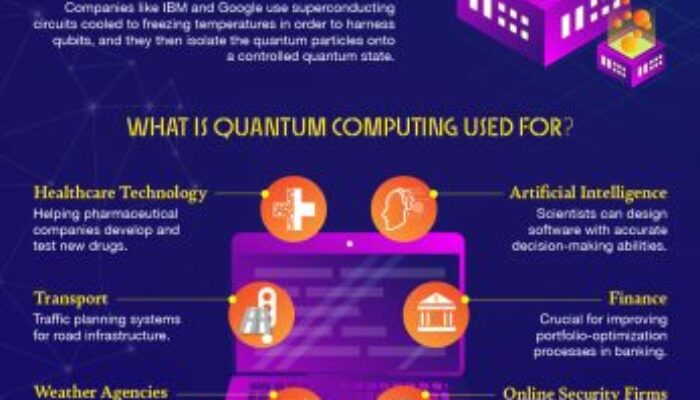
Quantum computing holds promise across diverse sectors:
- Cryptography:
Algorithms like Shor’s algorithm can factor large numbers exponentially faster than classical methods, threatening current encryption standards. - Search Optimization:
Grover’s algorithm accelerates unstructured database searches, offering quadratic speedups. - Material Science:
Simulating molecular interactions at quantum levels to design new materials and drugs. - Artificial Intelligence:
Enhancing machine learning models through quantum-enhanced data processing.
Common Misunderstandings About Quantum Computing
- Misconception: Quantum computers will replace classical computers entirely.
Correction: Quantum computers are specialized devices designed for particular problem types and will complement rather than replace classical systems. - Misconception: Qubits are just faster bits.
Correction: Qubits operate under fundamentally different principles, enabling parallelism and entanglement, which classical bits cannot achieve. - Misconception: Quantum computing is fully mature and widely available.
Correction: The technology is still in developmental stages, with practical, large-scale quantum computers yet to be realized.
Steps to Learn Quantum Computing
For those interested in exploring quantum computing, a structured approach is beneficial:
- Start with Accessible Literature:
Books like “Quantum Computing for Everyone” by Chris Bernhardt offer clear introductions without requiring advanced physics knowledge. - Engage with Online Courses:
Platforms such as Coursera, edX, and Udacity provide comprehensive courses combining theory and hands-on programming. - Develop Mathematical Skills:
Mastery of linear algebra, complex numbers, and matrix operations is crucial. Resources like Khan Academy and MIT OpenCourseWare are valuable. - Practice Programming:
Learn Python and explore quantum programming frameworks like Qiskit, Cirq, and Quipper to implement quantum algorithms. - Join the Community:
Participate in forums, attend webinars, and collaborate with peers to deepen understanding and stay motivated.
Staying Updated with Quantum Computing Advances
Keeping informed about the latest research and technological breakthroughs is vital. Subscribing to scientific journals such as “Nature Quantum Information” and “Physical Review Letters” provides insights into cutting-edge developments. Additionally, following organizations like the Quantum Computing Report and academic institutions helps track industry trends and emerging applications.
Significance of Quantum Computing
Quantum computing is poised to redefine computational capabilities, impacting science, technology, and everyday life. By harnessing quantum phenomena, it offers solutions to problems currently intractable for classical computers, from cryptography to complex simulations. Beyond its practical applications, quantum computing challenges our understanding of reality, inspiring new philosophical and scientific inquiries. Embracing this technology equips individuals and industries to participate in a transformative era of innovation.
FAQ
What is quantum computing?
Quantum computing is a computational approach that uses quantum mechanics principles, leveraging qubits to process information more efficiently than classical computers.
How do quantum computers differ from classical computers?
Quantum computers utilize qubits that can exist in multiple states simultaneously, allowing for parallel computations, unlike classical computers that use bits.
What are some applications of quantum computing?
Quantum computing has applications in cryptography, search optimization, material science, and artificial intelligence.






Leave a Reply