
Short Answer
Definition of Experimental Error
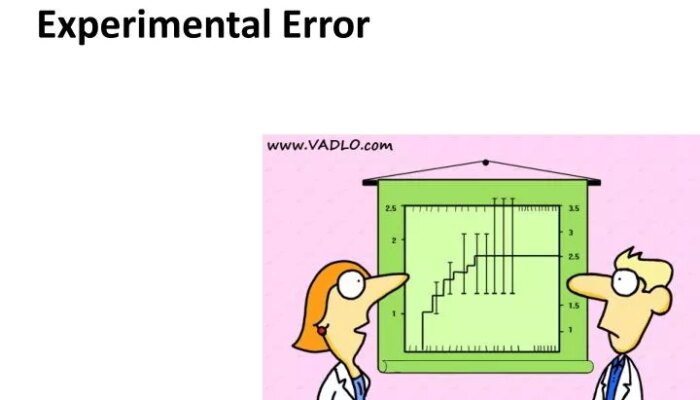
Experimental error refers to the deviations or inaccuracies that occur during the process of measurement in scientific experiments. These errors affect the precision and accuracy of empirical data, influencing the reliability of conclusions drawn from experimental results. Understanding and quantifying experimental error is fundamental to the scientific method, as it helps researchers evaluate the trustworthiness of their findings and refine their methodologies.
Types of Experimental Errors
Experimental errors can be broadly categorized into two main types: systematic errors and random errors. Each type has distinct characteristics and origins.
- Systematic Errors:
These errors consistently skew measurements in a particular direction due to persistent factors such as faulty calibration, environmental influences, or inherent flaws in measurement instruments. For example, a miscalibrated scale that is not zeroed correctly will produce measurements that are uniformly offset, introducing bias into the data. - Random Errors:
These errors arise from unpredictable and uncontrollable fluctuations during measurement. Causes include minor environmental changes, variations in instrument sensitivity, or human observational inconsistencies. Unlike systematic errors, random errors vary in magnitude and direction, leading to scatter in the data.
Propagation of Errors in Measurements
When experiments involve multiple measurements combined through calculations, the uncertainties from each measurement can accumulate and affect the final result. This phenomenon is known as error propagation. The mathematical framework for this is provided by the law of propagation of uncertainty, which quantifies how individual measurement errors contribute to the overall uncertainty in derived quantities. Employing statistical tools alongside this law enables scientists to estimate confidence levels and assess the reliability of their experimental outcomes.
Methods for Quantifying Experimental Error
Researchers utilize several techniques to evaluate and minimize experimental errors:
- Repeated Measurements:
Taking multiple measurements of the same quantity allows calculation of the mean value, which helps reduce the influence of random errors. The standard deviation of these measurements indicates the spread or variability, with smaller values signifying higher precision. - Calibration:
Systematic errors are addressed by calibrating instruments against known standards or reference materials. Regular calibration ensures that measurement devices maintain accuracy over time, reducing bias. - Blind Experiments:
Conducting experiments where the experimenter is unaware of key variables helps eliminate subjective bias, enhancing data integrity. - Outlier Detection:
Identifying anomalous data points that deviate significantly from the rest is crucial. Statistical tests such as Grubb’s test or Dixon’s Q test assist in objectively recognizing outliers, which can then be excluded or further investigated.
Incorporating Error Analysis in Experimental Design
Effective experimental design anticipates potential sources of error and incorporates strategies to mitigate them. Techniques such as randomization, replication, and blinding improve the robustness of experiments by controlling for confounding variables and reducing bias. Thoughtful planning ensures that errors are minimized and that the data collected is as reliable as possible.
Advanced Techniques: Monte Carlo Simulations
Monte Carlo simulations represent a sophisticated approach to error analysis. This computational method uses random sampling to model the impact of uncertainty on experimental results. By simulating numerous scenarios that incorporate variability in measurements, researchers can generate probability distributions of possible outcomes. This technique provides deeper insight into the range and likelihood of errors, reflecting the complexity of real-world experimental conditions.
Communicating Experimental Uncertainty
Transparent reporting of experimental results includes clearly stating the associated uncertainties. Expressing findings with error margins, such as confidence intervals or percentage errors, allows for a more nuanced interpretation of data. This practice is essential for comparing results across different studies, validating scientific theories, and fostering open scientific discourse.
Significance of Understanding Experimental Error
Grasping the nature and implications of experimental error is vital for advancing scientific knowledge. Accurate error determination enhances the credibility of research, guides improvements in experimental techniques, and supports the development of reliable technologies. Ultimately, meticulous error analysis contributes to the collective endeavor of unraveling the complexities of the natural world with precision and confidence.
FAQ
What is experimental error?
Experimental error refers to the inaccuracies that occur during measurements in scientific experiments, affecting the reliability of the results.
What are the types of experimental errors?
The two main types of experimental errors are systematic errors, which consistently skew measurements, and random errors, which arise from unpredictable fluctuations.
How can experimental errors be quantified?
Experimental errors can be quantified using repeated measurements, calibration, blind experiments, and statistical tests for outlier detection.
What is error propagation?
Error propagation is the process by which uncertainties from multiple measurements combine and affect the final result of an experiment.




Leave a Reply