
Short Answer
Definition of the Sun’s Gravitational Influence
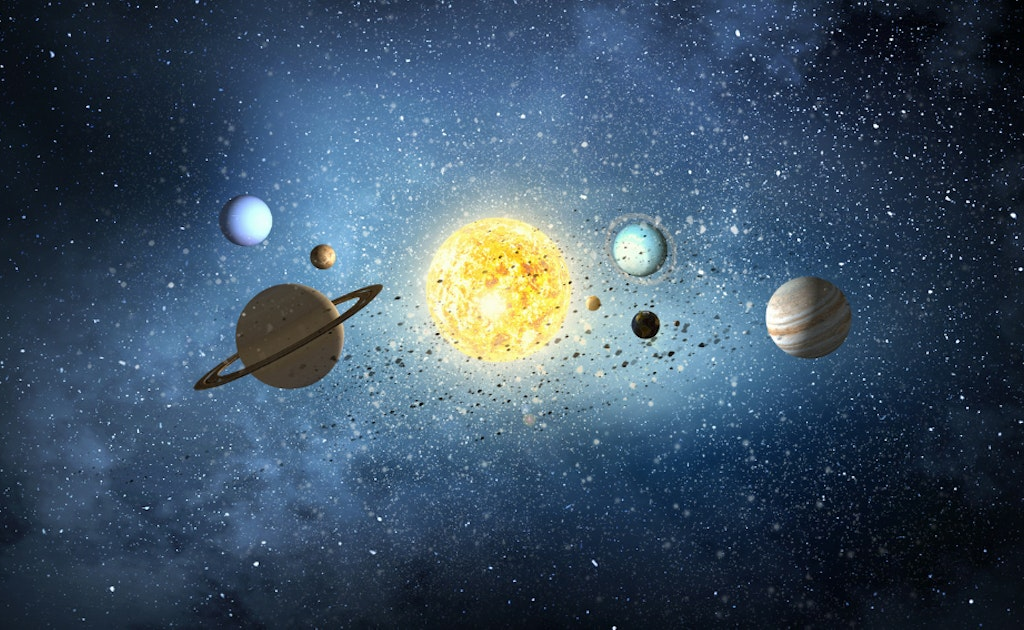
The Sun’s gravity is the invisible yet immensely powerful force that governs the motion of all objects within our solar system. It acts as the central anchor, holding planets, asteroids, comets, and cosmic debris in their orbits, thereby maintaining the structural integrity and dynamic balance of our celestial neighborhood.
- Central Force:
The Sun’s gravitational pull is the primary force that keeps planets bound in elliptical orbits around it. - Massive Origin:
This force arises from the Sun’s enormous mass, which is roughly 330,000 times that of Earth.
Fundamentals of Orbital Mechanics
The motion of planets around the Sun is governed by the principles of orbital mechanics, where gravity and velocity interact to create stable paths. Planetary orbits are elliptical rather than perfectly circular, shaped by the balance between the Sun’s gravitational attraction and the planet’s forward motion.
- Orbital Shape:
Planets follow elliptical trajectories due to the interplay of gravitational pull and their velocity. - Velocity Balance:
If a planet’s speed is too slow, it spirals inward toward the Sun; if too fast, it risks escaping the solar system.
Distance and Orbital Velocity Relationship
The strength of the Sun’s gravitational pull diminishes with distance, following the inverse square law. This means planets closer to the Sun experience a stronger force and must travel faster to maintain their orbits, while those farther away move more slowly but remain gravitationally bound.
- Inner Planets:
Mercury and Venus orbit rapidly due to the intense gravitational force at close range, with Mercury completing an orbit in just 88 Earth days. - Outer Planets:
Distant planets like Neptune orbit much more slowly, taking about 165 Earth years to complete one revolution. - Inverse Square Law:
Gravitational force decreases proportionally to the square of the distance from the Sun, explaining the variation in orbital speeds.
Gravitational Interactions Within the Solar System
While the Sun’s gravity dominates, planets also exert subtle gravitational influences on each other. These interactions cause gradual changes in orbital eccentricity and inclination, leading to phenomena such as orbital precession and resonances that shape the long-term dynamics of the solar system.
- Mutual Perturbations:
Planets’ gravitational tugs cause small but significant shifts in each other’s orbits over millennia. - Orbital Precession:
The slow rotation of orbital paths, influenced by gravitational interactions, affects planetary alignments and stability.
Extent of the Sun’s Gravitational Domain
The Sun’s gravitational reach extends far beyond the planets, encompassing the asteroid belt, the Kuiper Belt, and the distant Oort Cloud. These regions contain numerous small bodies loosely bound by solar gravity, which can be influenced by external forces such as passing stars or galactic tides.
- Asteroid Belt:
Located between Mars and Jupiter, this region contains rocky debris held by the Sun’s gravity. - Kuiper Belt:
A collection of icy bodies beyond Neptune’s orbit, also gravitationally tethered to the Sun. - Oort Cloud:
A vast, spherical shell of icy objects at the solar system’s outermost edge, weakly bound and susceptible to external perturbations.
Relativistic Effects of Solar Gravity
Beyond Newtonian gravity, the Sun’s immense mass warps spacetime, producing relativistic effects predicted by Einstein’s theory of general relativity. These effects, though subtle, are measurable and essential for precise astronomical calculations.
- Spacetime Curvature:
The Sun’s gravity bends the fabric of spacetime, influencing the paths of orbiting bodies. - Mercury’s Perihelion Precession:
The advance of Mercury’s closest orbital point is accurately explained only through relativistic physics.
Practical Importance of Solar Gravity
The Sun’s gravitational control over planetary orbits is crucial for both scientific understanding and practical applications. It enables accurate prediction of celestial events, supports space mission planning, and ensures the stability of Earth’s environment.
- Astronomical Calendars:
Predictable orbits allow for precise timing of eclipses, transits, and other phenomena. - Space Navigation:
Space agencies rely on solar gravity models to chart spacecraft trajectories and utilize gravitational assists. - Earth’s Habitability:
The Sun’s gravitational hold keeps Earth within the habitable zone, maintaining conditions suitable for life.
Modern Research and Technological Advances
Contemporary studies of solar gravity employ advanced methods such as helioseismology, gravitational wave detection, and high-precision spacecraft telemetry. Computational simulations model the solar system’s evolution, predicting future orbital shifts and potential asteroid encounters.
- Helioseismology:
Analyzes solar oscillations to understand internal solar dynamics affecting gravity. - Gravitational Wave Detection:
Explores subtle ripples in spacetime related to massive gravitational interactions. - Computer Simulations:
Predict long-term stability and changes in planetary orbits under gravitational forces.
Summary: The Sun’s Gravitational Role in the Solar System
The Sun’s gravity acts as the master regulator of the solar system’s architecture, orchestrating the orbits of planets and smaller bodies alike. This force not only preserves the spatial arrangement and timing of celestial motions but also underpins the conditions necessary for life on Earth. Its profound influence continues to inspire scientific inquiry, revealing the elegant laws that govern our cosmic environment.
FAQ
How does the Sun's gravity affect planetary orbits?
The Sun's gravity keeps planets in elliptical orbits, balancing gravitational pull with their forward motion.
What is the inverse square law?
The inverse square law states that gravitational force decreases proportionally to the square of the distance from the Sun.
What are relativistic effects in relation to solar gravity?
Relativistic effects refer to the warping of spacetime caused by the Sun's mass, affecting the paths of orbiting bodies.

Leave a Reply