
Short Answer
Definition of Space Telescopes
Space telescopes are advanced observational instruments positioned beyond Earth’s atmosphere, designed to capture and analyze electromagnetic radiation from celestial objects. Unlike ground-based telescopes, they operate in the vacuum of space, free from atmospheric distortions, enabling clearer and more detailed views of the universe.
- Purpose:
To observe distant stars, galaxies, and cosmic phenomena without interference from Earth’s atmospheric conditions. - Location:
Typically placed in orbit around Earth or at strategic points in space to maximize observational capabilities.
Advantages Over Ground-Based Telescopes
Earth’s atmosphere, while essential for life, poses significant challenges for astronomical observations. Atmospheric turbulence causes light to scatter and blur, limiting the resolution and clarity of images captured by terrestrial telescopes. Space telescopes circumvent these issues by operating above the atmosphere, providing an unobstructed and stable platform for observing faint and distant cosmic sources.
- Atmospheric Interference:
Ground telescopes contend with air turbulence, weather conditions, and light pollution, all of which degrade image quality. - Unobstructed View:
Space telescopes avoid these problems, offering sharper and more precise data across various wavelengths.
Core Components and Design Principles
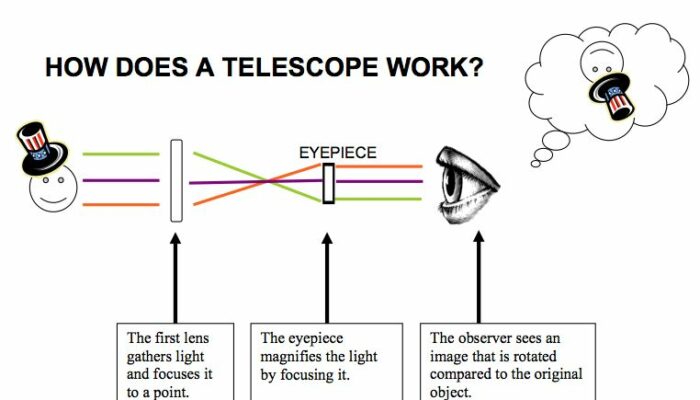
At the heart of a space telescope lies its primary light-collecting element, usually a mirror or lens, engineered to gather photons that have traveled vast cosmic distances. These components are crafted from ultra-lightweight, thermally stable materials to withstand the extreme temperature variations encountered in space, ensuring the optical system maintains its precise shape and alignment.
- Primary Mirror or Lens:
Acts as a large collector of light, focusing it onto detectors with high precision. - Material Engineering:
Utilizes materials that resist deformation from temperature swings, preserving image clarity. - Structural Support:
Designed to maintain microscopic accuracy in alignment, critical for high-resolution imaging.
Optical Systems and Detection Mechanisms
Once light is collected, it passes through a series of finely tuned optical components that refine and direct it toward sensitive detectors. These detectors, often charge-coupled devices (CCDs) or similar sensor arrays, convert incoming photons into electrical signals. This process transforms raw cosmic light into digital data that scientists can interpret and analyze.
- Optical Assemblies:
Include lenses, mirrors, and filters that enhance image quality and isolate specific wavelengths. - Photon Detection:
Sensors register photon energy and convert it into measurable electrical signals. - Data Conversion:
Translates cosmic information into formats suitable for scientific study.
Electromagnetic Spectrum Coverage
Space telescopes are uniquely capable of observing a broad range of electromagnetic wavelengths beyond the visible spectrum accessible to the human eye. This multi-wavelength capability allows astronomers to explore diverse cosmic phenomena and gain a more comprehensive understanding of the universe.
- Infrared Observations:
Penetrate dust clouds to reveal star and planet formation regions hidden from visible light. - Ultraviolet Imaging:
Highlights energetic processes in young, hot stars and galactic environments. - X-ray and Gamma-ray Detection:
Expose high-energy events such as supernovae, black hole activity, and cosmic explosions.
Operational Challenges in Space
Operating telescopes in the harsh environment of space presents unique difficulties. Maintenance is nearly impossible once deployed, requiring exceptional reliability and autonomous functionality. Precision in calibration and orientation is critical, as even minor errors can compromise data quality.
- Remote Control and Automation:
Onboard computers manage telescope positioning and data collection with high accuracy. - Calibration Constraints:
Instruments must maintain alignment and focus without physical intervention. - Environmental Extremes:
Systems endure temperature extremes, cosmic radiation, and micrometeoroid impacts.
Data Transmission and Processing
The vast quantities of data gathered by space telescopes are transmitted back to Earth via high-bandwidth communication links. This process involves sophisticated radio wave transmission and encryption to preserve data integrity over immense distances. Once received, the data undergoes extensive processing and analysis by teams of scientists and engineers.
- Communication Systems:
Utilize advanced radio frequencies and encryption protocols for secure data transfer. - Ground Stations:
Receive and process incoming data streams for scientific use. - Data Analysis:
Involves calibration, correction, and interpretation to extract meaningful insights.
Longevity and Technological Innovations
Space telescopes are engineered for long-term missions, often spanning decades, with minimal maintenance opportunities. This longevity drives innovation in materials, power systems, and protective technologies to ensure sustained operation in space’s demanding environment.
- Durability:
Designed to withstand prolonged exposure to radiation and temperature fluctuations. - Power Systems:
Employ flexible solar arrays and efficient energy storage solutions. - Thermal Management:
Use radiators and insulation to regulate instrument temperatures. - Radiation Shielding:
Protect sensitive electronics from cosmic rays and solar particles.
Scientific Impact and Importance
Space telescopes have revolutionized our understanding of the cosmos by providing unprecedented clarity and access to previously hidden phenomena. They serve as vital tools in astrophysics, cosmology, and planetary science, enabling discoveries about star formation, galaxy evolution, and the origins of the universe.
- Cosmic History:
Reveal information about the early universe and the lifecycle of celestial bodies. - Technological Advancement:
Drive innovation in optics, materials science, and data processing. - Human Knowledge:
Expand our comprehension of the universe and humanity’s place within it.
Common Misconceptions About Space Telescopes
Space telescopes can be easily repaired or upgraded in orbit.
Most space telescopes are designed for autonomous operation with limited or no maintenance, making repairs extremely challenging and rare.
Space telescopes only observe visible light.
They are equipped to detect a wide range of electromagnetic wavelengths, including infrared, ultraviolet, X-rays, and gamma rays.
Future Prospects
As technology progresses, space telescopes will continue to evolve, offering even more detailed and diverse observations. Upcoming missions aim to explore new spectral regions, improve resolution, and extend mission lifespans, further unveiling the universe’s mysteries and enhancing our cosmic perspective.
FAQ
How do space telescopes work?
They capture light from celestial objects through mirrors or lenses, convert it to electrical signals, and transmit data to Earth.



Leave a Reply