
Short Answer
Overview of Fundamental Forces
The strong nuclear force and electromagnetism are two of the fundamental interactions that shape the universe. Although they arise from different origins and manifest distinct behaviors, these forces share remarkable similarities that highlight their essential roles in atomic and subatomic phenomena. Understanding their interplay provides insight into the structure and stability of matter as well as the interactions that govern particle dynamics.
Definition and Roles in Atomic Structure
Both the strong nuclear force and electromagnetism are foundational forces discovered during the development of modern physics. They operate at the core of atomic and subatomic systems:
- Strong Nuclear Force:
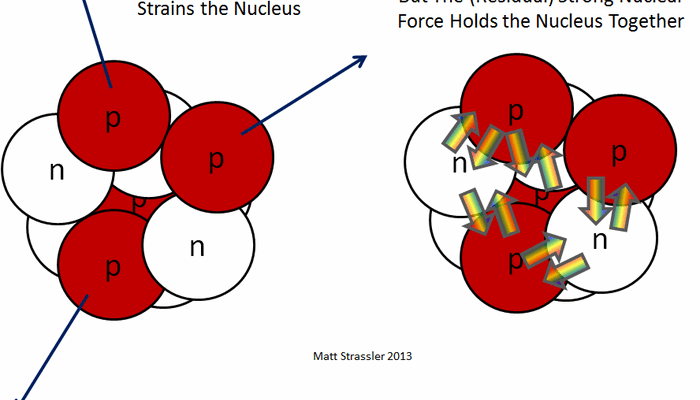
This force binds protons and neutrons together within the atomic nucleus, overcoming the repulsive electromagnetic force between positively charged protons. - Electromagnetism:
Governs the interactions between charged particles, such as electrons and protons, facilitating the formation of atoms and molecules that constitute matter.
Range and Strength Characteristics
The two forces differ significantly in their effective range and relative strength:
- Strong Nuclear Force:
Mediated by gluons, it acts over an extremely short distance-approximately 1 femtometer (10-15 meters)-yet is immensely powerful, strong enough to hold the nucleus intact despite electromagnetic repulsion. - Electromagnetic Force:
Extends over infinite distances, influencing charged particles across vast spatial scales and enabling the diverse chemical interactions observed in nature.
Behavioral Properties and Symmetry
Each force exhibits unique behaviors and underlying symmetries that govern their interactions:
- Distance Dependence:
Electromagnetism follows an inverse-square law, weakening with the square of the distance between charges. In contrast, the strong force displays a complex, non-linear dependence, growing stronger as quarks cluster together-a phenomenon known as confinement, which prevents quarks from existing in isolation. - Gauge Symmetry:
Both forces are described by gauge theories, which impose symmetry constraints essential for their mathematical formulation. Electromagnetism corresponds to U(1) gauge symmetry, while the strong force is associated with SU(3) gauge symmetry, reflecting the complexity of quark-gluon interactions.
Mass Generation and Energy Equivalence
The relationship between these forces and mass is profound and multifaceted:
- Strong Nuclear Force and Mass:
The majority of the mass of ordinary matter arises from the strong force binding energy within protons and neutrons, as explained by Einstein’s mass-energy equivalence principle (E=mc²). - Electromagnetism and Mass:
While electromagnetism contributes indirectly to the mass of electrons through mechanisms like the Higgs field, it is the strong force that predominantly accounts for the mass of atomic nuclei.
Analogies Illustrating Their Roles
Visual metaphors help conceptualize the complementary nature of these forces:
- Strong Nuclear Force:
Comparable to a powerful river that sustains and nourishes the surrounding environment, it maintains the integrity and stability of atomic nuclei. - Electromagnetism:
Like the wind dispersing seeds over great distances, it enables long-range interactions and the formation of complex chemical structures.
Scientific and Practical Significance
The influence of these forces extends beyond atomic scales to broader scientific phenomena:
- Strong Nuclear Force in Astrophysics:
Drives nuclear fusion reactions in stars, including the Sun, providing the energy necessary for stellar luminosity and life on Earth. - Electromagnetism in Chemistry:
Underpins chemical bonding and reactions, shaping the diversity of matter from gases to solids within the solar system and beyond.
Challenges in Theoretical Understanding
Both forces present complex theoretical frameworks that challenge physicists:
- Quantum Chromodynamics (QCD):
Governs the strong force but involves intricate, non-intuitive phenomena such as confinement and asymptotic freedom, making calculations highly complex. - Quantum Electrodynamics (QED):
Describes electromagnetic interactions, revealing subtle effects like virtual particles and the uncertainty principle, which complicate precise predictions.
Summary and Future Perspectives
Despite their distinct characteristics, the strong nuclear force and electromagnetism are intertwined in their fundamental contributions to the universe’s structure and behavior. Their combined effects orchestrate the stability of matter, the energy production in stars, and the chemical complexity essential for life. Continued exploration of these forces promises to deepen our understanding of the cosmos and inspire new discoveries in physics.
FAQ
What is the strong nuclear force?
It is the force that binds protons and neutrons together within the atomic nucleus.
How does electromagnetism work?
Electromagnetism governs the interactions between charged particles, facilitating the formation of atoms and molecules.





Leave a Reply