
Short Answer
Definition of Atomic Mass and Hydrogen Atom
Atomic mass, often called atomic weight, represents the weighted average mass of an element’s isotopes, expressed in atomic mass units (amu). A hydrogen atom, the simplest and most abundant element in the universe, consists mainly of one proton and one electron in its most common form. This fundamental simplicity makes hydrogen a cornerstone for understanding atomic mass and comparing it with more complex elements. The average atomic mass of hydrogen is approximately 1.008 amu, making it the lightest element known.
Isotopes of Hydrogen and Their Characteristics
Hydrogen naturally occurs in three isotopic forms, each differing in neutron count:
- Protium (¹H):
The predominant isotope, accounting for about 99.98% of hydrogen atoms, contains one proton and no neutrons. - Deuterium (²H):
This stable isotope includes one neutron alongside the proton, making up roughly 0.02% of natural hydrogen. - Tritium (³H):
A rare, radioactive isotope with two neutrons, tritium is scarce in nature but important in nuclear research.
The presence of neutrons in deuterium and tritium slightly increases their atomic masses, influencing the overall weighted average atomic mass of hydrogen.
Calculating the Mass of a Single Hydrogen Atom
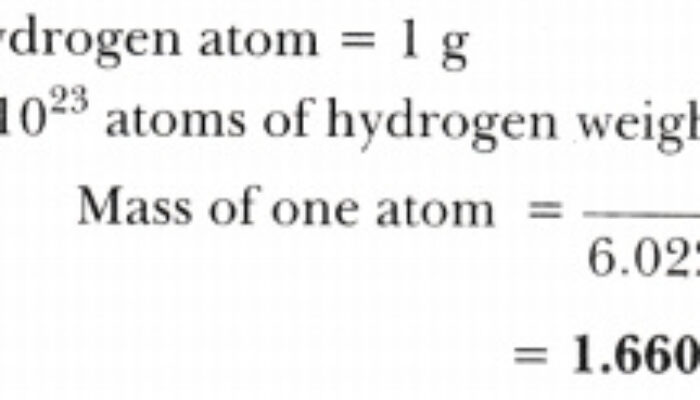
The atomic mass unit (amu) is defined as one twelfth the mass of a carbon-12 atom, approximately 1.66 × 10⁻²⁷ kilograms. Using this standard, the mass of individual hydrogen isotopes can be expressed as:
- Protium (¹H): 1.008 amu ≈ 1.67 × 10⁻²⁷ kg
- Deuterium (²H): 2.014 amu ≈ 3.34 × 10⁻²⁷ kg
- Tritium (³H): 3.016 amu ≈ 5.03 × 10⁻²⁷ kg
These values highlight how even minor isotopic variations can significantly affect hydrogen’s atomic mass, which is crucial in precise scientific calculations.
Hydrogen’s Role in Chemical Reactions and Stoichiometry
Hydrogen’s atomic mass is vital in chemical bonding and reaction calculations. For example, in water (H₂O), two hydrogen atoms combine with one oxygen atom, and their masses determine the stoichiometric ratios essential for predicting reaction outcomes. Moreover, hydrogen frequently acts as a reducing agent in synthesis reactions, where its atomic weight influences reaction kinetics and product formation.
Importance of Hydrogen in Biological Molecules
Hydrogen atoms are fundamental components of many biomolecules, including hydrocarbons, amino acids, proteins, and nucleic acids. The atomic mass of hydrogen affects molecular weight calculations, which are critical in biochemistry, especially in metabolic pathways involving hydrogen transfer. Due to its low mass, hydrogen facilitates rapid movement within biological systems, playing a key role in processes such as cellular respiration and photosynthesis.
Hydrogen in Astrophysics and Cosmology
Hydrogen’s mass is also significant in the field of astronomy. It constitutes a major portion of baryonic matter in the universe, forming stars and galaxies. Nuclear fusion within stars converts hydrogen into helium, driving stellar energy production and contributing to the cosmic synthesis of elements. Understanding hydrogen’s mass and behavior is essential for studying the chemical evolution of the universe and various astrophysical phenomena.
Technological Advances in Measuring Atomic Mass
Modern technology has greatly enhanced the precision of atomic mass measurements. Techniques such as mass spectrometry allow scientists to determine atomic weights with exceptional accuracy. These advancements support cutting-edge research in nanotechnology, materials science, and other disciplines, expanding our understanding of atomic and molecular properties.
Summary: The Significance of Hydrogen’s Atomic Mass
Although the mass of a single hydrogen atom is extraordinarily small-about 1.67 × 10⁻²⁷ kilograms-its impact spans multiple scientific fields. From fundamental chemical reactions and biological functions to cosmic processes, hydrogen’s atomic mass provides critical insights into the nature of matter. This knowledge underpins both theoretical models and practical applications across chemistry, biology, physics, and astronomy.
FAQ
What is the mass of a single hydrogen atom?
The mass of a single hydrogen atom (Protium) is approximately 1.67 × 10^-27 kilograms.
How does hydrogen's atomic mass affect its role in chemical reactions?
Hydrogen's atomic mass influences stoichiometric ratios in reactions, determining the quantity of reactants and products.




Leave a Reply