
Short Answer
Definition and Historical Overview of Physics
Physics is the scientific discipline dedicated to understanding the fundamental laws governing the natural world, encompassing matter, energy, space, and time. Its evolution spans millennia, reflecting humanity’s persistent endeavor to decode the universe’s underlying mechanisms. From its philosophical origins in antiquity to the sophisticated theories of the modern era, physics has continuously transformed in both approach and scope.
Early Foundations: Natural Philosophy and Classical Thought
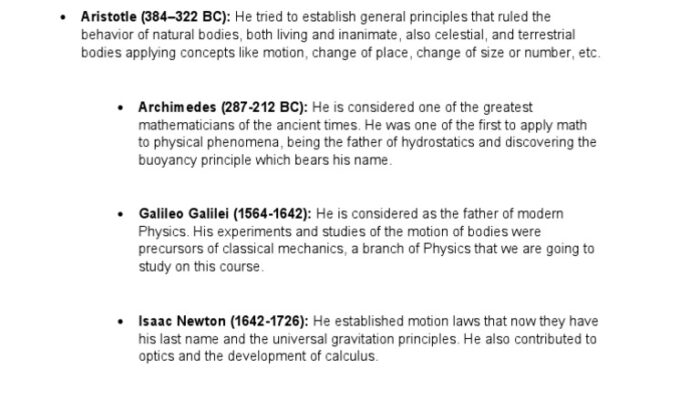
In ancient civilizations, physics was deeply intertwined with philosophy and metaphysics, lacking the empirical rigor seen today. Early thinkers such as Thales and Anaximander pioneered the shift from supernatural explanations to naturalistic interpretations of phenomena, laying the groundwork for natural philosophy-the precursor to modern science. Aristotle’s extensive contributions in the 4th century BCE systematically organized knowledge, emphasizing observation and logical analysis, which profoundly influenced subsequent scientific thought.
The Scientific Revolution: Empiricism and New Cosmologies
The 16th and 17th centuries heralded a transformative period known as the Scientific Revolution, marked by the adoption of empirical methods and experimental validation. Galileo Galilei challenged Aristotelian doctrines through meticulous observation and experimentation, particularly in motion and kinematics. His support for heliocentrism, alongside Johannes Kepler’s formulation of planetary motion laws, dismantled the long-held geocentric worldview, revolutionizing the understanding of celestial dynamics.
Newtonian Mechanics and the Classical Paradigm
Isaac Newton’s seminal work, Philosophiæ Naturalis Principia Mathematica (1687), synthesized prior discoveries into a unified mathematical framework describing motion and gravitation. Newton’s three laws of motion and the law of universal gravitation established a deterministic model that dominated classical physics for over two centuries. This framework not only advanced theoretical knowledge but also catalyzed technological progress in engineering, astronomy, and navigation.
Advancements in Thermodynamics and Energy Concepts
The 19th century witnessed the expansion of classical mechanics to incorporate thermal phenomena, driven by the Industrial Revolution’s demands. Scientists like Sadi Carnot and Rudolf Clausius formulated the laws of thermodynamics, elucidating the principles of energy conservation and transformation. These developments profoundly influenced both scientific understanding and industrial practices, shaping modern technological society.
Emergence of Modern Physics: Relativity and Quantum Mechanics
The dawn of the 20th century introduced revolutionary paradigms that challenged classical assumptions. Albert Einstein’s special relativity (1905) redefined concepts of space and time as relative and interconnected, while his general relativity (1915) reconceptualized gravity as the curvature of spacetime rather than a force acting at a distance. Concurrently, quantum mechanics emerged to explain atomic and subatomic phenomena, initiated by Max Planck’s quantum hypothesis (1900) and expanded by Niels Bohr, Werner Heisenberg, and Erwin Schrödinger. This framework introduced principles such as wave-particle duality, superposition, and entanglement, fundamentally altering the deterministic worldview.
Experimental Breakthroughs and Particle Physics
Throughout the 20th century, experimental physics unveiled the intricate structure of matter and fundamental forces. Discoveries such as the electron and the development of the Standard Model deepened insights into particle interactions. Large-scale experiments, notably at CERN, have identified key particles including the Higgs boson, enhancing comprehension of the universe’s earliest moments and the forces shaping it.
Contemporary Challenges and Interdisciplinary Approaches
Modern physics continues to evolve, addressing unresolved questions like the nature of dark matter and dark energy, and striving for a unified theory that reconciles quantum mechanics with gravity. Collaboration across disciplines-such as astrophysics, biophysics, and information technology-has fostered innovative methodologies and broadened investigative horizons.
Dissemination of Physics Knowledge in the Digital Era
The ways in which physics knowledge is shared have transformed dramatically with digital technology. Academic journals, popular science books, podcasts, and online courses cater to diverse audiences, facilitating both scholarly communication and public engagement. Enhanced visualizations, interactive simulations, and multimedia content have become vital tools for conveying complex scientific concepts, bridging the gap between experts and the general public.
Why the Evolution of Physics is Significant
The historical development of physics exemplifies humanity’s relentless pursuit to understand the natural world, driving scientific and technological progress. From ancient philosophical inquiries to cutting-edge quantum theories, physics has shaped our worldview and enabled innovations that impact daily life, industry, and our comprehension of the cosmos. Its ongoing evolution promises to unlock further mysteries, enriching scientific knowledge and inspiring future generations.
FAQ
What is the significance of the evolution of physics?
The evolution of physics showcases humanity's quest to understand the natural world, facilitating scientific advancements and technological innovations.




Leave a Reply