
Short Answer
Definition of the Solar System’s Extent
The question of how far the solar system stretches is more intricate than it initially appears. While many envision the solar system as the domain of the eight planets orbiting the Sun, its true boundaries extend far beyond these familiar worlds. The solar system encompasses a vast array of celestial objects and regions, from the inner planets to distant icy bodies and invisible magnetic fields, making its limits a complex and multifaceted concept.
Key Regions Within the Solar System
The Planetary Zone
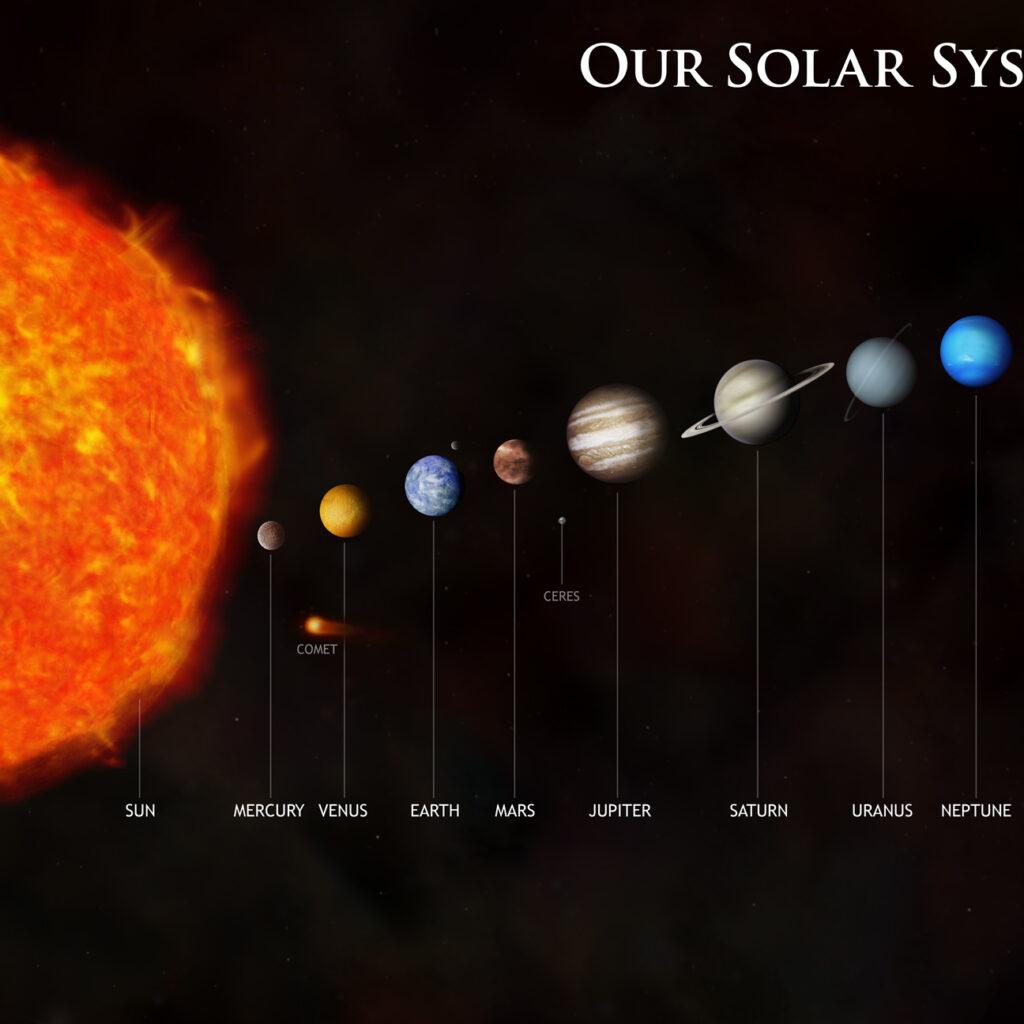
At the heart of the solar system lie the eight major planets, orbiting the Sun in relatively stable, elliptical paths. These range from Mercury, the closest to the Sun, to Neptune, the outermost giant planet. This zone represents the most well-known and densely populated part of our cosmic neighborhood.
The Kuiper Belt
Beyond Neptune’s orbit lies the Kuiper Belt, a toroidal region filled with icy bodies, dwarf planets such as Pluto, and numerous smaller objects. This belt extends roughly from 30 to 55 astronomical units (AU) from the Sun, where one AU equals the average distance between Earth and the Sun, about 93 million miles. The Kuiper Belt marks the outer boundary of the solar system’s primary collection of orbiting bodies.
The Scattered Disc
Further out is the scattered disc, a more distant and less orderly region populated by objects with highly elongated and inclined orbits. These bodies can travel hundreds of AU from the Sun, blurring the lines of the solar system’s structure and challenging traditional definitions of its edge.
The Heliosphere: The Sun’s Magnetic Bubble
Encasing the solar system is the heliosphere, an enormous, invisible bubble formed by the solar wind-a continuous flow of charged particles emitted by the Sun. This plasma and magnetic field sheath acts as a shield, protecting the solar system from the majority of cosmic radiation originating from interstellar space. The outer boundary of this bubble, known as the heliopause, is often considered the solar system’s true edge in terms of solar influence.
Voyager Missions and the Heliopause
Determining the exact location of the heliopause is challenging due to its dynamic nature, influenced by solar activity and interstellar conditions. NASA’s Voyager 1 and Voyager 2 spacecraft have crossed this boundary, providing invaluable data on the interaction between the solar wind and the interstellar medium. Their measurements reveal a turbulent and fluctuating frontier where the Sun’s influence wanes and the vastness of interstellar space begins.
The Oort Cloud: The Solar System’s Outer Frontier
Beyond the heliosphere lies the hypothesized Oort Cloud, a spherical shell of icy objects extending from approximately 2,000 AU to as far as 100,000 AU from the Sun. This distant reservoir is believed to contain billions of comets and represents the farthest reach of the Sun’s gravitational pull. Although no direct observations have confirmed its existence, the Oort Cloud is thought to be a remnant of the primordial solar nebula from which the Sun and planets formed.
Defining the Solar System’s Boundaries
Determining where the solar system ends depends on the criteria used:
- Planetary and Small Body Orbits:
These extend roughly up to 50-100 AU, encompassing planets, dwarf planets, and smaller objects. - Heliosphere Boundary (Heliopause):
Located around 123 AU, this marks the limit of the Sun’s magnetic and particle wind influence. - Gravitational Influence:
Extends to the Oort Cloud, tens of thousands of AU away, where the Sun’s gravity still governs the motion of distant icy bodies.
External Influences on the Solar System’s Edge
The solar system’s outer regions are subject to gravitational forces from nearby stars, galactic tides, and the Milky Way’s dark matter halo. These external factors perturb the orbits of distant objects, making the boundary a dynamic zone of gravitational interaction rather than a fixed line.
The Solar System’s Journey Through the Galaxy
Orbiting the center of the Milky Way approximately every 225 million years, the solar system traverses regions of varying interstellar density. This journey affects the size and shape of the heliosphere, causing the heliopause to expand or contract in response to changing external pressures. Thus, the solar system’s boundary is influenced not only by the Sun but also by its galactic environment.
Visualizing the Solar System’s Structure
One can imagine the solar system as a vast cosmic city:
- Downtown Core: The planets, bustling with activity and well-defined orbits.
- Suburbs: The Kuiper Belt and scattered disc, sprawling regions with numerous icy bodies.
- City Limits: The heliosphere, a protective boundary separating the solar system from interstellar space.
- Rural Outskirts: The Oort Cloud, a distant, sparsely populated region holding ancient relics of the solar system’s formation.
Common Misconceptions About the Solar System’s Size
The solar system ends at the orbit of Pluto.
Pluto is just one of many objects in the Kuiper Belt, and the solar system extends far beyond it, including the scattered disc, heliosphere, and Oort Cloud.
The heliopause is a fixed boundary.
The heliopause fluctuates with solar activity and interstellar conditions, making it a dynamic and shifting frontier.
The Sun’s gravitational influence stops at the heliopause.
Gravity extends much farther, encompassing the Oort Cloud and influencing objects tens of thousands of AU away.
Significance of Understanding the Solar System’s Extent
Grasping the true scale and boundaries of the solar system is crucial for multiple scientific fields, including astronomy, astrophysics, and space exploration. It informs our understanding of the Sun’s influence, the behavior of distant celestial bodies, and the interaction between our solar environment and the broader galaxy. Moreover, it shapes how we conceptualize our place in the cosmos, highlighting the fluid and interconnected nature of cosmic structures.
FAQ
What is the extent of the solar system?
The solar system includes the planets, Kuiper Belt, scattered disc, heliosphere, and hypothesized Oort Cloud.
How is the boundary of the solar system defined?
It can be defined by the orbits of planetesimals, heliopause, and the gravitational influence of the Sun.
What is the Oort Cloud?
The Oort Cloud is a hypothesized region of icy bodies extending from approximately 2,000 AU to 100,000 AU from the Sun.

Leave a Reply